

Lecture 8 RICS and FLIM PowerPoint PPT Presentation
Title: Lecture 8 RICS and FLIM
1
Lecture 8 RICS and FLIM Enrico
Gratton Laboratory for Fluorescence
Dynamics University of Illinois at
Urbana-Champaign
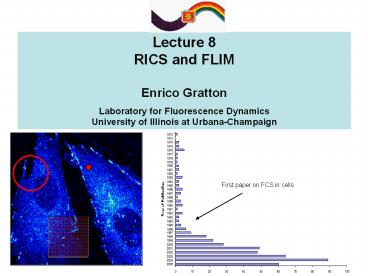
First paper on FCS in cells
2
INTRODUCTION
- Fluctuation Spectroscopy in cells is rapidly
expanding - Advantages and challenges of FCS in cells
- Single point autocorrelation and
cross-correlation provide information on
molecular mobility and interactions - PCH provides information on molecular
concentration and brightness. Titration
experiments in cells - Most studies use fluorescent proteins
- Single point FCS is difficult to interpret
- Immobile fraction and bleaching perturb the
correlation function - Negative-going correlation curves
- Different cell locations show different dynamics!
3
Single point FCS of Adenylate Kinaseb -EGFP
Plasma Membrane
Cytosol
D
D
Diffusion constants (mm2/s) of AK EGFP-AKb in the
cytosol -EGFP in the cell (HeLa). At the
membrane, a dual diffusion rate is calculated
from FCS data. Away from the plasma membrane,
single diffusion constants are found.
(Qiaoqiao Ruan, 1999)
4
FCS a closer look at existing techniques
Conventional FCS
Temporal ICS
Time resolution sec-min
Time resolution µsec-msec
Monitors temporal fluctuations at a particular
position in the cell to measure relatively faster
diffusion (beam transit time in
ms). Measurements contain single pixel
information.
Monitors temporal fluctuations at every point in
a stack of 2-D images to measure very slow
diffusion (Frame rates in the subsecond
range). Measurements contain spatial information
(pixel resolution).
Can we put the two technologies together?
5
FCS in cells Challenges
- Need for spatial resolution Spatio-temporal
correlations - Few years ago we proposed scanning FCS (circular
orbit) as a method to measure the correlation
function at several points in a cell
simultaneously (Berland et al, 1995) - N. Petersen and P. Wiseman proposed image
correlation spectroscopy (ICS) and recently,
time-resolved ICS, similar in concept of scanning
FCS in which a point in the image is measured
repetitively - These methods have very high spatial resolution
but limited time resolution - Scanning correlation in the millisecond
- Image correlation in the sub-second
- Can we improve the temporal resolution to the
level that we can measure freely diffusing
molecules, and at the same time have high (pixel)
spatial resolution?
6
FCS novel ideas
- The quick answer is not yet, but we can have a
combination of very high time resolution with
good spatial resolution. - In addition, there are other major benefits of
the technique I will present - It can be done with commercial laser scanning
microscopes (either one or two photon systems) - It can be done with analog detection, as well as
with photon counting systems, although the
statistics is different - The new technique provides a simple method to
account for the immobile fraction - It provides a powerful method to distinguish
diffusion from binding - How does it work?
7
Temporal information hidden in the raster-scan
image the RICS approach
Images obtained in a laser scanning microscope
contain temporal information because they are
recorded sequentially pixel after pixel as
opposed to a camera snap shot.
RICS Raster-scan Image Correlation Spectroscopy
8
Available time scales in RICS
Range of diffusion times accessible by different
RICS techniques. Depending of the time scale of
the process, pixel (?s), line (ms) or frame (s)
correlation methods can be used. Points long a
line are microsecond apart. Points in successive
lines are millisecond apart and frames are second
apart.
9
The RICS approach correlation functions
The mathematics and concepts for
computation What is different in RICS is the way
the correlation function is calculated. We are
all familiar with the concept of correlation
function of a time series. Definitions
To calculate this function efficiently, the time
series must be continuous. Generally, data
points are collected every dt. The
autocorrelation function is then calculated using
either direct numerical algorithms or the FFT
method. If the time series is not continuous,
but it has regular gaps the correlation function
is modulated (convolution with a periodic square
wave).
10
The RICS approach 2-D spatial correlations
In a raster-scan image, points are measured at
different positions and at different times
simultaneously If we consider the time sequence,
it is not continuous in time If we consider the
image, it is contiguous in space In the RICS
approach we calculate the spatial 2-D spatial
correlation function (similarly to the ICS method
of Petersen and Wiseman)
The variables x and y represent spatial
increments in the x and y directions,
respectively 2-D spatial correlation can be
computed very efficiently using FFT methods. To
introduce the RICS concept we must account for
the relationship between time and position of the
scanning laser beam.
11
The RICS approach for diffusion
We assume that the correlations due to spatial
scanning and the correlations due to the dynamics
at a point are independent i.e., the dynamics
at a point is independent on the scanning motion
of the laser beam
Consider now the process of diffusion (as one
example!). The diffusion kernel can be described
by the following expression
r
Given a particle at the origin at time zero, it
can be found at time t at a distance r with a
gaussian probability function with standard
deviation that increases as a function of time
and amplitude that decreases as a function of time
12
RICS space and time relationships
At any position, the ACF due to diffusion takes
the familiar form
tp and tl indicate the pixel time and the line
time, respectively. The correlation due to the
scanner movement is
dr is the pixel size. For D0 the spatial
correlation gives the PSF, with an amplitude
equal to 1/N (Petersen and Wiseman). As D
increases, the correlation (G term) becomes
narrower and the width of the S term increases.
Digman et al. Biophys. J., 2005
13
Performing a RICS measurement
- Setup any laser confocal microscope
- Acquire a raster scan image with a pixel time
generally in the microsecond range and a line
scan time in the millisecond range. - Calculate the 2-D spatial correlation (or RICS
analysis). - Fit the 2-D autocorrelation with the previous
equations. - For circular or line scanning represent data as
pseudo-image, one coordinate being spatial (along
the line) and the other being time. This
representation allows us to use the RICS
approach. The fitting expressions are slightly
different (see Digman et al, BJ 2005).
14
RICS Fit of spatial correlation
functions Simulations
Spatial correlation function
Image
10 nm beads
EGFP in a plane
256x256, 16 ?s/pixel, 0.050 ?m/pixel
Digman et al. Biophys. J., 2005.
15
RICS Fits to spatial correlation
functions Olympus Fluoview300 LSM
EGFP in solution
Spatial ACF
128x128, 4 ?s/pixel, 5.4 ms/line, 0.023 ?m/pixel
Fit to Spatial ACF
D 105 10 ?m2/s
Digman et al. Biophys. J., 2005
16
Testing RICS
For molecules in solution, the method works fine.
The same G(0) and the same D is obtained using
single point FCS or the RICS calculation.
Single point Circular scan Raster scan
D (mm2/s) G(0) 101 2.10 101 2.04 99 2.06
D (mm2/s) G(0) 6.55 2.10 6.21 2.00 6.07 2.08
Simulations comparison between 3 different
methods to recover D and G(0) for 2 different
values of D (100 mm2/s and 6 mm2/s).
Conditions Sampling frequency was 128 kHz for
the fast moving particle and 32 kHz for the
slowly diffusing particle. The orbit was sample
at 128 points and the frame for the raster scan
was 128x128 pixels. 1.6M points were simulated
in each run irrespective of the sample frequency.
Single point Scanning FCS Circular scan Raster Scan
D(?m2/s) 5.9 8.4 8.2 8.6
Experimental data fluorescent bead diffusing in
solution
17
RICS benefits better S/N at low concentrations
Repetition of 10 runs
Method (data acquired at 16 ms per point) D in mm2/s G(0)
Single point FCS 2.55 ? 0.92 1.69 ? 0.43
Circular scan 2.46 ? 0.14 1.57 ? 0.07
Circular scan (128 points per orbit) 2.46 ? 0.26 1.51 ? 0.06
Raster scan (128x128 pixels) 2.47 ? 0.31 1.54 ? 0.02
Repetitions of the same simulation (N10) to
estimate standard deviations. 100 particle
diffusing in a plane of 128x128 pixels of 0.05?m
each detected by different methods and recovered
by the different equations. The length of the
data stream is the same for each simulation, 320k
points were simulated.
18
How we go from solutions to cells?
In cells we have an immobile fraction molecules
not moving during the course of the
experiment. If we perform the 2-D-image
correlation operation of an image that contains
immobile features, we obtain the transform (power
spectrum) of the image. In this transform is
impossible to distinguish the moving
particles. We need to separate this immobile
fraction from the mobile part before calculating
the transform How is this achieved?
19
RICS subtraction of immobile features
Basic idea In a truly immobile bright region,
at each pixel the intensity fluctuates according
to the Poisson distribution. However the time
correlation of the shot noise is zero, except at
channel zero. Also, if we cross-correlate the
intensity at any two pixels, even if very close
(within the PSF), the cross-correlation due to
shot noise is zero. Therefore, if we subtract
the average intensity and disregard the zero
time-space point, the immobile bright region
totally disappear from the correlation function
(in the first approximation). After subtraction
of the average image, a small number (equal to
the image intensity is added). Attention!!!! This
is not true for analog detection, not even in
the first order approximation. For analog
detection the shot noise is time (and space)
correlated.
20
Subtraction of the immobile fraction
The stack of images contains both mobile and
immobile bright particles. The correlation
function mostly reflects the shape of the
immobile bright particles. After subtraction,
the RICS only shows the fast diffusing molecules!
original image
RICS
The stack of images contains only mobile
particles. The RICS and the subtracted RICS are
identical
RICS
original image
The same method can be used to subtract very
slowly moving structure to account for the cell
movement
21
RICS Immobile Component Removal
Paxillin-EGFP in CHO K1
Region of Interest
ACF with Immobile
ACF no Immobile
64x64, 8 ?s/pixel, 5.4 ms/line, 0.023 ?m/pixel
Fit to ACF with Immobile Component Removed
D 0.49 0.05 ?m2/s
Digman et al. Biophys. J., 2005
22
RICS Removal of slowly varying component
Very often cells (or parts of the cell)
move. Instead of subtracting the average (over
the entire image stack), we could subtract a
local moving average. This is equivalent to
high-pas filtering of the image only the fast
changing features remain. In our software, it is
possible to use different moving average lengths,
depending on the speed of motion of the quasi
immobile features. Warning The principle
that the shot noise is time and space
uncorrelated is not valid. After high-pass
filtering, the intensity of one pixel carries to
the next, both in time and in space, introducing
correlations that were not there originally.
However, the effect of filtering can be predicted
and recognized.
High pass filter effect ACF of a bright slowly
mobile particle
t
Effect of HPF
23
Example GAP-GFP Small peptide that anchors GFP
to the membrane
2-D spatial correlation
Average image of a 64x64 ROI
Original image (128x128) 700 frames
Recovered diffusion parameters for the mobile
fraction G(0) 0.020 D
0.50 µm2/s
Note that the diffusion coefficient recovered is
an average over the entire ROI analyzed the
spatial resolution is dependent on the size of
the ROI.
Fit of the 2-D spatial correlation
24
RICS Spatio-temporal correlations
Diffusion or binding? (or blinking)
- Frequently, we obtain apparent diffusion
coefficients below 0.01 mm2/s. These values are
highly suspicious for single molecules or small
aggregates! - Experimentally it is difficult to distinguish
between binding (exponential functions) and
diffusion. PCH analysis often show that the
amplitude fluctuations correspond to few
fluorescent molecules. - The original work of Elson, Magde and Webb in
FCS was to measure binding. - In solution is possible to predict the value
of the diffusion in cell this is problematic. - The spatial correlation resulting from binding
to immobile structures is different from
diffusion. - RICS could identify binding (to immobile
structures), blinking of diffusing particles and
pure diffusion.
25
RICS Models
Diffusion or binding? (or blinking) For pure
binding equilibria the function G(x,y) assumes
a different expression
Line scan measurement (Fluoview300). Fit (black
line) of pixel 190 data (red line) of the line
scan experiment using A) diffusion equation
D0.032mm2/s and B) using exponential relaxation
t0.63 s. The residues (blue lines) of the
exponential fit are smaller and less correlated
indicating a better fit using the exponential
model
26
RICS Models
Diffusion or binding? (or blinking)
Slowly diffusing
Diffusion is faster than binding The RICS
correlation function should be identical to the
PSF. The amplitude should correspond to the
brightness of the particle binding. Adjacent
points should be uncorrelated. The binding
kinetics is independent on the beam waist. If
there is only one binding site (or few), we could
obtain directly the on-off statistics.
Diffusion is very slow The RICS correlation
function should be slightly broadened. The
amplitude should correspond to the brightness of
the particle. Adjacent points could be
correlated. The diffusion kinetics depends on the
square of the beam waist
27
RICS Models
Unimolecular reaction
K kf / kb is the equilibrium coefficient l
kf kb is the apparent reaction rate
coefficient and fj is the fractional intensity
contribution of species j
Note that diffusion modifies the shape of the
spatial correlation function while binding
equilibria gives always the same shape (the PSF)
assuming that diffusion is fast compared to
binding rate (either the on or the off rate)
28
RICS Summary of spatial and time resolution
Resolution of the various scan methods
Method Temporal resolution Spatial Resolution
Line or circular scan Millisecond Pixel resolution (submicron)
Raster scan Microsecond Low resolution (typically 16 or 32 pixels), depends on the particle diffusion coefficient and the scan speed
Frame scan Second Pixel resolution (submicron)
Digman et al. Biophys. J., 2005
29
RICS Conclusions
- There is a hidden time structure in the laser
scanning images that can be exploited to obtain
information about - Diffusion
- Velocity
- Brightness
- Aggregation
- Blinking, binding-unbinding equilibria
- We developed a general method to separate mobile
from immobile fraction - This new development has great potential
consequences for anyone interested in cellular
imaging and dynamics
30
spectroscopy
images
The Globals program originally developed at the
LFD for analysis of multiple files from
spectroscopy is now available for image analysis.
This new program analyzes FCS in images by the
RICS approach, and lifetime images using the
phasor approach. Available in the Fall of
2005. Price 1000 for Globals for
Spectroscopy 1000 for Globals for Images More
information at www.lfd.uiuc.edu
31
GLOBALS for IMAGES derives from SimFCS
- It is intended for analysis of images using
physical models - Has the same minimization engine and error
analysis of the original Globals Unlimited
program - It has a very extensive library for analysis of
- FCS
- RICS
- FLIM
- SPT
- 2-D and 3-D representations of data
- Reads most of the file formats (BH, FIFO, TIF,
Methamorph, LSM, binary) - The emphasis is on model analysis (not image
processing)
32
Ultrafast Analysis of Fluorescence Lifetime
Images using the Phasor approach Application to
FRET analysis
Enrico Gratton University of California at
Irvine
33
Introduction
FLIM (fluorescence lifetime imaging microscopy)
is becoming an important technique in
fluorescence imaging microscopy. FLIM is used
for FRET Ion concentration In a FLIM
experiment, the fluorescence lifetime is measured
at every single point in a image, generally
256x256 pixels There are technical challenges
regarding how to achieve the necessary data
acquisition speed A major problem is data
analysis and interpretation
34
The challenges of FLIM
At every pixel there are contributions of several
fluorescent species, each one could be
multi-exponential. To make things worse, we can
only collect light for a limited amount of time
(100-200 microseconds per pixel) which result in
about 500-1000 photons per pixel. This is
barely enough to distinguish a double exponential
from a single exponential decay. Resolving the
decay at each pixel in multiple components is a
complex computational task for experts only,
partially alleviated by extensive use of global
techniques.
35
Major issues with FLIM
- Rather difficult technique
- Long times for calculations
- Results depend on initial conditions
- Interpretation requires expertise
- Can we avoid all these problems?
- No expertise necessary
- Instantaneous results
- Independent on initial choices
- Quantitative results
- Intuitive simple interface
36
A new approach
- Presently, the analysis proceed by resolving the
exponential components at each pixel and by
identifying molecular species with lifetime
components. - In the microscope environment, this process is
prone to errors and depends on interpretation. - We propose a change in paradigm Use a different
representation of the decay where each molecular
species has its own unique representation and
where each process (FRET, ion concentration
changes) is easily identified. - We need to go to a new space.
37
The phasor space and the universal circle (From
Star-Trek)
This is what we need the phaser!
Where does this concept come from?
- When a fluorescent sample is excited with a
sinusoidally modulated light, it responds with
emission that has the same frequency but is phase
shifted and demodulated with respect to
excitation. - Where does this concept come from??
- We need some math.
38
What is a phasor??
- A phasor is a quantity like a vector. Phasors
can be added like vectors. You need to calculate
the vector components and then add the components
to obtain the vector sum
s
g
39
How to calculate the components g and s of a
phasor from the time decay?
Frequency-domain components of a phasor. m and
f is what is measured
Time-domain components of a phasor. I(t) is what
is measured
Note that I(t) is not resolved in components!!
40
Calculation of phase and modulation frequency
domain
41
Calculation of phase and modulation time domain
n1
n2
n3
n4
n1
DC(n1n2n3n4)/4 AC2(n1-n3)2(n2-n4)2 ftan-1(
n2-n4)/(n1-n3) MAC/DC
One period
We use identical formulas!!!
42
The algebra of phasors
Universal circle
Lifetime representation using phasors. A
Rotating vectors for excitation an demission with
different phase delay. B As the modulation
frequency increases the end of the phasor
describes a semicircle of radius ½ and centered
at (½, 0). C) Mixtures of t1 and t2 must be on
the line between t1 and t2 in proportion to their
fractional intensity contribution. Given the
experimental point and t1 we can find t2 and the
fractional contribution. Given the experimental
point, t1 must be less than t1 max and t2 must
be greater than a t2 min.
43
How to distinguish two-exponential components
from FRET?
Exponential components fall on the semicircle. A)
Decay components made of multi-exponentials can
fall any where. A linear combination of the two
decays must fall in the line between the two
decays. B) If there is quenching of t2 (the
donor) the experimental values of experimental
phasor cannot be on the line joining t2 to t1.
Quenching trajectories can be very curved since
t2 could become smaller that t1 depending on the
FRET efficiency.
44
Example of FLIM analysis using phasors
Several regions the image can be identified
corresponding to a) background (2 exponentials
b) cell 1 bright (2 exponentials) c) cell 2 dim,
d) cell junctions dim.
Image of cell expressing uPAR-EGFP and uPAR-MRFP
receptor. Upon addition of a ligand, the
receptor aggregates. FRET should occur at the
cell junctions
45
The pitfall of conventional FLIM analysis
Image obtained using BH 830 in our 2-photon
microscope
Shorter lifetime region could be interpreted to
be due to FRET
Donoracceptorligand. A) intensity image after
background subtraction, B) tp image C) tm image.
46
Identification of FRET using the phasor plot
FRET only occurs at the cell junctions
Selecting regions of the phasor diagram.
Selecting the region in A (donor acceptor) the
part in white lights up (A). Selecting the
region in B (autofluorescence) the part in white
in lights up (B). The color scale in B has been
changed to better show the region of the
autofluorescence. Selecting the region in C
(along the donor quenching line as shown in D)
the part in white in at the cell junction lights
up in C.
47
How to identify components?
Phasors for common fluorophores. EGFP (green),
CFP (blue) mRFP1 (red), autofluorescence (at 880
nm -2photon excitation) violet. In any given
pixel, mixture of EGFP and autofluorescence must
be on the yellow line, mixtures of EGFP and mRFP1
must be on the red line. Mixtures of three of
them must be inside the triangle with the corner
in the 3 phasors.
48
How to identify processes?
Delay of the excitation of the acceptor due to
FRET moves the acceptor phasor to the left
(yellow arrow). If the delay is sufficiently
long, the phasor could fall outside the
semicircle. The donor phasor moves to the right
(red arrow) due to quenching (shorter lifetime).
49
Features of the new approach
Many of the obstacles in FLIM data analysis can
be removed. The accuracy of lifetime
determination improved. The speed of data
analysis reduced to be almost instantaneous for
an entire image and also using several (gt10)
images simultaneously. The analysis is global
over the image and across images. The
interpretation of the FLIM experiment is
straightforward. Minimal prior spectroscopy
knowledge needed. The tool can be applied to all
modes of data acquisition (frequency-domain and
time-domain)
50
Raichu FLIM/FRET analysis
- In MEF cells
http//www.biken.osaka-u.ac.jp/biken/shuyouvirus/e
-phogemon/raichu-Rac.htm
51
DONOR CFPTauP2.7TauM3.1
Locating the CFP phasor
Git1-CFP
CFP only
Pax-CFP
Pax-CFP
CFP
CFP
52
Life time of the background
TauP2.4TauM4.6
53
Determining the cell autofluorescence phasor
Cells only, no CFP
TauP1.557 TauM3.03
54
Calculating FRET trajectories
Donor
autoflourescence
55
Wt Raichu (1011variant) in MEF
TauP2.2 TauM2.9
56
Wt Raichu 1011 in MEF
TauP1.9 TauM2.6
57
Lifetime explorer and FRET efficiency calculator
for multiple images
Images of cells 1,2PAX-CFP, 3-8 Wt
Raichu1011, 9-12 V12 Raichu, MEF cells
1Phasor plot
1
2
3
4
5
6
12
9
10
11
7
8
58
Examples Ion concentration in situ calibration
Excised skin sample
59
Acknowledgements
- LFD
- Michelle Digman
- Susana Sanchez
- Istituto San Raffaele, Milano
- Valeria Caiolfa
- Moreno Zamai
- Gabriele Malengo
- University of Hamburg
- Martin Behne
- BH
- Wolfgang Becker
Recommended

