

Chapter 34 Phylum Hemichordata- Acorn Worms PowerPoint PPT Presentation
1 / 114
Title: Chapter 34 Phylum Hemichordata- Acorn Worms
1
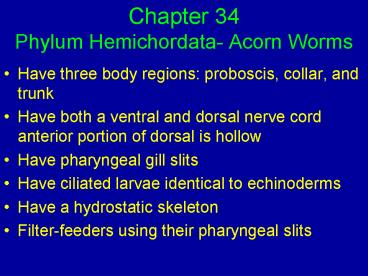
Chapter 34 Phylum Hemichordata- Acorn Worms
- Have three body regions proboscis, collar, and
trunk - Have both a ventral and dorsal nerve cord
anterior portion of dorsal is hollow - Have pharyngeal gill slits
- Have ciliated larvae identical to echinoderms
- Have a hydrostatic skeleton
- Filter-feeders using their pharyngeal slits
2
Hemichordata
3
Hemichordata
4
Hemichordata
5
Hemichordata
6
Hemichordata
7
(No Transcript)
8
Chapter 34 Vertebrate Evolution and Diversity
- Characteristics of Chordata
- 1. Notochord
- 2. Dorsal hollow nerve cord
- 3. Pharyngeal Slits
- 4. Muscular Postanal Tail
9
Notochord This is a longitudinal, flexible rod
of cartilage that is located between the gut and
the dorsal nerve cord. The notochord can last
into adulthood, but in most cases it is replaced
by the vertebral column. The spongy material in
between the vertebral bones is all that is left
of the notochord.
10
Notochord
11
Dorsal, Hollow Nerve Cord This is a tube that is
formed from a plate of ectoderm that is rolled up
into a tube. It is located dorsal to the
notochord, it lies above the gut and beneath a
single, hollow nerve cord. Due to its hollow
structure the dorsal nerve cord is considered
very unique. It will develop into the chordate's
central nervous system.
12
Pharyngeal Gill Slits These structures are
openings of the upper digestive tube. During the
embryonic stage these slits connect the outside
to the pharynx. Early chordates used them to
filter feeding. Over time the slits became
modified to function in gas exchange.
13
Muscular Post anal Tail Most chordates have a
tail extending beyond the anus. In many aquatic
species the tail is equipped with skeletal and
muscular tissue for movement.
Anus Tail
14
Subphylum Urochordata
15
Subphylum Urochordata-sea squirtstunicates
cellulose in outer covering
16
Subphylum Urochordata
17
Subphylum Urochordata
18
Subphylum Urochordata
19
Subphylum Cephalochordata lancelets
20
Subphylum Cephalochordata lancelets
- Most like early chordates (but chordates did not
descend from them) - Marine filter feeders
- Feeble swimmers
- Muscles segments develop from blocks of mesoderm
called somites that are arranged around each side
of the notochord.
21
Subphylum Cephalochordata lancelets
22
Subphylum Cephalochordata lancelets
23
Subphylum Cephalochordata lancelets
24
Fossils of early vertebrates
25
Subphylum Vertebrata
- Notochord develops into a cartilaginous or boney
vertebral column that surrounds and protects the
spinal cord - Have a cranium or skull that surrounds and
protects the brain - Have a advanced closed circulatory system
- Cephalization increases dramatically
26
Embryonic formation of the neural crest
27
Class Myxini-Jawless fish-Hagfish-All marine No
limbs or appendages Cartilaginous skeleton no
vertebrae
28
Class Myxini-Jawless fish-Hagfish
29
Class Myxini-Jawless fish-Hagfish
30
Class Myxini-Jawless fish-Hagfish
31
Class Myxini-Jawless fish-Hagfish
32
(No Transcript)
33
Class Cephalaspidomorphi-lamprey-Jawless fish
Cartilaginous skeleton No limbs or appendages
notochord has dorsal extensions that partially
enclose the nerve cord vertebrae
34
Class Cephalaspidomorphi-lamprey
35
Class Cephalaspidomorphi-lamprey
36
Class Cephalaspidomorphi-lamprey
37
Class Cephalaspidomorphi-lamprey
38
Class Cephalaspidomorphi-lamprey
39
Evolution of the Vertebrate Jaw
40
Ostracoderms- armored but no jaws some were
active and had paired fins
41
Ostracoderms
42
Placoderms-first jaws
- Skeletal rods called gill arches of the most
anterior pharyngeal gill slits became the jaw
43
Placoderms
Placoderms
44
(No Transcript)
45
Chondricthyes sharks and rays
- Completely cartilaginous skeleton
- Strong powerful swimmers
- Must swim constantly to produce water flow over
gills due to no operculum - Lateral line system that
detects sound waves - Oviparous
- Ovoviviparous
- Viviparous
- Cloaca
46
Chondricthyes sharks and rays
47
Chondricthyes sharks and rays
48
Chondricthyes sharks and rays
49
Osteichthyes-bony fish
- Operculum-bony covering over gill arches pulls
water into mouth and over the gills - Swim bladder- gives buoyancy regulates level in
water evolved from crude lungs - Bony fish evolved in freshwater first and
developed crude lungs to supplement gills for gas
exchange then when they returned to salt water,
the opening to the lungs closed and they evolved
into swim bladders - Two chambered heart
50
Ray-finned fishes
51
Ray-finned fishes
52
Ray-finned fishes
53
Lobed-finned fishes
54
Lobed-finned or lobed finnedfishes Coelacanths
55
Lobed-finned fishes
56
Lobed-finned fishes
57
Lobed-finned fishes
58
Osteichthyes- bony fish
59
Osteichthyes-bony fish
60
Amphibians
- Three chambered heart-
- External fertilization
- Embryo and larvae forms must have water
- Epidermis is permeable to water
- No claws on toes
61
Amphibians
62
Amphibians-salamander
63
Amphibians-tree frog
64
(No Transcript)
65
(No Transcript)
66
Young tadpole
67
Tadpole to frog
68
Amniote egg
69
Reptiles
- Amniote egg-
- Scales composed of keratin-also protein in hair
and feathers - Three chambered with partial septum in ventricle
- Internal fertilization-
- Modern reptiles are ectotherms but many dinosaurs
were endotherms
70
Reptiles
71
Care of eggs and young
72
Reptiles
73
Reptiles
Reptiles
74
Reptiles
75
Reptiles
76
Reptiles
77
Reptiles
78
Reptiles
79
Aves-birds
- Evolved from dinosaurs (reptiles)
- Modifications for flight-
- Internal fertilization with amniote egg
- Four-chambered heart
- Elastic air sacs connected to lungs for increased
respiration and dissipation of heat
80
Archaeopteryx
81
Archaeopteryx
82
(No Transcript)
83
(No Transcript)
84
Flightless dinosaur with protofeathers
85
Caudipteryx flightless but with true feathers
86
Aves
87
(No Transcript)
88
Aves-Birds
89
Aves-Birds
90
Mammalian Characteristics
- Hair- composed of keratin
- Endothermic
- Mammary glands
- Four-chambered heart
- Diaphragm
- Internal fertilization
- Differentiated teeth
91
(No Transcript)
92
Monotremes
93
Monotremes
94
Monotremes
95
Monotremes-echidnas
96
Monotremes
Monotremes-echidnas
97
Monotremes-echidnas
98
Monotremes-echidnas
99
Marsupials
100
Marsupials
101
Marsupials
102
Marsupials
103
Prosimians-lemurs
104
Hominid
Hominoid
Primates
105
New world monkeys Old world monkeys
prehensile tail lack prehensile tail
nostrils open to the sides nostrils open
downward all arboreal some ground
dwelling
106
Apes-Hominoids Not hominids
Gibbon
Orangutan
Chimpanzee
Gorilla
107
Apes-Bonobo
108
Hominids-bipedal-upright stance
109
Lucy-Australopithecus afarensis early hominid
110
(No Transcript)
111
Turkana boy1.7 million years oldbetween homo
habilis and homo erectus
112
(No Transcript)
113
(No Transcript)
114
(No Transcript)
Recommended

