

KEY%20CONCEPT%20Organisms%20can%20be%20classified%20based%20on%20physical%20similarities. PowerPoint PPT Presentation
Title: KEY%20CONCEPT%20Organisms%20can%20be%20classified%20based%20on%20physical%20similarities.
1
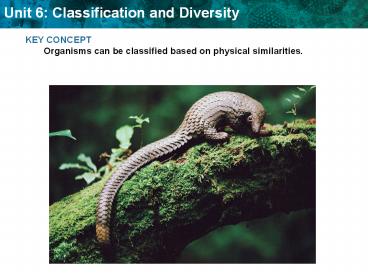
KEY CONCEPT Organisms can be classified based on
physical similarities.
2
Linnaeus developed the scientific naming system
still used today.
- Taxonomy is the science of naming and classifying
organisms.
White oakQuercus alba
- A taxon is a group of organisms in a
classification system.
3
- Binomial nomenclature is a two-part scientific
naming system.
- uses Latin words
- scientific names always written in italics
- two parts are the genus name and species
descriptor
4
- A genus includes one or more physically similar
species.
- Species in the same genus are thought to be
closely related. - Genus name is always capitalized.
- A species descriptor is the second part of a
scientific name. - always lowercase
- always follows genusname never written alone
Tyto alba
5
- Scientific names help scientists to communicate.
- Some species have very similar common names.
- Some species have many common names.
6
Linnaeus classification system has seven levels.
- Each level is included in the level above it.
- Levels get increasingly specific from kingdom to
species.
7
KEY CONCEPT The current tree of life has three
domains.
8
Classification is always a work in progress.
- The tree of life shows our most current
understanding. - New discoveries can lead to changes in
classification. - Until 1866 only two kingdoms,Animalia and
Plantae
9
Classification is always a work in progress.
- The tree of life shows our most current
understanding. - New discoveries can lead to changes in
classification. - Until 1866 only two kingdoms,Animalia and
Plantae
Plantae
Animalia
- 1866 all single-celled organisms moved to
kingdom Protista
10
Classification is always a work in progress.
- The tree of life shows our most current
understanding. - New discoveries can lead to changes in
classification. - Until 1866 only two kingdoms,Animalia and
Plantae
- 1866 all single-celled organisms moved to
kingdom Protista
- 1938 prokaryotes moved to kingdom Monera
11
Classification is always a work in progress.
- The tree of life shows our most current
understanding. - New discoveries can lead to changes in
classification. - Until 1866 only two kingdoms,Animalia and
Plantae
- 1866 all single-celled organisms moved to
kingdom Protista
- 1938 prokaryotes moved to kingdom Monera
- 1959 fungi moved to own kingdom
Monera
12
Classification is always a work in progress.
- The tree of life shows our most current
understanding. - New discoveries can lead to changes in
classification. - Until 1866 only two kingdoms,Animalia and
Plantae
- 1866 all single-celled organisms moved to
kingdom Protista
- 1938 prokaryotes moved to kingdom Monera
- 1959 fungi moved to own kingdom
- 1977 kingdom Monerasplit into kingdoms Bacteria
and Archaea
13
The three domains in the tree of life are
Bacteria, Archaea, and Eukarya.
- Domains are above the kingdom level.
- proposed by Carl Woese based on rRNA studies of
prokaryotes - domain model more clearly shows prokaryotic
diversity
14
- Domain Bacteria includes prokaryotes in the
kingdom Bacteria.
- one of largest groups on Earth
- classified by shape, need for oxygen, and
diseases caused
15
- Domain Archaea includes prokaryotes in the
kingdom Archaea.
- cell walls chemically different from bacteria
- differences discovered by studying RNA
- known for living in extreme environments
16
- Domain Eukarya includes all eukaryotes.
- kingdom Protista
17
- Domain Eukarya includes all eukaryotes.
- kingdom Protista
- kingdom Plantae
18
- Domain Eukarya includes all eukaryotes.
- kingdom Protista
- kingdom Plantae
- kingdom Fungi
19
- Domain Eukarya includes all eukaryotes.
- kingdom Protista
- kingdom Plantae
- kingdom Fungi
- kingdom Animalia
20
- Bacteria and archaea can be difficult to classify.
- transfer genes among themselves outside of
reproduction - blurs the linebetween species
- more researchneeded tounderstand prokaryotes
Recommended

