

Chemical Analysis PowerPoint PPT Presentation
1 / 1
Title: Chemical Analysis
1
Chemical Analysis
Chemists play an important role in society by
monitoring our environment to ensure that it
remains healthy and safe and that pollution is
tackled as it arises. A variety of methods
exist which enable chemists to monitor the
environment both qualitatively and
quantitatively, such as acid/base titration,
precipitation, flame testing (data
book). Titrations Remember the titration
calculation in unit 1 Pa x Va x Ca Pb x Vb x
Cb (where P is the number of H or OH- in the
acid/alkali, C is the concentration and V is the
volume) The concentration of an acid or alkali c
an be calculated by carrying out an experiment
called a titration. During a titration
experiment ROUGH results should NEVER be used in
calculations. The average volume used in a
titration is calculated by adding together the
two values within 0.2cm3 of each other and
dividing by two. An indicator is used to the end
point of a titration (usually via a colour
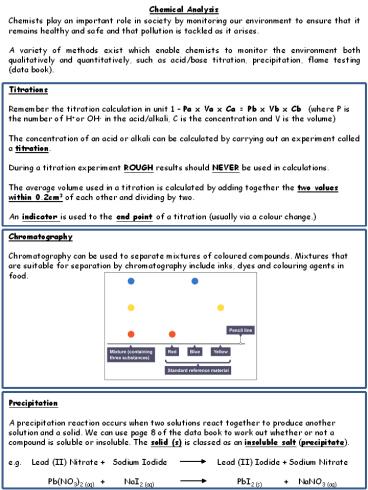
change.) Chromatography Chromatography can be
used to separate mixtures of coloured compounds.
Mixtures that are suitable for separation by
chromatography include inks, dyes and colouring
agents in food. Precipitation A
precipitation reaction occurs when two solutions
react together to produce another solution and a
solid. We can use page 8 of the data book to work
out whether or not a compound is soluble or
insoluble. The solid (s) is classed as an
insoluble salt (precipitate). e.g. Lead (II)
Nitrate Sodium Iodide Lead
(II) Iodide Sodium Nitrate
Pb(NO3)2 (aq) NaI2 (aq)
PbI2 (s) NaNO3 (aq)
Recommended

