

The name of every organic molecule has 3 parts: PowerPoint PPT Presentation
1 / 16
Title: The name of every organic molecule has 3 parts:
1
Alkanes - Nomenclature
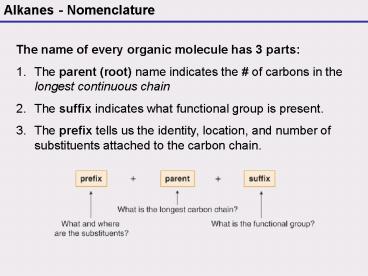
- The name of every organic molecule has 3 parts
- The parent (root) name indicates the of carbons
in the longest continuous chain - The suffix indicates what functional group is
present. - The prefix tells us the identity, location, and
number of substituents attached to the carbon
chain.
2
Alkanes - Nomenclature
Parent Longest contiguous carbon chain
3
Alkanes - Nomenclature
Suffix Our first functional group is alkane, so
the suffix is ane For later functional groups we
will drop the ane root suffix for others
Alkane chain Carbons Name
CH4 1 methane
CH3CH3 2 ethane
CH3CH2CH3 3 propane
CH3CH2CH2CH3 4 butane
CH3CH2CH2CH2CH3 5 pentane
CH3CH2CH2CH2CH2CH3 6 hexane
CH3CH2CH2CH2CH2CH2CH3 7 heptane
CH3CH2CH2CH2CH2CH2CH2CH3 8 octane
CH3CH2CH2CH2CH2CH2CH2CH2CH3 9 nonane
CH3CH2CH2CH2CH2CH2CH2CH2CH2CH3 10 decane
CH3CH2CH2CH2CH2CH2CH2CH2CH2CH2CH3 11 undecane
CH3CH2CH2CH2CH2CH2CH2CH2CH2CH2CH2CH3 12 dodecane
4
Alkanes - Nomenclature
Prefix Our substituents will be branches in the
alkane structure A branch is another alkane minus
one hydrogen an alkyl group Example if CH3-
is a branch on a longer chain CH3- is CH4
minus 1 hydrogen Since it is a side chain it will
replace the ane suffix with yl CH3- is a
methyl group We can also abbreviate this group
as Me-
5
Alkanes - Nomenclature
Prefixes -
Alkyl group Structure IUPAC name Abbreviation
CH3- CH3- methyl Me-
CH3CH2- ethyl Et-
CH3CH2CH2- n-propyl n-Pr
CH3CHCH3 isopropyl or i-propyl i-Pr
CH3CH2CH2CH2- n-butyl n-Bu
CH3CH2CHCH3 sec-butyl s-Bu
(CH3)2CHCH2- isobutyl or i-butyl i-Bu
(CH3)3C- tert-butyl or t-butyl t-Bu
C6H5- phenyl Ph
6
Alkanes - Nomenclature
1. Find the parent carbon chain and add the
suffix.
Note that it does not matter if the chain is
straight or it bends.
7
Alkanes - Nomenclature
Also note that if there are two chains of equal
length, pick the chain with more substituents. In
the following example, two different chains in
the same alkane have seven C atoms. We circle the
longest continuous chain as shown in the diagram
on the left, since this results in the greater
number of substituents.
8
Alkanes - Nomenclature
2. Number the atoms in the carbon chain to give
the first substituent the lowest number.
9
Alkanes - Nomenclature
If the first substituent is the same distance
from both ends, number the chain to give the
second substituent the lower number.
10
Alkanes - Nomenclature
When numbering a carbon chain results in the same
numbers from either end of the chain, assign the
lower number alphabetically to the first
substituent.
11
Alkanes - Nomenclature
3. Name and number the substituents.
- Name the substituents as alkyl groups.
- Every carbon belongs to either the longest chain
or a substituent, not both. - Each substituent needs its own number
- If two or more identical substituents are bonded
to the longest chain, use prefixes to indicate
how many di- for two groups, tri- for three
groups, tetra- for four groups, and so forth.
12
Alkanes - Nomenclature
4. Combine substituent names and numbers parent
and suffix.
- Precede the name of the parent by the names of
the substituents. - Alphabetize the names of the substituents,
ignoring all prefixes except iso, as in isopropyl
and isobutyl. - Precede the name of each substituent by the
number that indicates its location. - Separate numbers by commas and separate numbers
from letters by hyphens. The name of an alkane is
a single word, with no spaces after hyphens and
commas.
13
Alkanes - Nomenclature
Cycloalkanes are named by using similar rules,
but the prefix cyclo- immediately precedes the
name of the parent.
1. Find the parent cycloalkane.
14
Alkanes - Nomenclature
2. Name and number the substituents. No number is
needed to indicate the location of a single
substituent.
For rings with more than one substituent, begin
numbering at one substituent and proceed around
the ring to give the second substituent the
lowest number.
15
Alkanes - Nomenclature
With two different substituents, number the ring
to assign the lower number to the substituents
alphabetically.
Note the special case of an alkane composed of
both a ring and a long chain. If the number of
carbons in the ring is greater than or equal to
the number of carbons in the longest chain, the
compound is named as a cycloalkane.
16
Alkanes - Nomenclature
Recommended

