

Intro to Classical Mechanics Zita@evergreen.edu, 3.Oct.2002 PowerPoint PPT Presentation
1 / 12
Title: Intro to Classical Mechanics Zita@evergreen.edu, 3.Oct.2002
1
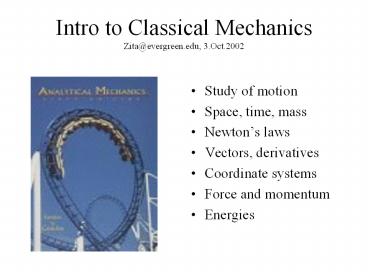
Intro to Classical MechanicsZita_at_evergreen.edu,
3.Oct.2002
- Study of motion
- Space, time, mass
- Newtons laws
- Vectors, derivatives
- Coordinate systems
- Force and momentum
- Energies
2
Four realms of physics
3
Mechanics study of motion of objects in
absolute space and time
Time and space are NOT absolute, but their
interrelatedness shows up only at very high
speeds, where moving objects contract and moving
clocks run slow. Virtually all everyday
(macroscopic, vltc) motions can be described very
well with classical mechanics, even though Earth
is not an inertial reference frame (its spin and
orbital motions are forms of acceleration).
4
Space and time are defined via speed of light.
- c 3 x 10⁸ m/s
- meter distance light travels in 1/(3 x 108)
second - second is fit to match
- period T 1/frequency 1/f
- E hf 2mB (hyperfine splitting in Cesium)
- second 9 x 10¹⁰ TCs
5
Vectors and derivatives
Practice differentiation vectors 1.6 (p.36) A
i a t j b t2 k g t3
6
Polar coordinates
r der/dt deq /dt
v dr/dt a dv/dt
7
Cylindrical and spherical coordinates
8
Practice 1.22 (p.36)
Ants motion on the surface of a ball of radius b
is given by rb, f w t, q p/2 1 1/4 cos (4
w t). Find the velocity.
9
Newtons Laws
I. If F 0, then v constant II. S F dp/dt
m a III. F12 -F21 Momentum p m v a F/m
dv/dt v ? a dt dx/dt x ? v dt
10
Practice 2.1, 2.2
Given a force F, find the resultant velocity
v. For time-dependent forces, use a(t) F(t)/m,
v(t) ? a(t) dt. For space-dependent forces, use
F(x) ma m dv/dt where dv/dt dv/dx dx/dt
v dv/dx and show that ?v dv 1/m ?F dx. 2.1(a)
F(t) F0 c t 2.2(a) F(x)
F0 k x
11
Energies
F m dv/dt m v (dv/dx). Trick d(v2)/dx
Show that F mv ( ) m/2
d(v2)/dx Define F dT/dx where T Kinetic
energy. Then change in kinetic energy ? F dx
work done. Define F -dV/dx where V Potential
energy. Total mechanical energy E T V is
conserved in the absence of friction or other
dissipative forces.
12
Practice with energies
To solve for the motion x(t), integrate v dx/dt
where T 1/2 m v2 E - V Note x is real only
if V lt E ? turning points where
VE. 2.3 Find V - ? F dx for forces in 2.1
and 2.2. Solve for v and find locations (x) of
turning points.
Recommended

