

Chapter 4 - Tissues PowerPoint PPT Presentation
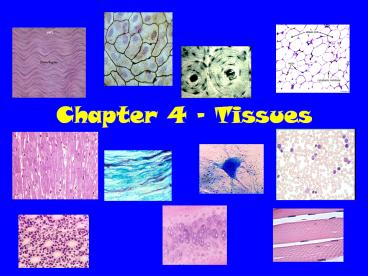
Title: Chapter 4 - Tissues
1
Chapter 4 - Tissues
2
Tissues
- Definition
- A group of similar cells and their intercellular
substances specialized to perform a specific
function.
3
Tissues
- Epithelial covers exposed surfaces, lines
internal passageways and chambers, and forms
glands. - Connective Fills internal spaces, provides
structural support for other tissues, transports
materials within the body, and stores energy. - Muscle Specialized for contraction.
- Nervous Regulates and controls body functions.
Carries information in the form of electrical
impulses.
4
Epithelial Tissue or Epithelium
- epithe laid on, covering
- Sheet of cells that covers a body surface or
lines a body cavity - Forms boundaries between different environments.
5
Occurs in the body as
- Covering and lining epithelium
- Forms the outer layer of skin, dips into and
lines the open cavities of the cardiovascular,
digestive, and respiratory system, and covers the
walls and organs of the ventral body cavity. - Glandular epithelium
- Forms the glands of the body.
6
Functions
- Protection
- Protects underlying tissues from mechanical and
chemical injury and bacterial invasion and
contains nerve endings - Absorption
- Digestive system is specialized to absorb
substances. - Filtration
- Kidneys filter the blood.
- Excretion
- Excrete waste products from the body and reabsorb
needed materials from the urine. Sweat is
excreted from the body in the sweat glands - Secretion
- Specialty of glands. Examples enzymes, hormones
and lubricating fluids - Sensory reception
- Has sensory nerves (smell, taste, sight, and
hearing)
7
Special Characteristics
- Polarity
- Apical surface upper free surface that is
exposed to body exterior or the cavity of an
internal organ. - May have microvilli, cilia, or be smooth
- Basal surface Lower attached surface to the
basement membrane - Basal lamina non cellular, adhesive sheet
(consists mainly of glycoproteins) that lies
adjacent to basal surface. - Filter - determines which molecules can diffuse
from the basement membrane - Scaffolding so cells can migrate to repair a wound
8
Special Characteristics
- Specialized Contacts
- Cells are fit very close together to form
continuous sheets. - Cell Junctions
- Specialized areas of plasma membrane that attach
a cell to another cell - Gap Junction
- Tight Junction
- Desmosomes
9
Special Characteristics
- Gap Junction
- Forms a narrow passageway between two cells that
allows molecules or ions to move between the
cells - Common where the movement of ions helps to
coordinate function. - Beating of cilia
- Beating of cardiac cells
10
Special Characteristics
- Tight Junction
- The lipid portions of the two plasma membranes
are tightly bound together. - So tight that prevents water and solutes from
passing between cells. - Impermeable junction.
11
Special Characteristics
- Desmosomes
- Binding bodies Anchoring junction
- Prevents the separation of cells
- Like nails in wood.
- Seen in the skin, why when you burn your skin
peels off in sheets.
12
Special Characteristics
- Supported by Connective tissue
- All rest upon and are supported by connective
tissue - Basement membrane made up of the reticular
lamina and the basal lamina
13
Special Characteristics
- Avascular but innervated
- Avascular contains no blood vessels. Cells get
nutrients by diffusion or absorption across the
apical or basal surface. - Innervated supplied by nerve fibers
14
Special Characteristics
- Regeneration
- If/when the tissue is destroyed, epithelial cells
begin to reproduce themselves rapidly. As long
as epithelial cells receive adequate nutrition,
they can replace lost cells by cell division.
15
Epithelial Tissue
- Classification
- Number of cell layers
- Simple only a single layer of cells
- Stratified Several layers of cells
- Shape of exposed cells
- Squamous flattened/scale like
- Cuboidal - boxlike
- Columnar tall and column shaped
Recommended

