

Production of cold antihydrogen atoms in large quantities PowerPoint PPT Presentation
1 / 35
Title: Production of cold antihydrogen atoms in large quantities
1
Production of cold antihydrogen atoms in large
quantities
C. Regenfus
University of Zürich
On behalf of the ATHENA collaboration
Sept. 02 gt 50k cold antiatoms produced
- Introduction
- The ATHENA experiment
- New results
- Summary
- Outlook
H detector
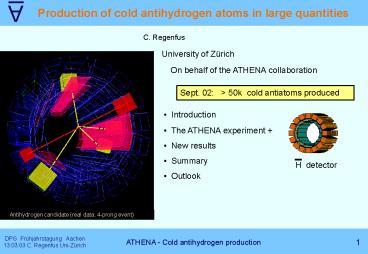
Antihydrogen candidate (real data, 4-prong
event)
2
Motivation
Antihydrogen The simplest antimatter
counterpart to matter for testing fundamental
physic principles
- CPT symmetry (Theoretical underpinning of field
theories) - Gravitational acceleration (Equivalence
principle)
A very high precision can be achieved by
comparing antihydrogen to hydrogen
3
Future high resolution laser spectroscopy
Atomic 1S - 2S transition by two-photon
excitation (first order Doppler-free) Lyman
a D E 10.2 eV 2.5 x 10¹⁵ Hz 122 nm UV
2 x 243 nm photons
(mW) Lifetime of 2S state 122 ms gt
precision 10-16
H spectroscopy
Need Cold antihydrogen ( T lt mK ) Capture in
neutral trap Hydrogen reference cell
Cesar et al. (1996) (Laser 3kHz, 150µK)
Gravitation atomic fountain / interferometry
4
Present physics menu
Plasma studies new kind of plasma imaging
- Particle losses in trap
- (Re)combination mechanism
- Production of cold antihydrogen in larger
quantities
Investigations
- Antihydrogen energy distribution ( inner
states) - Laser spectroscopy on non trapped atoms
- Trapping H and/or creation of a H beam
5
The ATHENA collaboration
Particle traps control INFN, Sez. di Genova,
and Dipartimento di Fisica, Università di Genova,
Italy EP Division, CERN, Geneva,
Switzerland Department of Physics, University of
Tokyo, Japan Precision lasers Department of
Physics and Astronomy, University of Aarhus,
Denmark Instituto de Fisica, Rio de Janeiro,
Centro de Educação Tecnologica do Ceara,
Brazil Positron plasma Department of Physics,
University of Wales Swansea, UK Detector
Analysis Physik-Institut, Zürich University,
Switzerland INFN, Sez. di Pavia, and Dipartimento
di Fisica Nucleare e Teorica, Università di
Pavia, Italy Dipartimento di Chimica e Fisica per
l'Ingegneria e per iMateriali, Università di
Brescia, Italy
6
Experimental overview
Scint.
Scint.
Scint.
15 K , 10-11 mbar
Main ATHENA features Open access system (no
sealed vacuum) Powerful e accumulation Plasma
diagnosis and control High granularity imaging
detector
7
ATHENA Photo
8
Penning traps
ATHENA Multi-ring Penning trap (choose Vz as you
like )
- Trapped electron at B 3 T, E 1 eV, U
10 V - Cyclotron motion (perpendicular to B)
- f 84 GHz, r 1 µm
- Emission of synchrotron radiation (cooling)
- t cool 0.3 s
- Axial motion (along B)
- f 7 MHz, d µm cm
- E x B drift (magnetron) (cooling over
coupling) - f kHz, r mm
- Single particle ltgt Plasma
- Coulomb coupling parameter Ecoul/Etherm
- Electrical screening distance Debye length
9
Antiproton decelerator (CERN)
10
Antiproton capture and cooling with electrons
- Capture dynamics
- Capture trap (50 cm)
10 000 p / AD shot
11
Positron accumulation
Accumulation rate 106 e/s
150 million e / 5 min
After transfer 75 x 106 in mixing
trap Positron plasma r2mm, l32mm,
n2.5 x 108 / cm3 Lifetime hours
12
Non destructive positron plasma diagnostics
Complete model of plasma mode excitation (based
on Cold Fluid Theory ) PLASMA SHAPE, LENGTH,
DENSITY Plasma temperature change
drive
read
D. Dubin, PRL 66, 2076 (1991)
30 MHz
heat
13
Detection principle of antihydrogen annihilations
- H atom dissociates to p and e
- by contact with the trap wall or
- rest gas atoms
- pN -gt charged and neutral pions
- e e- -gt 511keV photons (back to back)
Measure 1MeV on background of 2GeV
Monte Carlo
511 keV opening angle
Good spatial resolution (lt 1 cm ) of
charged vertex ( at least 2 prong events) Time
coincidence ( 1 µs) High rate capability (self
triggering)
14
Detector development
Silicon micro strip layer
- Compact design (radial thickness 3 cm)
- High granularity (8K strips, 192 crystals)
- Large solid angle (gt75 )
Full detector installed August 2001
All photodiodes replaced with APDs Spring 2002
Mechanics for 77K
- Much effort into RD
- Low temperature ( 140 K)
- High magnetic field (3 T)
- Low power consumption
- Light yield of pure-CsI crystals ?
- CTE matching (Kapton, silicon, ceramics)
- Electronic components
Workshop Zürich , J. Rochet
15
Pure-CsI crystals Avalanche Photo Diodes
- Read out close up
- Crystal APD unit
- Crystal detector performance
Pure-CsI
16 times higher light yield _at_ 80K C. Amsler,
et al. Temperature dependence of pure-CsI,
scintillation light yield and decay time. NIM A
480, 494500 (2002).
16
Full GEANT Monte Carlo simulations
EM cascades, Hadronic Showers (GEISHA) (gt 10
keV) Geometry from AutoCAD Module-by-module
(in)efficiency taken into account Same analysis
routine for MC and data
Radial vertex position
17
Antiproton annihilations
- Antiproton annihilation on the trap wall (real
data, 3-prong event) - strip hits (inner outer layer) gt p vertex
- crystals hit (matched to charged tracks)
- vertex resolution, 4 mm (curvature not
resolved)
18
Plasma imaging (antiprotons only)
p vertex evolution in time
Powerful plasma and loss diagnostics !
19
Mixing trap (nested penning trap)
In one mixing cycle (5 min) we mix 104
antiprotons with 108 positrons
G. Gabrielse et al., Phys. Lett. A129, 38 (1988)
20
Cooling of antiprotons by 75 million positrons
- Rapid cooling (lt 20 ms)
- Decreasing energy of antiprotons
- Increasing separation of plasmas
21
Antiprotons in the positron plasma
Energy loss by dE/dx and thermalization
Incoming antiproton
e cloud (108/cm3) T 10K .. 10000K (by RF
heating)
22
Antihydrogen production
1. Fill positron well in mixing region with
75106 positrons allow them to cool to ambient
temperature (15 K) 2. Launch 104 antiprotons
into mixing region 3. Mixing time 190 s -
continuous monitoring by detector (charged
trigger) 4. Repeat cycle every 5 minutes (data
for 165 cycles)
For comparison hot mixing continuous RF
heating of positron cloud (suppression of
antihydrogen production)
23
Antiproton annihilation rate (charged trigger
rate)
High initial rate 100 Hz
Background trigger rate 0.5 Hz
24
Analysis Procedure
Antihydrogen candidate (real data, 4-prong event)
Event reconstruction (165 mixing cycles 2 days)
Reconstruct annihilation vertex (103 k)
Search for clean 511 keV-photons exclude
crystals hit by charged particles its 8
nearest neighbours 511 keV candidate 400
620 keV no hits in any adjacent crystals
Select events with two 511 keV photons
Reconstruction efficiency 0.25
golden events !
25
Antihydrogen Signal (golden events)
Opening angle between two 511 keV photons (seen
from charged particle vertex)
Comparison with Monte Carlo
M. Amoretti et al., Nature 419, 456 (2002)
gt 50,000 produced antiatoms (conservative
estimate) Background mixing with hot positrons
26
Background measurements
Opening angle between two 511 keV photons
(seen from charged particle vertex)
Can antiproton annihilations on electrode fake
back-to-back signal? No ! 1) Secondary e within
10 mm 0.1 2) Monte Carlo - no peak 3)
Measurement - no peak
Histogram Antiproton-only data (99,610
vertices, 5,658 clean 2-photon events plotted).
Dots Antiproton cold positrons, but
analyzed using an energy window displaced upward
so as not to include the 511 keV photo-peak
M. Amoretti et al., Nature 419, 456 (2002)
27
Antihydrogen main source of annihilations
X-Y vertex distribution
Time distribution of golden events and all
annihilations
28
Physics of antihydrogen production
ANTIHYDROGEN VERSUS BACKGROUND ABSOLUTE
PRODUCTION RATES DEPENDENCE ON TEMPERATURE ANGULAR
DISTRIBUTION
PRELIMINARY
29
Opening angle fit
Fit Result
PRELIMINARY
Fit result 2/3 of the events are antihydrogen
30
Vertex spatial distribution fit
PRELIMINARY
Antihydrogen on trap electrode
Antihydrogen on trapped ions or rest gas
Compare to cold mix data
Average fraction of antihydrogen 65 10 during
mixing !
In 2002, ATHENA produced 0.7 0.3 Million
antihydrogen atoms
gt
31
Rate of antihydrogen production
Analysis 65 10 antihydrogen 50
vertex / annihilation
PRELIMINARY
High Initial Rate (gt 100 Hz) High S/B ( 101) in
first seconds
32
Pulsed antihydrogen production
Switch positron heating Off/On resp. On / Off
We observe
Annihilation rate
Heat On
Rise time 0.4 s (Positron cooling time)
Mixing time
PRELIMINARY
Vertex distribution along z
33
Antihydrogen Production - T dependence
Radiative Three-body s(T) dependence T-0.5 T-
4.5 Final state n lt 10 n gtgt 100 Stability
(re-ionization) high low Expected rates Hz ?
34
Summary
First production and detection of cold
antihydrogen - high positron accumulation rate
fast duty cycle - sensitive detector observe
clear signals High rate production - initial
rate gt 100 Hz, average rate 10 Hz Antihydrogen
dominates annihilation signal ( 2/3) Pulsed
antihydrogen production Temperature dependence
measured Antihydrogen production at room
temperature
35
Outlook
Next steps - physics
Next steps - technology
Study Formation process
Spectroscopy High precision comparison
1S-2S Hyperfine structure
More Increase formation rate More
antiprotons Laser induced recombination
Gravitational effects E 0.000 1 meV Atom
interferometry
Trapping and cooling ... Anti-Hydrogen at E lt
0.05 meV ? Dense plasmas in magnetic multipole
fields ? Laser cooling? Collisions with
ultra-cold hydrogen atoms?
Recommended

