

Turing Machines PowerPoint PPT Presentation
Title: Turing Machines
1
Section 3.1
Turing Machines
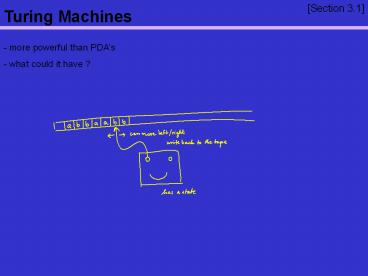
- more powerful than PDAs
- what could it have ?
2
Section 3.1
Turing Machines
Example A aibici i 0
3
Section 3.1
Turing Machines
Example B ww w 2 0,1
4
Section 3.1
Turing Machines
- Def 3.3
- A Turing machine (TM) is a 7-tuple
(Q,,,,q0,qaccept,qreject), where - Q is the (finite) set of states
- is the (finite) input alphabet, not containing
? - is the (finite) tape alphabet, ? µ
-
is the transition function - q0 2 Q
- qaccept 2 Q is the accept state
- qreject 2 Q-qaccept is the reject state
5
Section 3.1
Turing Machines
- Computation of Turing machines
- first we define a configuration
- uqv means the tape contains uv, the state is
q, and the machine reads the first symbol of v - suppose configuration is uaqbv and
(q,b)(p,c,R) - We say that uaqbv yields
6
Section 3.1
Turing Machines
- Computation of Turing machines
- first we define a configuration
- uqv means the tape contains uv, the state is
q, and the machine reads the first symbol of v - start configuration
- accepting configuration
- rejecting configuration
- Note accepting/rejecting configurations are
halting
7
Section 3.1
Turing Machines
- Computation of Turing machines
- first we define a configuration
- uqv means the tape contains uv, the state is
q, and the machine reads the first symbol of v - A TM M accepts w if
- The language of a TM M is the set of strings that
M accepts/recognizes.
8
Section 3.1
Turing Machines
Def 3.5 A language is Turing-recognizable if
there is some TM that recognizes it. Def 3.6 A
language is Turing-decidable if there is some TM
that decides it.
9
Section 3.1
Turing Machines
Example A 0n n2k for some k 0
Recommended

