

Users and Technology: Perspectives on Information Technology and Society Part II PowerPoint PPT Presentation
Title: Users and Technology: Perspectives on Information Technology and Society Part II
1
Users and Technology Perspectives on
Information Technology and Society Part II
http//itb.isikun.edu.tr/en/bilimdali.php
- I203 Social and Organizational Issues of
Information
2
Agenda
- Social Construction of Technology
- Actor-Network Theory
- Other Explanations for Technological Change
3
Next Week
- Tuesday, in-class discussion lead by Ashwin and
Devin - Implications of the Internet
- Small group discussion of paper topics,
brainstorming - Thursday
- No class, catch up on any readings and/or work on
Assn1.
4
Main arguments of SCOT (review)
- Interpretive flexibility
- Different interpretations of same artifact by
different social groups - Stabilization
- Over time, negotiations lead to convergence.
- Closure
- Closure is a social process in which the
technological artifact reaches a final,
consensual form.
5
Relevant Social Groups in SCOT
- What is a relevant social group?
- all members of a social group share the same set
of meanings, attached to a specific artifact
(Pinch and Bijker 1987) - Different groups may lead to different
interpretations. - Resulting technology is a negotiation between
these groups.
6
Technological frames
- Technological frame A shared cognitive view that
defines a relevant social group members with a
shared technological frame have a common
interpretation of an artifact. - Goals
- Tacit knowledge
- Current/available theories
- Design methods
- (among other factors)
- Technological frame is similar to concept of the
paradigm though not quite as broad.
7
Critiques of SCOT (selected)
- SCOT assumes equality of groups.
- Fails to recognize power dynamics between social
actors, groups. - Politically Insipid
- SCOT tends to avoid making, over-arching
pronouncements for or against the particular
technological developmentsbecause the
researchers know enough to realize the
complexities they are examining that the futility
of trying to change the world by pronouncements. - SCOT is a historical method, but history is
tricky! - The details of a technologys historical
development heavily influence a SCOT analysis. - Historical details are often contested.
- See Clayton, Nick. 2002. SCOT Does it Answer?
Technology and Culture 43351-360.
8
Critiques of SCOT (selected)
- Over-emphasizes agency, under-emphasizes
structure. - Agency Ability to be in action or to exert power
- Structure Arrangement of parts that together
form a whole The composition of a social group
and the way it is organized. - Fails to recognize the powerful influences of
institutions and forces that are difficult to
change, construct - (e.g. political economy, social classes,
geography, socio-demographic factors) - We make our own world, but not exactly as we
please. Jean Lave
9
Rosens Critique of SCOT The Social Construction
of the Mountain Bike
10
Determinism SCOT in Practice
- Both perspectives are extremes, hard to justify
on their own. - A moderate approach is reasonable, but arguably
less exciting and certainly not any better at
prediction. - Where do we place the emphasis on the
technology, or on the people? - The POV you choose helps determine
- The problems you choose to research
- The methods you use
- Your analysis and interpretation of data (i.e.
Agency)
11
Actor-Network Theory (ANT)
- Builds on ideas from SCOT acknowledges non-human
elements in technological development. - Originally credited to Michel Callon, Bruno
Latour and John Law. - Deals with processes by which scientific disputes
become closed, ideas accepted, methods adopted. - Mostly a qualitative approach following the
actor, or following inscriptions (texts, images,
databases, etc)
12
Vs.
13
Actor-Network Theory
- Human and Non-human elements are connected in a
network that can be used to understand the
competing influences on some outcome. - Actor can be human or non-human.
- Humans
- Texts
- Technologies themselves
14
(No Transcript)
15
ANT applied to web services
16
Critiques of ANT
- How can inanimate objects have agency?
- Proponents say that they know that objects do not
have intentional action - Critics say that if you treat humans and objects
exactly the same way, it leads to preposterous
claims about the effect of technology - What does it mean that an actor is simultaneously
an actor and a network? How do you test and
measure that? - If every actor can be a network, how far does
this logic go before we have a network that is
too complex to even comprehend?
17
Other Economic and Sociological Explanations for
Technological Change
- Problems with neoclassical economic solutions to
tech change and radical innovation - Natural Trajectories and Self-fulfilling
prophecies
18
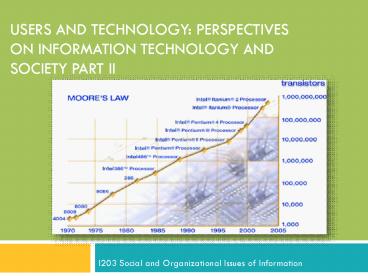
Moores Law Example
- Since Intel was founded in 1969 by Robert
Noyce and Gordon Moore, Moore's Law became a
target that drove product development within the
company. In fact, the entire semiconductor
industry is striving to track Moore's curve the
Semiconductor Industry Association puts together
periodic "Technology Roadmaps" that were closely
followed by the chip industry. These roadmaps,
designed by technology working groups made up of
leading industry experts, define in detail the
course for future developments over a 15-year
period, driven by the desire to continue the past
trends of Moore's Law. In this way, Moore's Law
has become a self-fulfilling prophecy. - -Mendelson, 1979
19
Other Economic and Sociological Explanations for
Technological Change
- Ethnoaccountancy
- Do accounting practices help guide innovation?
20
Assignment 1
- Available on Course Website
Recommended

