

Chemical Formula: shows the kinds and numbers of atoms in the smallest representative unit of the substance (aka formula unit) PowerPoint PPT Presentation
1 / 9
Title: Chemical Formula: shows the kinds and numbers of atoms in the smallest representative unit of the substance (aka formula unit)
1
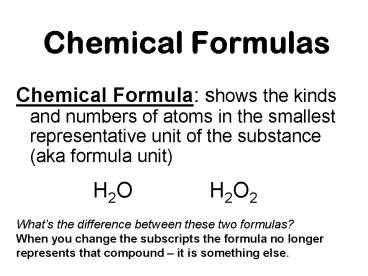
- Chemical Formula shows the kinds and numbers of
atoms in the smallest representative unit of the
substance (aka formula unit)
H2O
H2O2
Whats the difference between these two
formulas? When you change the subscripts the
formula no longer represents that compound it
is something else.
2
Important differences between covalent and ionic
compounds
Characteristic Covalent compound Ionic compound
Representative unit Molecule (atoms sharing electrons) Formula unit (balance of oppositely charged ions)
Type of elements Nonmetallic Metallic combined with nonmetallic
Physical state Solid, liquid or gas Solid
Covalent compounds- Composed of two or more
nonmetals
Ionic compounds- composed of a metal and a
nonmetal - total positive charge equals total
negative charge
3
Molecules
- A molecule is the smallest electrically neutral
unit of a substance that still has the properties
of the substance - 1. Monatomic consist as a single atom (Ex Noble
gases) - 2. Diatomic molecule (Ex O2) BrINCl HOF
- 3. Triatomic molecule ( Ex O3)
He
4
Chemical Formulas
- How to read formulas
- H2O 2 hydrogen atoms 1 oxygen atom
- Ca(OH)2 1 calcium atom, 2 oxygen atoms
- 2 hydrogen atoms
Practice MgCl2 H2SO4 Al2(SO4)3
1 2
Mg
Al
2 3 12
H
2 1 4
S
Cl
S
O
O
5
- Oxidation Numbers how many electrons an atom
would gain or lose to follow the octet rule - (also called its charges)
1
2
-1
-2
-3
3
6
Charges of Transition Metals
Add to the periodic table in your Reference
Section
- These transition metals have more than one
charge - Cr2 or 3 Cu or 2
- Mn2 or 3 Sn2 or 4
- Fe2 or 3 Pb2 or 4
- Co2 or 3 Ni2 or 3
- Hg1 or 2 Au1 or 3
7
Writing Formulas for Binary Ionic Compounds
- Rules
- Write symbol and charge for both cation and
anion. - Crisscross charges, drop the charge and write as
subscripts. - CHECK!! The formula must be in the lowest
possible ratio.
The cation is always written first!
8
Example Problems
- Write formulas for these compounds
- calcium iodide
2
-
I
Ca
2
1
CaI2
9
Tin (IV) oxide
4
-2
O
Sn
2
4
Sn2O4
SnO2
Recommended

