

The Grim Cost of War PowerPoint PPT Presentation
Title: The Grim Cost of War
1
The Grim Cost of War
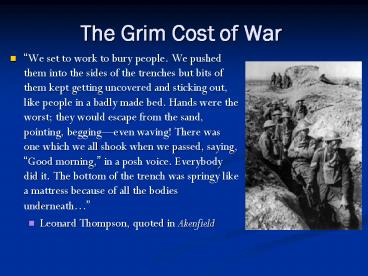
- We set to work to bury people. We pushed them
into the sides of the trenches but bits of them
kept getting uncovered and sticking out, like
people in a badly made bed. Hands were the worst
they would escape from the sand, pointing,
beggingeven waving! There was one which we all
shook when we passed, saying, Good morning, in
a posh voice. Everybody did it. The bottom of the
trench was springy like a mattress because of all
the bodies underneath - Leonard Thompson, quoted in Akenfield
2
LONG-TERM CAUSES OF WORLD WAR I
3
NATIONALISM
- Loyalty and pride for ones nation
- People usually share common language, history or
culture - In Germany, many small regions united to form one
country (late 1800s)
4
- Problem small disputes between 2 countries can
become major issues and involve many countries - Austria-Hungary and Russia
- Made up of many minority groups
- Many had a desire to unify all Slavic people
(Pan-Slavism) - Austrian government was loyal to
- Germany (Pan-Germanism)
5
MANY ETHNIC GROUPS FOUND WITHIN AUSTRIA-HUNGARY
6
ALLIANCES
- Fear and distrust among countries led to the
formation of alliances - Discouraged attacks from enemies
- Dangers
- Gave countries a sense of security
- A country may deal differently with another if it
has support - Conflict will involve numerous countries instead
of the original 2
7
Triple Entente
Triple Alliance
Great Britain
Germany
Austria-Hungary
France
Italy
Russia
8
IMPERIALISM
- Domination by one country of the political,
economic, or cultural life of another country or
region (Colonies) - Major European nations began dividing up Africa,
Asia and the Middle East into colonies - Supply raw materials for production
- Larger market to sell goods
- More opportunities for investments
9
EUROPEAN COLONIES WORLDWIDE
10
- Britain was the worlds superpower throughout
most of the 1700s and 1800s - However Germany began to out produce Britain by
early 1900s - Also competing for colonies worldwide
- Created an economic rivalry
11
MILITARISM
- Glorification (build up) of the military
- Military leaders began to gain more influence in
national policy due to rivalry among countries - The public supported military build up and the
use of force to achieve national goals
12
- BRITAIN
- Worlds best navy
- Began to fear Germanys strength
British Warship
Kaiser Wilhelm
- GERMANY
- Best trained army in world
- Significant increase in naval power(u-boats)
13
American Neutrality
- Wilson declares the US to be neutral
- Britain uses propaganda to gain US support
- Also cut transatlantic cable to limit media
coverage - US businesses and banks support Allies
14
Lusitania
- May 1915 British passenger ship, Lusitania, sank
by German U-Boat (128 Americans on board)
15
Sussex
- U-boat shot at French ship, Sussex
- Results in Sussex Pledge
- President Wilson issued Germans a warning
- Germany promised not to fire on merchant ships
without warning- kept US out of war for a little
longer
16
Zimmermann Telegram
- Zimmerman Telegram
- Secret telegram from Germany to Mexico asking
them to fight against the U.S.intercepted by the
British, angers the U.S.
US declares war on Germany
17
Buildingup the Military
- National Defense Act increased the size of the
army and trained officers through conscription
and selective service (2.8 million drafted) - Women and African Americans served in the armed
forces - Women in non-combat positions
- African Americans faced discriminations and
prejudice
18
Organizing Industry
- War Industries Board- coordinated production of
war materials - Victory Gardens
- Liberty/Victory Bonds
19
Ensuring Public Support
- Set up Committee on Public Information/George
Creel - Hired writers to create propaganda to swing
public opinion in favor of the war - Espionage Act of 1917- made it illegal to spy or
interfere with government - Sedition Act of 1918- no public opposition of war
- Schenck v. the United States- Supreme Court rules
that a persons freedom of speech is limited when
the words constitute a clear and present danger - Ex. Yelling fire! in a crowded theatre
20
An Industrialized War
- Weapons were produced with the same efficient
methods of mass production that industrialists
had applied to other products
21
TECHNOLOGICAL ADVANCEMENTS IN WARFARE
- Machine Gun
- Accurate and rapid fire
- 1 man could hold off a hundred
22
The Machine Gun
- One of the most important weapons of WWI
- Highly effective
- Land armies often found any advance difficult and
costly
23
Machine Guns
24
Trench Warfare
- Protection from machine gun fire and artillery
bombardments - Armies dug large trenches where they might live
for months
25
(No Transcript)
26
British boys play acting Trench Warfare
27
Tanks
- Introduced by the British
- An armored vehicle mounted with guns
- Enabled troops to break though enemy lines
28
TANKS
- Armored vehicle designed to break trenches
- Protected advancing troops
- Often slow and clumsy
29
POISONOUS GAS
- Various gases caused choking, blinding, or skin
blisters - Used to kill or disable troops during an attack
- Gas masks lessened the effectiveness
30
Poison Gas
- Germans were 1st to use chlorine gas in 1915
(Battle of Ypres) - Caused a burning sensation to the throat and
chest pains. Painful death by suffocation - Weather had to be just rightany wind could blow
gas back on your own men - Mustard gas was most deadly weapon used
- Fired into the trenches in shellscolorless and
takes 12 hours to begin working (death can take
up to 5 weeks) - Effects include blistering skin, vomiting, sore
yes, internal and external bleeding
31
Poison Gas
- The Germans were the first to use it
- The Allies quickly followed suit
32
American wearing a Gas Mask
British Horse wearing a Gas Mask
33
American wearing a respirator
Sounding the gong in preparation of a gas attack
34
Casualties From Gas - The Numbers
Country Total Casualties Death
Austria-Hungary 100,000 3,000
British Empire 188,706 8,109
France 190,000 8,000
Germany 200,000 9,000
Italy 60,000 4,627
Russia 419,340 56,000
USA 72,807 1,462
Others 10,000 1,000
35
FLAMETHROWERS
- Used to clear enemy trenches
- Could be hazardous carrying into combat
36
- Used for observation early
- Later on dogfights were carried out
- Overall, minor impact on the war
AIRPLANES
37
Airplanes
- Airplanes in the early 1900s were neither very
maneuverable nor very fast - They were used primarily for observing troop
movements and for dropping explosives
38
Gun on German Airplane
Balloons were also used in WWI
39
U- BOATS (Unterseeboot)
- Underwater ships launch torpedoes or bombs
- Used mostly by Germans to destroy Allied shipping
and break blockades
40
Submarines/U-boats
- Did serious damage to Allied shipping
41
Loading torpedoes into a French submarine
42
The Draft
- Most European wars before this time had been
fought by professional soldiers who worked for
money and rations - WWI was fought by armies of drafted citizens
- Those who could not fight worked at home to help
the war effort - Many women participated in the war effort by
working in factories - Governments made use of propaganda
43
Move Toward Peace
- Peace conference begins January 1919 in Paris
- Big Four
- President Wilson, British Prime Minister David
Lloyd George, French Premier Georges Clemenceau,
Italian Prime Minister Vittorio Orlando - Fourteen Points
- President Wilsons plan for peace
- League of Nations- help to prevent wars
44
Fourteen Points
- Allies felt it was too easy on Germany
- Required Germany to disband armed forces
- Had to accept blame and pay reparations
- Many members of Congress opposed the Treaty of
Versailles (thought the League of Nations would
drag the U.S. into conflict) - Wilson suffers a stroke
- Senate refuses Treaty of Versailles, signs
individual treaties with the Central Powers - League of Nations starts without the U.S.
45
The Red Scare
- Strikes cause fear of Communist revolution within
the U.S. - U.S. Attorney General A. Mitchell Palmers house
is damaged by a bomb (Communists are blamed) - Palmer sets up General Intelligence Division,
headed by J. Edgar Hoover (later became the FBI) - Palmer Raids- Raids on private homes and
businesses conducted by the GIB to investigate
communists
Recommended

