

CMPE 49B Sp. Top. in CMPE: Multi-Core Programming PowerPoint PPT Presentation
1 / 71
Title: CMPE 49B Sp. Top. in CMPE: Multi-Core Programming
1
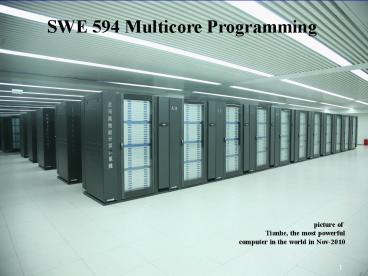
SWE 594 Multicore Programming
picture of Tianhe, the most powerful computer in
the world in Nov-2010
2
Von Neumann Architecture
CPU
RAM
Device
Device
BUS
- sequential computer
3
Memory Hierarchy
Fast
Registers
Cache
Real Memory
Disk
Slow
CD
4
History of Computer Architecture
- 4 Generations (identified by logic technology)
- Tubes
- Transistors
- Integrated Circuits
- VLSI (very large scale integration)
5
PERFORMANCE TRENDS
6
PERFORMANCE TRENDS
- Traditional mainframe/supercomputer performance
25 increase per year - But microprocessor performance 50 increase per
year since mid 80s.
7
Moores Law
- Transistor density doubles every 18 months
- Moore is co-founder of Intel.
- 60 increase per year
- Exponential growth
- PC costs decline.
- PCs are building bricks of all future systems.
Intel 62 core xeon Phi 2012
5 billion
8
VLSI Generation
9
Bit Level Parallelism(upto mid 80s)
- 4 bit microprocessors replaced by 8 bit, 16 bit,
32 bit etc. - doubling the width of the datapath reduces the
number of cycles required to perform a full
32-bit operation - mid 80s reap benefits of this kind of
parallelism (full 32-bit word operations combined
with the use of caches)
10
Instruction Level Parallelism(mid 80s to mid
90s)
- Basic steps in instruction processing
(instruction decode, integer arithmetic, address
calculations, could be performed in a single
cycle) - Pipelined instruction processing
- Reduced instruction set (RISC)
- Superscalar execution
- Branch prediction
11
Thread/Process Level Parallelism(mid 90s to
present)
- On average control transfers occur roughly once
in five instructions, so exploiting instruction
level parallelism at a larger scale is not
possible - Use multiple independent threads or processes
- Concurrently running threads, processes
12
Evolution of the Infrastructure
- Electronic Accounting Machine Era 1930-1950
- General Purpose Mainframe and Minicomputer Era
1959-Present - Personal Computer Era 1981 Present
- Client/Server Era 1983 Present
- Enterprise Internet Computing Era 1992- Present
13
Sequential vs Parallel Processing
- physical limits reached
- easy to program
- expensive supercomputers
- raw power unlimited
- more memory, multiple cache
- made up of COTS, so cheap
- difficult to program
14
What is Multi-Core Programming ?
- Answer It is basically parallel programming on
a single computer box (e.g. a desktop, a
notebook, a blade)
15
Another Important Benefit of Multi-Core
Reduced Energy Consumption
Dual core
Single core
1 GHz
1 GHz
2 GHz
Single core executes workload of N Clock cycles
Each core executes workload of N/2 Clock cycles
2
2
Energy per cycle(E ) CVdd EnergyE N
Energy per cycle(E ) C(0.5Vdd)
0.25CVdd
Energy 2(E 0.5 N
) E N
0.25(E N) 0.25Energy
c
c
2
c
c
c
c
16
SPMD Model (Single Program Multiple Data)
- Each processor executes the same program
asynchronously - Synchronization takes place only when processors
need to exchange data - SPMD is extension of SIMD (relax synchronized
instruction execution) - SPMD is restriction of MIMD (use only one
source/object)
17
Parallel Processing Terminology
- Embarassingly Parallel
- applications which are trivial to parallelize
- large amounts of independent computation
- Little communication
- Data Parallelism
- model of parallel computing in which a single
operation can be applied to all data elements
simultaneously - amenable to SIMD or SPMD style of computation
- Control Parallelism
- many different operations may be executed
concurrently - require MIMD/SPMD style of computation
18
Parallel Processing Terminology
- Scalability
- If the size of problem is increased, number of
processors that can be effectively used can be
increased (i.e. there is no limit on
parallelism). - Cost of scalable algorithm grows slowly as input
size and the number of processors are increased. - Data parallel algorithms are more scalable than
control parallel alorithms - Granularity
- fine grain machines employ massive number of
weak processors each with small memory - coarse grain machines smaller number of powerful
processors each with large amounts of memory
19
Models of Parallel Computers
- Message Passing Model
- Distributed memory
- Multicomputer
- 2. Shared Memory Model
- Multiprocessor
- Multi-core
- 3. Theoretical Model
- PRAM
- New architectures combination of 1 and 2.
20
Theoretical PRAM Model
- Used by parallel algorithm designers
- Algorithm designers do not want to worry about
low level details They want to concentrate on
algorithmic details - Extends classic RAM model
- Consist of
- Control unit (common clock), synchronous
- Global shared memory
- Unbounded set of processors, each with its
private own memory
21
Theoretical PRAM Model
- Some characteristics
- Each processor has a unique identifier,
mypid0,1,2, - All processors operate synhronously under the
control of a common clock - In each unit of time, each procesor is allowed to
execute an instruction or stay idle
22
Various PRAM Models
weakest
(how write conflicts to the same memory location
are handled)
strongest
23
Flynns Taxonomy
- classifies computer architectures according to
- Number of instruction streams it can process at a
time - Number of data elements on which it can operate
simultaneously
Data Streams
Single Multiple
Single
SIMD
SISD
Instruction Streams
Multiple
MISD
MIMD
24
Shared Memory Machines
- Memory is globally shared, therefore processes
(threads) see single address - space
- Coordination of accesses to locations done by use
of locks provided by - thread libraries
- Example Machines Sequent, Alliant, SUN Ultra,
Dual/Quad Board Pentium PC
- Example Thread Libraries POSIX threads, Linux
threads.
25
Shared Memory Machines
- can be classified as
- UMA uniform memory access
- NUMA nonuniform memory access
- based on the amount of time a processor takes to
access local and global memory.
P M P M .. P M
Inter- connection network
P M P M .. P M
Inter- connection network
M M M .. M
P P .. P
M M .. M
Inter- connection network/ or BUS
(a)
(c)
(b)
26
Distributed Memory Machines
- Each processor has its own local memory (not
directly accessible by others)
- Processors communicate by passing messages to
each other
- Example Machines IBM SP2, Intel Paragon, COWs
(cluster of workstations)
- Example Message Passing Libraries PVM, MPI
27
Beowulf Clusters
- Use COTS, ordinary PCs and networking equipment
- Has the best price/performance ratio
PC cluster
28
Multi-Core Computing
- A multi-core microprocessor is one which combines
two or more independent processors into a single
package, often a single integrated circuit. - A dual-core device contains only two independent
microprocessors.
29
Comparison of Different Architectures
Single Core Architecture
30
Comparison of Different Architectures
Multiprocessor
31
Comparison of Different Architectures
CPU State
CPU State
Execution unit
Cache
Hyper-Threading Technology
32
Comparison of Different Architectures
Multi-Core Architecture
33
Comparison of Different Architectures
CPU State
CPU State
Execution unit
Execution unit
Cache
Multi-Core Architecture with Shared Cache
34
Comparison of Different Architectures
Multi-Core with Hyper-Threading Technology
35
(No Transcript)
36
Top 500 Most Power Supercomputer Lists
- http//www.top500.org/
- ..
37
Grid Computing
- provide access to computing power and various
resources just like accessing electrical power
from electrical grid - Allows coupling of geographically distributed
resources - Provide inexpensive access to resources
irrespective of their physical location or access
point - Internet dedicated networks can be used to
interconnect distributed computational resources
and present them as a single unified resource - Resources supercomputers, clusters, storage
systems, data resources, special devices
37
38
Grid Computing
- the GRID is, in effect, a set of software tools,
which when combined with hardware, would let
users tap processing power off the Internet as
easily as the electrical power can be drawn from
the electricty grid. - Examples of Grids
- -TeraGrid (USA)
- -EGEE Grid (Europe)
- TR-Grid (Turkey)
38
39
GRID COMPUTING
Power Grid
Compute Grid
40
Archeology Astronomy Astrophysics Civil
Protection Comp. Chemistry Earth
Sciences Finance Fusion Geophysics High Energy
Physics Life Sciences Multimedia Material
Sciences
gt250 sites 48 countries gt50,000 CPUs gt20
PetaBytes gt10,000 users gt150 VOs gt150,000 jobs/day
40
41
Virtualization
- Virtualization is abstraction of computer
resources. - Make a single physical resource such as a server,
an operating system, an application, or storage
device appear to function as multiple logical
resources - It may also mean making multiple physical
resources such as storage devices or servers
appear as a single logical resource - Server virtualization enables companies to run
more than one operating system at the same time
on a single machine
41
42
Advantages of Virtualization
- Most servers run at just 10-15 capacity
virtualization can increase server utilization to
70 or higher. - Higher utilization means fewer computers are
required to process the same amount of work.
Fewer machines means less power consumption. - Legacy applications can also be run on older
versions of an operating system - Other advantages easier administration, fault
tolerancy, security
42
43
VMware Virtual Platform
Real machines
- VMware is now tens of billion dollar company !!
43
44
Cloud Computing
- Style of computing in which IT-related
capabilities are provided as a - service,allowing users to access
technology-enabled services from the Internet - ("in the cloud") without knowledge of,
expertise with, or control over the - technology infrastructure that supports them.
- General concept that incorporates software as a
service (SaaS), Web 2.0 and - other recent, well-known technology trends, in
which the common theme is - reliance on the Internet for satisfying the
computing needs of the users.
44
45
Cloud Computing
- Virtualisation provides separation between
infrastructure and user runtime environment - Users specify virtual images as their deployment
building blocks - Pay-as-you-go allows users to use the service
when they want and only pay for what they use - Elasticity of the cloud allows users to start
simple and explore more complex deployment over
time - Simple interface allows easy integration with
existing systems
45
46
Cloud Unique Features
- Ease of use
- REST and HTTP(S)
- Runtime environment
- Hardware virtualisation
- Gives users full control
- Elasticity
- Pay-as-you-go
- Cloud providers can buy hardware faster than you!
46
47
Example Cloud Amazon Web Services
- EC2 (Elastic Computing Cloud) is the computing
service of Amazon - Based on hardware virtualisation
- Users request virtual machine instances, pointing
to an image (public or private) stored in S3 - Users have full control over each instance (e.g.
access as root, if required) - Requests can be issued via SOAP and REST
47
48
Example Cloud Amazon Web Services
- Pricing information
- http//aws.amazon.com/ec2/
48
49
PARALLEL PERFORMANCE MODELSand ALGORITHMS
49
50
Amdahls Law
- The serial percentage of a program is fixed. So
speed-up obtained by employing parallel
processing is bounded. - Lead to pessimism in in the parallel processing
community and prevented development of parallel
machines for a long time.
1
Speedup
1-s
s
P
- In the limit
- Spedup 1/s
s
51
Gustafsons Law
- Serial percentage is dependent on the number of
processors/input. - Demonstrated achieving more than 1000 fold
speedup using 1024 processors. - Justified parallel processing
52
Algorithmic Performance Parameters
- Notation
Input size
Time Complexity of the best sequential algorithm
Number of processors
Time complexity of the parallel algorithm when
run on P processors
Time complexity of the parallel algorithm when
run on 1 processors
53
Algorithmic Performance Parameters
- Speed-Up
- Efficiency
54
Algorithmic Performance Parameters
- Work Processors X Time
- Informally How much time a parallel algorithm
will take to simulate on a serial machine - Formally
55
Algorithmic Performance Parameters
- Work Efficient
- Informally a work efficient parallel algorithm
does no more work than the best serial algorithm - Formally a work efficient algorithm satisfies
56
Algorithmic Performance Parameters
- Scalability
- Informally, scalability implies that if the size
of the problem is increased, the number of
processors effectively used can be increased
(i.e. there is no limit on parallelism) - Formally, scalability means
57
Algorithmic Performance Parameters
- Some remarks
- Cost of scalable algorithm grows slowly as input
size and the number of procesors are increased - Level of control parallelism is usually a
constant independent of problem size - Level of data parallelism is an increasing
function of problem size - Data parallel algorithms are more scalable than
control parallel algorithms
58
Goals in Designing Parallel Algorithms
- Scalability
- Algorithm cost grows slowly, preferably in a
polylogarithmic manner - Work Efficient
- We do not want to waste CPU cycles
- May be an important point when we are worried
about power consumption or money paid for CPU
usage
59
Summing N numbers in Parallel
step 1
x1..x4
result
- Array of N numbers can be summed in log(N) steps
using
N/2 processors
60
Prefix Summing N numbers in Parallel
step 1
step 2
x1..x4
x2..x4
x3..x6
x4..x7
x5..x8
x6..x8
x7x8
x8
step 3
x1..x8
x2..x8
x3..x8
x4..x8
x5..x8
x6..x8
x7x8
x8
- Computing partial sums of an array of N numbers
can be done in - log(N) steps using N processors
61
Prefix Paradigm for Parallel Algorithm Design
- Prefix computation forms a paradigm for parallel
algorithm - development, just like other well known
paradigms such as - divide and conquer, dynamic programming, etc.
- Prefix Paradigm
- If possible, transform your problem to prefix
type - computation
- Apply the efficient logarithmic prefix
computation
- Examples of Problems solved by Prefix Paradigm
- Solving linear recurrence equations
- Tridiagonal Solver
- Problems on trees
- Adaptive triangular mesh refinement
62
Solving Linear Recurrence Equations
- Given the linear recurrence equation
- we can rewrite it as
- if we expand it, we get the solution in terms of
partial products of coefficients and the initial
values z1 and z0 - use prefix to compute partial products
63
Pointer Jumping Technique
step 1
step 2
step 3
- A linked list of N numbers can be prefix-summed
in log(N)
steps using N processors
64
Euler Tour Technique
Tree Problems
- Preorder numbering
- Postorder numbering
- Number of Descendants
- Level of each node
- To solve such problems, first transform the tree
by linearizing it - into a linked-list and then apply the prefix
computation
65
Computing Level of Each Node by Euler Tour
Technique
-1
weight assignment
1
1
-1
-1
1
-1
1
1
-1
1
-1
-1
1
level(v) pw(ltv,parent(v)gt) level(root)
0
-1
1
1
-1
w(ltu,vgt)
initial weights
-1
1
1
1
-1
1
-1
-1
-1
1
-1
1
1
-1
1
-1
a
g
g
a
g
a
c
e
a
i
b
d
h
b
f
b
b
0
0
0
1
1
2
1
1
2
1
2
3
2
3
2
1
pw(ltu,vgt)
prefix
66
Computing Number of Descendants by Euler Tour
Technique
1
weight assignment
0
0
1
1
0
1
0
0
1
0
1
1
0
of descendants(v) pw(ltparent(v),vgt) -
pw(ltv,parent(v)gt) of descendants(root) n
1
0
0
1
w(ltu,vgt)
initial weights
1
0
0
0
1
0
1
1
1
0
1
0
0
1
0
1
a
g
g
a
g
a
c
e
a
i
b
d
h
b
f
b
b
6
7
8
0
1
1
5
7
0
2
2
2
3
3
4
6
pw(ltu,vgt)
prefix
67
Preorder Numbering by Euler Tour Technique
1
0
weight assignment
1
1
0
2
0
1
0
1
1
8
9
0
1
0
0
5
1
3
4
preorder(v) 1 pw(ltv,parent(v)gt) preorder(
root) 1
0
1
1
0
6
7
w(ltu,vgt)
initial weights
0
1
1
1
0
1
0
0
0
1
0
1
1
0
1
0
a
g
g
a
g
a
c
e
a
i
b
d
h
b
f
b
b
6
7
8
1
2
3
6
8
2
3
4
5
5
6
6
7
pw(ltu,vgt)
prefix
68
Postorder Numbering by Euler Tour Technique
9
1
weight assignment
0
0
6
1
1
0
1
0
8
0
7
1
0
1
1
0
5
2
postorder(v) pw(ltparent(v),vgt) postorder(ro
ot) n
1
1
0
0
1
3
4
w(ltu,vgt)
initial weights
1
0
0
0
1
0
1
1
1
0
1
0
0
1
0
1
a
g
g
a
g
a
c
e
a
i
b
d
h
b
f
b
b
6
7
8
0
1
1
5
7
0
2
2
2
3
3
4
6
pw(ltu,vgt)
prefix
69
Binary Tree Traversal
- Preorder
- Inorder
- Postorder
70
Brents Theorem
- Given a parallel algorithm with computation time
D, if parallel - algorithm performs W operations then P
processors can execute - the algorithm in time D (W-D)/P
- For proof consider DAG representation of
computation
71
Work Efficiency
- Parallel Summation
- Parallel Prefix Summation
Recommended

