

Effect of Cycloheximide on Extinction of Odor Discrimination Learning in Rats PowerPoint PPT Presentation
1 / 2
Title: Effect of Cycloheximide on Extinction of Odor Discrimination Learning in Rats
1
Effect of Cycloheximide on Extinction of Odor
Discrimination Learning in Rats Alexandra
Knoppel, Katherine Janson, Sonnett White, and
Gretchen Hanson Gotthard Randolph
College Lynchburg, VA 24503
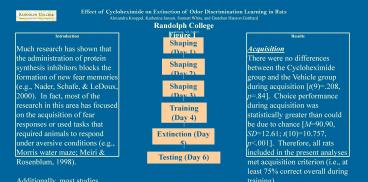
Figure 1
Introduction Much research has shown that the
administration of protein synthesis inhibitors
blocks the formation of new fear memories (e.g.,
Nader, Schafe, LeDoux, 2000). In fact, most of
the research in this area has focused on the
acquisition of fear responses or used tasks that
required animals to respond under aversive
conditions (e.g., Morris water maze Meiri
Rosenblum, 1998). Additionally, most studies
examining the effects of blocked protein
synthesis have examined acquisition of a
completely new response, rather than extinction
of an already-established response. A small
number of studies have begun to examine the
effects of protein synthesis inhibition on
extinction (Lattal Abel, 2001 Suzuki, et al.,
2004) however, the results have been mixed and
have been conducted with aversive tasks only
(e.g., fear conditioning and the water maze).
The present studied used an appetitive odor
discrimination digging task (Bunsey Eichenbaum,
1996) to examine the effects of a protein
synthesis inhibitor (cycloheximide) on extinction
in rats. Considering extinction is similar to
acquisition in that it also involves new
learning, it was hypothesized that protein
synthesis inhibition would block extinction and
produce continued high levels of responding
during testing.
Results Acquisition There were no differences
between the Cycloheximide group and the Vehicle
group during acquisition t(9).208, p.84.
Choice performance during acquisition was
statistically greater than could be due to chance
M90.90, SD12.61 t(10)10.757, plt.001.
Therefore, all rats included in the present
analyses met acquisition criterion (i.e., at
least 75 correct overall during training).
Extinction All rats met the extinction
criterion in three or less extinction trials
(i.e., no digging for 30 consecutive seconds).
Testing There were no differences in preference
scores for the Cycloheximide group (Test 1
M.37, SD.50 Test 2 M.33, SD.52) and the
Vehicle group (Test 1 M.00, SD.00 Test 2
M.20, SD.45) on Test 1 t(9)1.636, p.136, or
Test 2 t(9).452, p.662 (see Figure 2). The
Cycloheximide group Test 1 t(5)1.808, p.13
Test 2 t(5)1.581, p.175 and the Vehicle group
Test 2 t(4)1.00, p.374 did not differ from
chance on all test trials (see Figure 2).
Shaping (Day 1) One cup of unscented sand (two
trials)
Shaping (Day 2) Two cups of unscented sand (two
trials)
Shaping (Day 3) Two cups of unscented sand (six
trials)
Training (Day 4) Trained on one odor
discrimination (at least six trials with 75
correct total)
Extinction (Day 5) Extinction trials for the odor
discrimination (at least two trials)
Testing (Day 6) Two test trials for odor
discrimination
2
- Discussion
- Rats learned to dig in the correct odor and
showed a statistically significant preference for
it in both groups during acquisition. - Administration of a protein synthesis inhibitor
(cycloheximide) during extinction did not block
memory for extinction (as indicated by preference
scores that did not differ from chance during
testing). - Results suggest that protein synthesis may not be
critical for the new learning associated with
extinction in an appetitive odor discrimination
task.
Method Subjects Ninety-day old, male Long-Evans
rats (N11) were reduced to and maintained at 85
of their free-feeding weights one week prior to
and during experimentation. Water was available
ad libitum. Rats were maintained on a 12-hour
light/dark cycle. Apparatus All shaping,
training, and testing took place in the rats
home cages. Plastic Nalgene cups (125 ml size)
were used for the odor discriminations and were
mounted using Velcro onto rectangular Plexiglas
bases. Odor discriminations were created by
mixing play sand (148.5 grams) with different
dried spices (i.e., 1.5 grams of cocoa or
cinnamon). Procedure Rats were shaped to dig in
unscented cups of sand for three days prior to
training (10 shaping trials total see Figure 1
for shaping, training, and testing procedure).
Rats received one day of training during which
they learned one odor discrimination. One day
following training, rats received at least two
extinction trials for the odor discrimination
with a 1 mg/kg cycloheximide injection (n7) or a
vehicle injection (n6). Twenty-four hours later,
rats received two test trials.
References Bunsey, M. Eichenbaum, H. (1996).
Conservation of hippocampal memory function in
rats and humans. Nature, 379, 255-257. Lattal,
K. M. Abel, T. (2001). Different requirements
for protein synthesis in acquisition and
extinction of spatial preferences and
context-evoked fear. The Journal of
Neuroscience, 21(15), 5773-5780. Meiri, N.
Rosenblum, K. (1998). Lateral ventricle injection
of the protein synthesis inhibitor anisomycin
impairs long-term memory in a spatial memory
task. Brain Research, 789, 48-55. Nader, K.,
Schafe, G. E., LeDoux, J. E. (2000). Fear
memories require protein synthesis in the
amygdala for reconsolidation after retrieval.
Nature, 406, 722-726. Suzuki, A., Josselyn, S.
A., Frankland, P. W., Masushige, S., Silva, A.
J., Kida, S. (2004). Memory reconsolidation
and extinction have distinct temporal and
biochemical signatures. The Journal of
Neuroscience, 24(20), 4787-4795.
Recommended

