

Survey of Common Types I PowerPoint PPT Presentation
1 / 7
Title: Survey of Common Types I
1
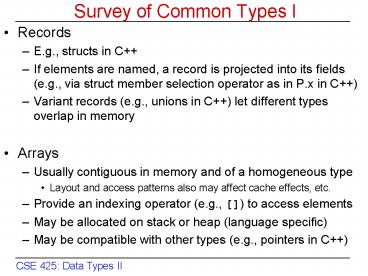
Survey of Common Types I
- Records
- E.g., structs in C
- If elements are named, a record is projected into
its fields (e.g., via struct member selection
operator as in P.x in C) - Variant records (e.g., unions in C) let
different types overlap in memory - Arrays
- Usually contiguous in memory and of a homogeneous
type - Layout and access patterns also may affect cache
effects, etc. - Provide an indexing operator (e.g., ) to access
elements - May be allocated on stack or heap (language
specific) - May be compatible with other types (e.g.,
pointers in C)
2
Survey of Common Types II
- Utility types (e.g., strings, sets, lists,
files) - Widely used but not necessarily inherent to a
language itself - Sometimes built into the language (e.g., Pascal)
- E.g., set operators (, , -) for union,
intersection, and difference - Sometimes provided by a library (e.g., the C
STL) - Strings
- Often just an array of characters (e.g., C style
char ) - Often an object with operators (e.g., C style
string) - Sets (similarly, lists)
- Contain unique values (or in the case of lists,
ordered sequences) of a common type - Files
- Streams of data coming from and/or going to
mass storage
3
Survey of Common Types III
- Recursive types
- May contain (an alias for) another instance of
the same type - E.g., a list node contains an alias for the next
node in the list - May require a pointer or other similar
abstraction - To halt the nesting (and/or construction) of
recursive type instances - Pointers and references
- Similar in some languages, different in others
- E.g., pointer/references semantics in Java vs.
C - Also may be similar to other types
- E.g., (const) pointer and array semantics in C
- E.g., address arithmetic vs. index arithmetic in
C
4
More about Type Constructors
- Used to construct sets from other sets
- E.g., as Cartesian products (tuples)
- If elements are named, a record is projected into
its fields (e.g., via struct member selection
operator as in P.x in C) - Specialized forms of type constructors are common
- Unions often are at best unnecessary in
object-oriented languages (or worse in C
certain examples can exhibit type problems
similar to those seen with reinterpret casting) - Subset type constructors narrow a set (e.g., in
Ada to construct a sub-range type from a range
type) - Array constructors project an index type into
another type - Pointer/reference constructors create aliases for
other types (pointers have their own operators
but references do not)
5
Type Checking with Polymorphism
- Hindley-Milner type checking
- Strongly typed functional languages (ML and
Haskell) do this - Unambiguous (deductive) type inference, by
propagating constraints and info up and down an
abstract parse tree - Relies on specific forms of instantiation and
unification - Different types of polymorphism
- Parametric (interface) polymorphism
- Explicit subtype (inheritance) polymorphism
- Liskov substitution principle whenever S is a
subtype of T, wherever you need an instance of T
you can use one of S - Occurs-check in unification
- Makes sure a variable isnt in an expression
substituted for it - Difficult to do efficiently, only use if
necessary (it is for H-M)
6
Explicit Polymorphism of Data
- Relies on syntax to declare forms of polymorphism
that cannot be handled implicitly as in previous
cases - E.g., declaring polymorphic data structures
- Essentially, they provide user-defined type
constructors - E.g., in C/C function pointer and array
typedefs - Explicit parametric polymorphism
- Explicit declaration of type parameters (e.g.,
C templates) can be used to make data types
generic over other types - In C calls to function templates are resolved
implicitly but template objects require concrete
type parameter declaration - Expressions within parameterized
functions/methods impose constraints on the
parameterized types (concept/models relation in
generic programming, see Austern on C STL)
7
Todays Studio Exercises
- Well code up ideas from Scott Chapter 7.3-7.9,
7.11 - Continuing our exploration of data types from
last time - Todays exercises are again in C
- C allows us to explore many type system issues
- Please take advantage of the on-line tutorial and
reference manual pages that are linked on the
course web site - As always, please ask us for help as needed
- When done, email your answers with Data Types
Studio II in the subject line, to the course
account - Send to cse425_at_seas.wustl.edu
Recommended

