

Ecosystem Health in Northern Aboriginal Communities in Manitoba PowerPoint PPT Presentation
Title: Ecosystem Health in Northern Aboriginal Communities in Manitoba
1
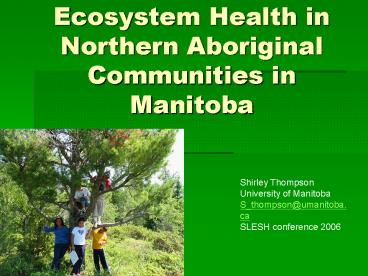
Ecosystem Health in Northern Aboriginal
Communities in Manitoba
Shirley Thompson University of Manitoba S_thompson
_at_umanitoba.ca SLESH conference 2006
2
Question
- Are sustainable livelihoods and Ecosystem health
approaches appropriate in Canada (for Northern
Aboriginal Communities)?
3
Agenda
- Introduction
- Health indicators
- Ecosystem health
- Case study TB and Housing
- Case study Water quality
- Conclusions
4
Four key challenges for an Ecosystem Approach to
Human Health
- finding a shared vision
- assuring community access
- gaining credibility and,
- measuring success.
5
Traditional Knowledge reveals the complexity of
traditional approaches to environmental systems.
Elder Robin Greene teaches the traditional ways.
Photo by Randy Paishk
6
(No Transcript)
7
Medicine Wheel
8
TO BE REPLACED BY UPDATED SLIDE
9
Community Food Security
- a condition in which all residents obtain a
safe, culturally appropriate, nutritionally sound
diet through an economically and environmentally
sustainable food system that promotes community
self-reliance and social justice! - Hamm Bellows
10
Health
- Not only the absence of disease but also the
extent to which an individual or group is able to
on the one hand to realize aspirations and
satisfy needs and on the other to change or cope
with the environment. - State of complete physical, mental and social
well-being and not merely the absence of disease
or infirmity. It is not an objective for
living, but a resource for everyday life. - WHO
11
Source Millenium Ecosystem Assessment
12
(No Transcript)
13
(No Transcript)
14
Age-standardized Leading Causes of Death, First
Nations (2000) and Canada (1999)
- Used to compare rates across groups with
different demographic characteristics - Reduces the effects of very old or young
population age differences
15
Potential Years of Life Lost (PYLL) by Cause of
Death, First Nations (2000) and Canada (1999)
Increased risk of suicide at all ages for First
Nations up to 65 years of age highest for young
males and females. Source Health Status of
First Nations in Canada (1999)
- Calculates the number of years of life lost
assuming an average lifespan of 75 years - Expressed as a rate per 100,000 population
(similar to death rates)
16
Infant Mortality Rates, Manitoba, 1991 to 2001
17
Life Expectancy at Birth, by Sex, First Nations
and Canada, 1980, 1990 and 2000
18
Projected Number of People with DiabetesMB First
Nations, 1996-2016
Source http//www.gov.mb.ca/health/publichealth/
epiunit/docs/storm.pdf
19
Diabetes Implications for Health Care
- Persons with diabetes account for
- 91 of lower limb amputations
- 60 of hospitalizations for heart disease
- 50 of hospitalizations for stroke
- 41 of hospital days
- 30 of all hospitalization
- (Strategy Steering Committee, 1998)
- First Nations patients with diabetes in Manitoba
have longer hospital stays with an increased
intensity of care, and there is an increase in
obstetrical admissions (Dow, 1999)
20
Health Facilities and Hospitals
21
NIHB Expenditures In Manitoba Region by Benefit
(FY 2003/2004
2.8M
48.5M
17.3M
5.6M
53.5M
Total 127.8 M
22
(No Transcript)
23
(No Transcript)
24
(No Transcript)
25
Environmental Change drivers
26
Case Study Housing
- Shelter Only 56.9 of homes in FN communities
adequate - (not needing major repair or replacement)
(1999/2000)
27
Pukatawagan Remediation
The houses condemned and knocked down because of
the fuel spill have not been replaced, leaving
only 299 residences for 2,600 people, with an
average of nearly nine occupants per house.
28
Rates of Tuberculosis, 1994 to 2004 in Manitoba
2004 Data is preliminary
29
Tuberculosis Notification Rates, by Community
Housing Density, First Nations, 1997-9
30
Host
Tuberculosis
Environment
Agent
31
Inadequate housing
32
Case study water quality
33
Determinants of Health Water and Sanitation
- Water Quality Only 41.4 of FN communities
reported at least 90 of homes connected to water
treatment plant (1999/20) - Sanitation Only 33.6 of FN communities had at
least 90 of homes connected to community sewage
disposal system (1999/2000) - Source A Statistical Profile on the Health of
First Nations in Canada, 2003, Statistics Canada
2001 Census
34
Difficulties with building adequate
infrastructure for Safe water on Reserves
- technical difficult and costly to develop
infrastructure in isolated areas, often having
difficult terrain (e.g., permafrost, swamp) and
often having drinking water source off-reserve - limited access to financing and recovery of costs
due to poor economic conditions - lack of qualified personnel in environmental
service delivery - high birth rates in these communities expanding
infrastructure needs rapidly and - unclear technical standards with limited support
for standards and enforcement mechanisms.
35
Why the safety of First Nations drinking water is
compromised?
- No laws and regulations govern the provision of
drinking water in First Nations communities. - INAC and Health Canada implement policies,
administrative guidelines, and funding
arrangements with First Nations inconsistently
and piecemeal. - Action with First Nation communities is not being
taken to - assess the capacity and support that
First Nations need to deliver safe drinking water
in their communities - establish the institution or institutions that
could consolidate these capacity-building and
support functions for all First Nations and - define the information needed to demonstrate that
the drinking water is safe (Gelinas 2005).
http//www.oag-bvg.gc.ca/domino/reports.nsf/html/c
20050905ce.html
36
Drinking water at risk in First Nations
communities
- In 2001, Indian and Northern Affairs (INAC) found
a significant risk to the quality or safety of
drinking water in three-quarters of the systems
(Gelinas 2005). - In Manitoba 5 northern First Nations are on
boil-water advisories one with a reported case of
E. coli contamination (Water Stewardship Branch
2005) - Assembly of Manitoba Chiefs spokesman, Michael
Hutchinson, reported that many as 25 Manitoba
First nations have varying degrees of water
quality problems (CanWest 2005). - Kashechewan First Nations story
http//www.cbc.ca/story/canada/national/2005/10/28
/kashechewan-evacuation051028.html
37
Multiple Barrier Approach to Safe Drinking Water
- (1) source the best possible raw water quality
should be maintained and protected - (2) treatment effective treatment should be
designed, operated and maintained - (3) distribution secure storage and distribution
of treated water should be provided - (4) monitoring appropriate and effective
monitoring should be performed - (5) response appropriate and effective responses
to adverse monitoring or adverse circumstances
are needed.
38
Thank you. Questions?
- Are sustainable livelihoods and Ecosystem health
approaches appropriate in Canada (for Northern
Aboriginal Communities)?
Recommended

