

Corneal Biomechanical Changes Following Surface Keratorefractive Surgery PowerPoint PPT Presentation
1 / 12
Title: Corneal Biomechanical Changes Following Surface Keratorefractive Surgery
1
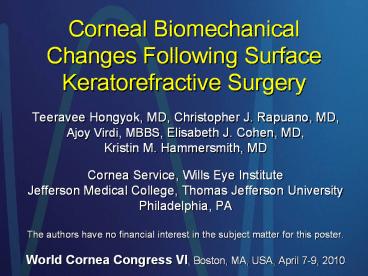
Corneal Biomechanical Changes Following Surface
Keratorefractive Surgery
- Teeravee Hongyok, MD, Christopher J. Rapuano, MD,
- Ajoy Virdi, MBBS, Elisabeth J. Cohen, MD,
- Kristin M. Hammersmith, MD
- Cornea Service, Wills Eye Institute
- Jefferson Medical College, Thomas Jefferson
University - Philadelphia, PA
- The authors have no financial interest in the
subject matter for this poster. - World Cornea Congress VI, Boston, MA, USA, April
7-9, 2010
2
Ocular Response Analyzer(ORA)
- The ORA is the only machine that can perform
direct - clinical assessment of corneal biomechanical
properties. - 4 main parameters are measured by ORA
- Corneal Hysteresis (CH) is the difference in
inward and outward applanation pressures (P1 and
P2). CH may reflect viscoelasticity of cornea. - Corneal Resistance Factor (CRF) may reflect
elasticity of cornea - Goldmann Correlated IOP (IOPG)
- Corneal Compensated IOP (IOPCC)
- The signal peak height and multiple oscillations
are changed in post-laser in situ keratomileusis
(LASIK) keratectasia eyes compared to the normal
post-LASIK eye (Glass DH, et al., ARVO 2008
E-abstract 646). - Using the new ORA software (version 2.04)
launched in 2009, the device can mathematically
describe the ORA waveform characteristics with 38
new parameters including height, slope,
area-under-the curve and waveform score.
Pictures from http//www.ocularresponseanalyzer.co
m/
3
Corneal Biomechanics in Keratoconus and after
Refractive Surgery
- CH and CRF have been found to be significantly
reduced in patients with keratoconus1,2 and
post-LASIK corneal ectasia3 - LASIK was also found to decrease CH and CRF.4-8
- The significant alteration of corneal
biomechanics may play a critical role in
development of this serious ectatic complication
after refractive surgery. - We hypothesized that surface ablation, which has
no stromal flap and leaves a thicker residual
stromal bed, would result in less change in
corneal biomechanics than LASIK.
1Luce JCRS 2005, 2 Kirwan Ophthalmologica 2008,
3Kerautret JCRS 2008, 4 Pepose AJO 2006, 5Ortiz
JCRS 2007, 6Chen JCRS 2008, 7Hamilton JCRS 2008,
8 Kirwan JCRS 2008
4
Purpose
- To evaluate pre- and post-operative changes in
corneal biomechanical properties - using the Reichert Ocular Response Analyzer (ORA)
- in patients who undergo surface keratorefractive
surgery.
5
Methods
- Prospective, non-randomized clinical trial
- Inclusion patients over the age of 18 who
planned to undergo surface keratorefractive
surgery on the Cornea Service at Wills Eye
Institute from November 2008 to February 2009 - IRB approved
- Data collection before surgery, 1 and 3 months
after surgery - Corneal thickness U/S (Accupach V) and optical
(Galilei) - Corneal topography Atlas 995 (Carl-Zeiss) and
Galilei (Ziemer) - Reichert ORA hardware version 3.0, software
version 2.04 - Basic biomechanics parameters and new waveform
parameters were analyzed.
6
Results
- 9 eyes of 5 male patients underwent custom
off-flap myopic epi-LASIK and completed 3 month
F/U (age 36 7.8 years).
Preoperative Postoperative Postoperative
1 month 3 months
UCVA logMAR SD (Snellen) 1.20 0.17 (20/316) -0.01 0.1 (20/20) -0.06 0.05 (20/17)
MRSE (D) -4.4 1.25 0.18 0.31 -0.21 0.36
Mean keratometry (mean SD, D) Mean keratometry (mean SD, D)
Atlas 43.80 0.44 40.07 1.03 40.50 0.99
Galilei 43.39 0.44 39.64 1.16 39.96 1.08
Laser ablation depth (µm) 60.67 17.2 60.67 17.2 60.67 17.2
Pachymetry (mean SD, µm) Pachymetry (mean SD, µm)
U/S (Accupach V) 549 31 467 37 495 27
Optical (Galilei) 560 29 495 32 503 34
7
Basic Corneal Biomechanics Parameters Changes
after Epi-LASIK
P lt 0.05 (Wilcoxon Signed Rank Test)
8
Corneal Hysteresis Changes after Laser Refractive
Surgery compared to other studies
9
Corneal Resistance Factors Changes after Laser
Refractive Surgery compared to other studies
10
New Waveform Parameters Significant Changes in 9
of 38 (plt0.05)
- Decreased overall Waveform Score
Sample of Signal Overlay of Preoperative ORA and
Postoperative ORA
11
Conclusions
- Epi-LASIK, a surface ablation procedure,
significantly reduced corneal hysteresis and
corneal resistance factor. - Unexpectedly, the magnitude of reduction seems to
be similar to LASIK from previous publications. - It appears that corneal thickness is more
important than the flap creation on the corneal
biomechanics. - Waveform analysis also found significant changes
in both peak 1 and peak 2 and a decrease in
overall waveform score after surface ablation.
12
Conclusions
- A marked decline in these parameters may reflect
changes in the viscous and elastic qualities of
the cornea after surface ablation. - Future work is needed to determine whether
differences in these corneal biomechanical
parameters are useful in detecting patients who
are at risk to develop post-refractive surgery
ectasia, even after surface ablation.
Recommended

