

SS6H7A The Russian Revolution PowerPoint PPT Presentation
1 / 34
Title: SS6H7A The Russian Revolution
1
SS6H7AThe Russian Revolution
- Before 1917, Russia was an
- autocracy
- The Czar was the absolute ruler
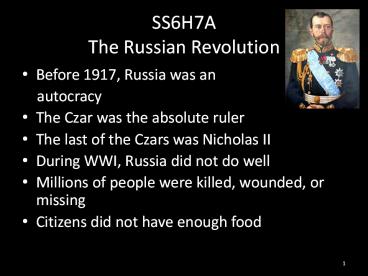
- The last of the Czars was Nicholas II
- During WWI, Russia did not do well
- Millions of people were killed, wounded, or
missing - Citizens did not have enough food
2
SS6H7A
- Soldiers did not have enough
- clothes, shoes, or weapons
- Germany seemed to be winning the war
- The Czar ignored the signs that people were
unhappy - He did not see that changes were needed in the
way that his country was run
3
SS6H7A
- In early 1917, there were
- riots in the streets
- women, factory workers,
- and farmers shouting
- for change outnumbered
- police
- The military could not keep the peace
4
SS6H7A
- Many in the Czars army turned against the rulers
- The Czar and his family
- were captured
- A government was set up to
- try to run the country, there
- were too many problems
5
SS6H7A
- There was another revolution
- Communists led by Vladimir
- Lenin
- The Czar and his family were
- executed
- Lenin reorganized the country
- and renamed it the Soviet
- Union
6
SS6H7A
- The soviets gave up a large amount of land to
Germany - This land was good for farming and had many
natural resources - The soviets had little choice, their country was
falling apart around them
7
SS6H7ATreaty of Versailles
- Versailles is a grand palace
- outside the city of Paris,
- France
- At the end, of WWI, leaders
- from the countries involved
- in the war met there to
- write a treaty
8
SS6H7A
- The Treaty of Versailles
- explained what the
- winners would gain and
- what the losers would
- lose
9
SS6H7A
- Many of the leaders of the
- winning countries blamed
- Germany for the war
- They wanted the Germans
- punished severely
- Germany lost important territory, including
- lands rich in natural resources
10
SS6H7A
- It also lost all of its
- colonies
- German Emperor Wilhelm
- II was to be put on trial
- for war crimes
- France and Great Britain
- wanted to make sure that Germany could not
- attack them again
11
SS6H7A
- Their goal was to make Germany a weak country
- Germany had to reduce the size of its army and
navy
12
SS6H7A
- France lost a lot in the
- war
- Over 2 million French
- people lost their lives
- A large part of the war was fought in France
- Farms, houses, cities, and industries were
destroyed
13
SS6H7A
- Highways, bridges, and railroads had to be
rebuilt - The allies added a part to the treaty that said
Germany had to pay the allies a very large amount
of money - This money was to be used to repay civilians who
lost property because of the war
14
SS6H7AWorld Wide Depression
- After WWI, most countries in the world began to
prosper - Americans enjoyed a time called
- the Roaring Twenties
- People felt good about the economy
- They believed that they had a chance
- to do well
- In 1929, the good times ended
15
SS6H7A
- In the fall of 1929, the U.S.
- experienced a stock market
- crash
- The value of stocks (shares of
- ownership) people held in companies began a
steep and quick drop - Stockholders realized that they were in danger
- of losing everything they owned
16
SS6H7A
- They began to sell their stocks as fast as they
could - Since there were more sellers than buyers, the
prices continued to fall
17
SS6H7A
- Businesses found they could no longer sell their
goods because people had less money to spend - The business could not pay their debts
- When businesses could not pay their debts, they
had to close
18
SS6H7A
- This meant workers lost their jobs, these events
happened so quickly that a panic occurred - People tried to get to their banks to get their
money, and they tried to sell their stocks for
any amount they could get
19
SS6H7A
- Panic selling and a run on the bank caused the
economy of the U.S. to come to a halt - Farmers who could not get money to pay their
loans lost their farms
20
SS6H7A
- Businesses around the world traded with America
- When the U.S. stopped buying goods, it hurt
businesses in other countries - When U.S. banks closed, banks in other countries
were hurt too
21
SS6H7A
- Stockholders in other countries began to sell
their stocks for low prices - They could not sell their stocks in American
companies for any price - What followed was called a worldwide economic
depression - As businesses and factories closed one by one,
buying and selling almost stopped
22
SS6H7A
- Germany faced many
- problems after WWI
- It had lost lands that
- contained valuable natural
- resources
- 2.5 million Germans lost
- their lives
23
SS6H7A
- 4 million were wounded
- Industry and farms in the country had been
destroyed - Highways, bridges, and railroads had to be rebuilt
24
SS6H7A
- The German government worked to solve the
countrys problems - The largest obstacle was it had to pay back the
Allied countries for the war - Millions of dollars were leaving Germany for
France and Great Britain - Germany was forbidden to have a large army and
navy, so many military people lost their jobs
25
SS6H7A
- Prices went up as goods
- became scarce
- Basic items such as food,
- and clothing were not
- always available
- Men had trouble finding jobs to support their
- families
26
SS6H7A
- People blamed the government
- They wanted their leaders to find solutions to
their problems - When the stock market crashed in the U.S. this
made conditions even worse for Germans
27
SS6H7A
- Adolf Hitler came on the scene
- with a big plan
- He and his followers, called the Nationalist
- Socialist or Nazi Party said they could fix
the problems in Germany - Germans blamed the Treaty of Versailles for
- many of the problems
28
SS6H7A
- They also said that Jews in
- the country were controlling
- the banks and money
- They blamed Jews for the fact that many
- Germans were not able to make a good living
29
SS6H7A
- Hitler was named Chancellor of
- Germany in 1933
- He mad sure that laws were
- quickly passed to give him more
- power
- Soon he had complete control of the
- government
30
SS6H7A
- He had the powers of a
- dictator
- He and the Nazis began to
- rebuild Germanys military
- He opened factories to build
- weapons
31
SS6H7A
- He put unemployed people to
- work building a super highway
- system
- The economy improved, but people lost many
- of their civil rights
- Many Germans decided that it was better to
- lose rights than to go without food
32
SS6H7A
- Germans who spoke
- against the Nazis were put
- in prison or murdered
- As Hitlers strength grew, he
- made plans to go to war
- In 1936, Hitler sent troops into some of
- Germanys former territories
33
SS6H7A
- By 1938, German troops
- controlled Austria and
- Czechoslovakia
- European countries protested, but did
- nothing to stop Hitler
- In 1939, Germany invaded Poland
34
SS6H7A
- France and England
- decided something must be
- done, they declared war on
- Germany, WWII began
Recommended

