

Escaping the Pesticide Trap: Non-Pesticide Management in India Ingredients for Success PowerPoint PPT Presentation
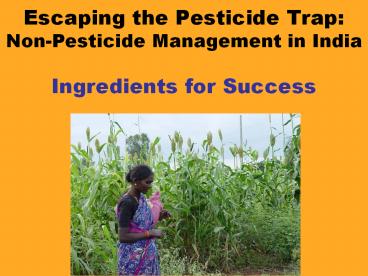
Title: Escaping the Pesticide Trap: Non-Pesticide Management in India Ingredients for Success
1
Escaping the Pesticide TrapNon-Pesticide
Management in IndiaIngredients for Success
2
The Crisis The Beginnings
- Cotton production spread among small farms as a
cash crop. - Cotton required chemical insecticides and
fertilizers new to - these farmers!
- Commercial dealers (a) sold seeds and
chemicals on credit - (b) guaranteed purchase of cotton crop (c)
provided information - about use from multinational corporate
suppliers. - Early years made profit because cotton pests
had not moved in.
3
The Crisis The Trap
- Cotton pests plagued fields, requiring regular
spraying. - Weak pests died while resistant pests lived and
multiplied. - Farmers reacted by spraying more pesticides
more often. - Insecticides killed predators birds, wasps,
beetles, spiders. - Without predators, forced to spray or the
harvest would be lost. - Insecticides damaged soil, requiring more
chemical fertilizers.
4
The Crisis The Decline
- Input expenses went up so much farmers lost
money on cotton. - Farmers debt deepened since inputs were bought
on credit. - Desperation led to illegal side-jobs
indentured labor for kids. - Education was set aside, assuring continued
cycle of poverty. - Insecticide poisoning spread illness, hospital
bills, death. - Farmers trapped in cotton production because
agrochemical - dealers required full debt repayment if they
stopped buying. - Suicide rate soared to highest in India as debt
escalated.
5
Non-Pesticide Management (NPM)
- Scientists devised system for using no chemical
insecticides. - Planting Neem trees, which have natural insect
repellants. - Applying Neem leaf/seed solution, chili-garlic
solution, - cow dung and urine to repel pests.
- Fighting pests by applying naturally occurring
viruses.
6
Non-Pesticide Management (NPM)
- Planting trap crops that lure away insect
pests. - Burning heavily infested branches.
- Using colorful sticky boards to trap pests.
- Lighting small bonfires to kill bollworm moths.
- Building bird perches to attract insect-eating
birds. - Plowing deeply between crops to wipe out pest
pupae in soil.
7
Outside stimulation and facilitation
- Venu Madhav came to Punukula as worker for NGO
SECURE. - Took villagers to distant farm that used NPM.
- Scientists put together a package of NPM
methods. - SECURE found and coached a villager willing to
risk NPM. - Two SECURE staff members stayed in Punukula to
help. - After Punukula success, Center for Sustainable
Agriculture - trained women in several thousand other
villages to use NPM.
8
Strong local democratic institutions and enduring
commitment of local leadership
- First adopter Margam Mutthaiah -- strong and
dedicated leader - NPM grew in a widening circle until entire
village used it. - Village council and farmers association
supported and helped. - Women pressured men to use NPM and prepared
materials. - NPM spread to existing women self-help groups
across region.
9
Co-adaption between social system and ecosystem
- Farmers organized to make eco-friendly NPM a
reality. - Farmers used local Neem trees instead of costly
insecticides. - Improved health of people and ecosystem.
- Soil nourished by Neem cakes and animal dung.
- NPM techniques allowed birds and livestock to
thrive. - Instead of chemical fertilizers they started
vermi-composting.
10
"Letting nature do the work"
- NPM methods repelled, trapped or killed pests.
- Neem leaves and seeds contain natural insect
repellants. - Repellants affected specific pests and didnt
harm other life. - Pests could not build resistance to such
diverse methods. - Birds and pest predators returned, so less Neem
needed. - Putting Neem cakes in soil improved nitrogen
content.
11
Rapid results
- First seasons harvest with NPM as big as with
insecticides. - Immediate and dramatic drop in production
costs. - The next year (1998), 20 farmers joined in
using NPM. - Within a few years, farmers cleared their
debts. - By 2004, village council declared Punukula
pesticide-free. - By 2008, 340,000 farmers in 3170 villages using
NPM.
12
Overcoming social obstacles
- Insecticide dealers demanded full debt payment
if farmers - stopped buying insecticides.
- Farmers banded together to fight this demand.
- Dealers punished NPM users by paying less for
their cotton. - Farmers formed a marketing cooperative and
found fair prices. - Convinced State to ignore corporate lobbyists
support NPM.
13
Social and ecological diversity
- Punukula farmers received a diversity of
technical assistance. - The Neem tree has a variety of natural
pesticides and defenses - which prevent development of resistance by
pests. - Used a diversity of NPM methods for unique
qualities of pests. - Diversity of pest predators restored natural
controls!
14
Social and ecological memory
- Neem traditionally used in health beauty
products and to - protect stored grains from pest insects.
- NPM used ecological memory of birds and pest
predators.
15
Building Resilience
- Healthier society and ecosystem helped sustain
their gains in - the face of unexpected challenges.
- Pesticide poisoning stopped and health and
vitality returned. - Less spent on agricultural chemicals and
hospitals allowed - farmers to pay off debts and achieve
financial resilience. - Children rescued from indentured servitude
started schooling. - Commitment secured by teaching NPM in schools
and training - women in self-help groups across the region.
16
Building Resilience
- Women built income making and selling NPM
materials. - Farmers expanded to new crops and businesses.
- Success bred confidence, solidarity stronger
social support. - Community united and made demands on
government. - Villagers worked on community projects, such as
purifying - village water setting up a cotton gin to
boost income.
Recommended

