

New Approach to RFID Reading and Writing via Wireless Control PowerPoint PPT Presentation
1 / 1
Title: New Approach to RFID Reading and Writing via Wireless Control
1
New Approach to RFIDReading and Writing via
Wireless Control
Introduction The National Science Foundation
WIMS program requested Team 5 develop a
wirelessly controlled Radio Frequency
Identification (RFID) system to educate high
school students. Wireless control liberates
the traditional immobile tag reader. The RFID
system now becomes a viable option for an
expanded array of inventory control and asset
tracking applications.
Abstract The NSF WIMS program educates K-12
students on emerging technologies in
collaboration with Michigan State University, the
University of Michigan, and Michigan
Technological University. Our team developed a
wirelessly controlled reader/writer system that
will be used to demonstrate cutting edge RFID
technology.
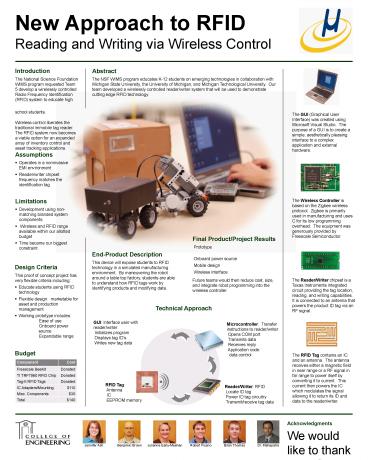
The GUI (Graphical User Interface) was created
using Microsoft Visual Studio. The purpose of a
GUI is to create a simple, aesthetically pleasing
interface to a complex application and external
hardware.
- Assumptions
- Operates in a noninvasive EMI environment
- Reader/writer chipset frequency matches the
identification tag
- Limitations
- Development using non-matching branded system
components - Wireless and RFID range available within our
allotted budget - Time became our biggest constraint
The Wireless Controller is based on the Zigbee
wireless protocol. Zigbee is primarily used in
manufacturing and uses C for its low programming
overhead. The equipment was generously provided
by Freescale Semiconductor.
- Final Product/Project Results
- Prototype
- Onboard power source
- Mobile design
- Wireless interface
- Future teams would then reduce cost, size, and
integrate robot programming into the wireless
controller.
End-Product Description This device will expose
students to RFID technology in a simulated
manufacturing environment. By maneuvering the
robot around a table top factory, students are
able to understand how RFID tags work by
identifying products and modifying data.
- Design Criteria
- This proof of concept project has
- very flexible criteria including
- Educate students using RFID technology
- Flexible design marketable for asset and
production management - Working prototype includes
- Ease of use
- Onboard power source
- Expandable range
The Reader/Writer chipset is a Texas Instruments
integrated circuit providing the tag location,
reading, and writing capabilities. It is
connected to an antenna that powers the product
ID tag via an RF signal.
Technical Approach
- GUI Interface user with reader/writer
- Initializes program
- Displays tag IDs
- Writes new tag data
- Microcontroller Transfer instructions to
reader/writer - Opens COM port
- Transmits data
- Receives reply
- Application code
- data control
Budget
The RFID Tag contains an IC and an antenna. The
antenna receives either a magnetic field in near
range or a RF signal in far range to power itself
by converting it to current. This current then
powers the IC which modulates the signal allowing
it to return its ID and data to the reader/writer.
- RFID Tag
- Antenna
- IC
- EEPROM memory
- Reader/Writer RFID
- Locate ID tag
- Power ID tag circuitry
- Transmit/receive tag data
Acknowledgments We would like to thank the NSF
WIMS program for a great idea and generous
funding. Thank you, Mike Varney, for all your
assistance.
Recommended

