

Graded potentials on the postsynaptic membrane: depolarization and hyperpolarization ligandgated mec PowerPoint PPT Presentation
1 / 12
Title: Graded potentials on the postsynaptic membrane: depolarization and hyperpolarization ligandgated mec
1
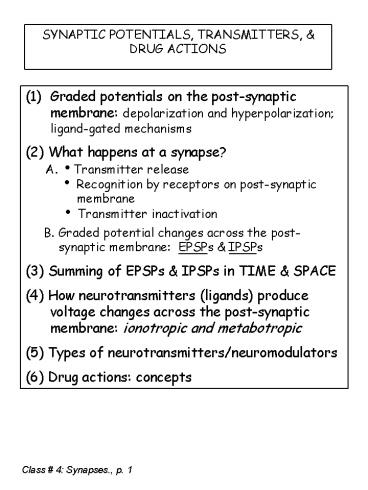
SYNAPTIC POTENTIALS, TRANSMITTERS, DRUG ACTIONS
- Graded potentials on the post-synaptic membrane
depolarization and hyperpolarization
ligand-gated mechanisms - (2) What happens at a synapse?
- A. ?Transmitter release
- ? Recognition by receptors on post-synaptic
- membrane
- ? Transmitter inactivation
- B. Graded potential changes across the post-
- synaptic membrane EPSPs IPSPs
- (3) Summing of EPSPs IPSPs in TIME SPACE
- (4) How neurotransmitters (ligands) produce
voltage changes across the post-synaptic
membrane ionotropic and metabotropic - (5) Types of neurotransmitters/neuromodulators
- (6) Drug actions concepts
Class 4 Synapses., p. 1
2
Graded membrane potentials
These graded deploarizations (EPSPs) and
hyperpolarizations (IPSPs) are brought about by
the movement of ions across channels of the
membrane. The type of channel involved is the
ligand-gated channel, which is activated by a
neurotransmitter at a synapse.
Class 4 Synapses., p. 2
3
What happens at a synapse?
Class 4 Synapses., p. 3
4
EPSPs bring the membrane potential closer to its
threshold for an action potential (i.e.,
depolarizes). IPSPs bring membrane further from
threshold (i.e., hyperpolarizes).
Class 4 Synapses., p. 4
5
SUMMATION OF EPSPs and IPSPs in time and space
Class 4 Synapses., p. 5
6
AN EXERCISE ON SUMMATION (to be done in class)
Class 4 Synapses., p. 6
7
LIGAND-GATED ACTIONS on the post-synaptic
membrane
SOME MAY BE VOLTAGE-GATED AS WELL AS
LIGAND-GATED i.e., transmitter action will not
occur unless the membrane voltage has also
changed in the required way.
Class 4 Synapses., p. 7
8
EXAMPLES of different types of synaptic effects,
and of the fact that neurotransmitters do not
always have the same effect on the post-synaptic
membrane. What happens depends on the
receptor-ligand combination, the type of ion that
crosses the membrane, and its direction of
movement IONOTROPIC direct action on ion
channels ?Acetylcholine (ACh) acts on several
types of nicotinic ionotropic receptors. At
receptors in CNS and skeletal muscle, ACh opens
Na channels ? EPSP at nictotinic receptors in
cardiac muscle, ACh opens K receptors ?
IPSP ?Glutamate acts on at least 4 types of
receptors (3 of which are ionotropic). For one
major type (the AMPA receptor), glutamate opens
Na channels ? EPSP ?GABA acts on many types of
receptors. For the GABAA type, it opens CL-
channels ? IPSP METABOTROPIC indirect action on
ion channels via G-protein and sometimes also a
second messenger. ?Norepinephrine (NE) acts on
at least 4 types of receptors (?1, ?2 , ?1 ,
?2), all metabotropic. For both beta types, it
closes K channel, extending the duration of
EPSPs.
(1) The binding of NE to the receptor activates a
G-protein in the membrane. (2) The G-protein
activates the enzyme adenylyl cyclase. (3)
Adenylyl cyclase converts ATP into the second
messenger cAMP. (4) cAMP activates a protein
kinase. (5) the protein kinase causes a K
channel to close by attaching a phosphate group
to it.
Class 4 Synapses., p. 8
9
TYPES OF NEUROTRANSMITTERS and NEUROMODULATORS
Class 4 Synapses., p. 9
10
SOME FACTORS THAT DETERMINE SYNAPTIC
ACTION (drugs can influence all these factors
except the first)
Location of synapse relative to axon
hillock. Nature/quantity of channels and
receptors. What transmitter is released,
(and how much). Which receptors are located on
post-synaptic membrane (and how many). How the
transmitter is stored and delivered to
synaptic cleft. Transmitter recognition by the
receptors (and the effect of recognition
direct vs indirect) If if indirect, which
G-proteins and second messengers are
involved. Transmitter inactivation reuptake,
enzyme degra- dation, diffusion, uptake into
glia, uptake into post-synaptic
cell. Synthesis of transmitters and inactivators.
Class 4 Synapses., p. 10
11
DRUGS and their ACTIONS (definitions)
Ligand A molecule that binds with the binding
site of a receptor. Agonist A ligand that binds
with and activates a receptor (or that mimics or
increases the effects of the typical ligand for
that the receptor) Affinity the strength by
which the agonist binds to
(attaches to) the receptor Efficacy the
intensity of the agonist-
produced receptor activation. Antagonist A drug
that opposes or blocks the effects of a
particular ligand on a receptor. Pharmacokinetics
How the body acts on the drug (processes by
which it is absorbed, distributed, metabolized,
and excreted). Pharmacodynamics How the drug
acts on the body (processes by which it exerts
its actions).
Class 4 Synapses., p. 11
12
DRUGS and their ACTIONS (definitions contd)
CONSENSUS STATEMENT 2001 by the American Academy
of Pain Medicine, American Pain Society, American
Society of Addiction Medicine.
Addiction a primary, chronic, neurobiologic
disease, with genetic psychosocial, and
enviornmental factors influenceing its
development and manifestations. It is
characterized by behaviors that include one or
more of the following imparied control over drug
use, compulsive use, continued use despite harm,
and craving. Physical Dependence a state of
adaptation that is manifested by a drug
class-specific withdrawal syndrome that can be
produced by abrupt cessation, rapid dose
reduction, decreasing blood level of the drug,
and/or administration of an antagonist.
Tolerance a state of adaptation in which
exposure to a drug induces changes that result in
a diminution of one or more of the drugs effects
over time.
Class 4 Synapses., p. 12
Recommended

