

AIA/HMI Science Meeting, Monterey, Feb-2006 PowerPoint PPT Presentation
Title: AIA/HMI Science Meeting, Monterey, Feb-2006
1
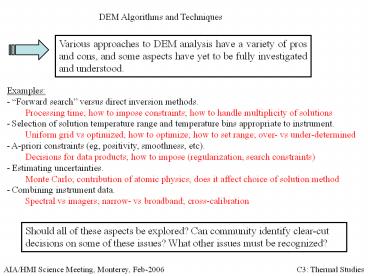
DEM Algorithms and Techniques
Various approaches to DEM analysis have a variety
of pros and cons, and some aspects have yet to be
fully investigated and understood.
- Examples
- Forward search versus direct inversion
methods. - Processing time how to impose constraints how
to handle multiplicity of solutions - - Selection of solution temperature range and
temperature bins appropriate to instrument. - Uniform grid vs optimized how to optimize how
to set range over- vs under-determined - A-priori constraints (eg, positivity,
smoothness, etc). - Decisions for data products how to impose
(regularization, search constraints) - Estimating uncertainties.
- Monte Carlo contribution of atomic physics does
it affect choice of solution method - Combining instrument data.
- Spectral vs imagers narrow- vs broadband
cross-calibration
Should all of these aspects be explored? Can
community identify clear-cut decisions on some of
these issues? What other issues must be
recognized?
AIA/HMI Science Meeting, Monterey, Feb-2006
C3 Thermal Studies
2
DEM Science
New types of investigations in coronal physics
will be possible with SDO data and
state-of-the-art DEM techniques.
- Benefits of Thermal Maps
- Distinguish structures along LOS.
- Catch plasma evolving through temperature bins
- distinguish temperature changes vs plasma flows.
- Locations and magnitudes of heating and cooling.
- Topology and connectivity (and helicity?).
- - Relation to EVE irradiance.
What science does community hope to do with SDO
(and other) thermal maps? What new science can be
done with regular, whole-Sun, thermal maps?
AIA/HMI Science Meeting, Monterey, Feb-2006
C3 Thermal Studies
Recommended

