

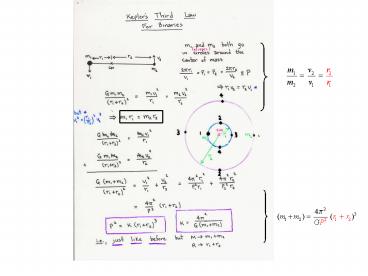
So if you can measure P, r1, and r2, PowerPoint PPT Presentation
1 / 38
Title: So if you can measure P, r1, and r2,
1
(No Transcript)
2
So if you can measure P, r1, and r2, you can
determine m1 and m2.
3
(No Transcript)
4
pc 206265 AU radian 206265 arc sec
s
r
if distance is in pc and angle is in arc sec, s
comes out in AU
5
Spectroscopic Binaries
6
(away)
Star 2
Star 1
(toward)
Complication The viewing angle
7
(No Transcript)
8
(No Transcript)
9
Complication The Inclination Angle
Only if i 90 degrees do we measure the
full velocity.
Let i be the angle of the observer relative to
the rotation axis, i.e., i 0 if we re along the
axis.
Measure v Sin i which is a lower bound to v.
To Observer
i
v
10
In the event that m ltlt M and we measure only one
velocity (for M), then it can be shown that what
we measure is m sin i (not m sin3 i). Let r1 be
the radius of the orbit of M.
f(m) is sometimes called the mass function.
11
Eclipsing Binary
12
(No Transcript)
13
(No Transcript)
14
(No Transcript)
15
(No Transcript)
16
(No Transcript)
17
(No Transcript)
18
(No Transcript)
19
(No Transcript)
20
Getting Planet Masses
Measure v velocity of parent star
P Period M mass of
parent star (known
from spectral type)
rp radius of planets orbit
r ltlt rp M gtgt mp
Note since it is easier to measure larger v
than small v, this makes it easier to detect
planets with short periods and higher masses. A
larger planet mass makes r greater. A short
period implies the planet is closer to the star.
21
Correcting for Viewing Angle
In the event that m ltlt M and we measure only one
velocity (for M), then it can be shown that what
we measure is m sin i (not m sin3 i). Let r1 be
the radius of the orbit of M.
f(m) is sometimes called the mass function.
22
A planet with a 3.097 day period around a star
similar to the sun HD 187123. Data from Keck.
note the velocities are much greater than for
Jupiter around the sun. The planet is more
massive or closer to its star or both. Compare
this Period to that of Mercury, 89 days.
23
As observed from Lick Observatory between October
11, 1995 and December 1996. The period is 4.231
- 0.001 days. The mass of the planet M Sin i
0.45 Jupiters.
24
(No Transcript)
25
69
1.89
3.75
Star Type F8V 13.47 pc
26
Most of the planets that are detected have high
mass (around that of Jupiter) and are near their
parent star.
27
(No Transcript)
28
(No Transcript)
29
Inclinations around 80 90 degrees are from
transits smaller angles are estimated e.g., from
the orientation of known dusty disks
30
(No Transcript)
31
(No Transcript)
32
(No Transcript)
33
(No Transcript)
34
Moons orbiting giant planets in the
habitable zone could have earth-like properties
art by Lynette Cook.
HD 177830b moon
35
(No Transcript)
36
(No Transcript)
37
(No Transcript)
38
(No Transcript)
Recommended

