

Pr PowerPoint PPT Presentation
1 / 1
Title: Pr
1
Holographic ART approach for Simulation of
protein flexibility
Lilianne Dupuis1, Normand Mousseau2 (1)
Département de biochimie, (2) Département de
physique, (1, 2) and Centre Robert-Cedergren,
Université de Montréal, Montréal, Québec, Canada
ABSTRACT We need to study protein flexibility
for a better understanding of its function.
Flexibility determines how a conformation changes
when the protein enters in contact with a ligand
for enzymatic purposes or with other proteins
during formation of complexes. In the protein
organization, we can distinguish highly regular
regions, or secondary structures, linked together
by irregular loops. In our approach, we compute
secondary structure movement as elastic blocks.
Complex movements are then reserved to the
irregular parts. This allows us to avoid local
changes when we travel in the conformation space
during the simulations. Secondary structures can
easily be reevaluated on the fly between each
event, allowing us to perform dynamical coarse
graining. We use a real force field to perform
these moves, computing consensus block forces
from atomic forces. Tests on a single set of
pivots have established that the optimal pivot is
not always near the border between the all-atom
and an elastic block or secondary structure. We
get better results by performing a dynamic
optimization of the pivot placement all along the
simulation. This can be done by establishing a
distinction between coarse graining and ensemble
move. In protein, a long-range move always
implies a sensible change of the torsion angles ?
and ? bordering one or several CA of the main
chain. For each CA pivots in the flexible areas,
the entire protein part that is preceding it may
swivel relatively to the entire protein part
following it. We therefore reformulate the ART
convergence method a holographic view of the
molecule forces for each free CA pivots
viewpoint, enhancing the detection of the ? and ?
angles modifications that serve the best interest
of the whole molecule.
ART nouveau (Activation Relaxation Technique)
Computing speed is one of our main goals. We use
an activated method for the simulation of
conformation change events. ART is characterized
by its ability to seek for energetically
favorable passages between molecular
conformations, each of them associated to a local
minima. It has been used with success for glasses
and proteins.(1,2). In this project, ART works
with positions and forces from several
representation levels.
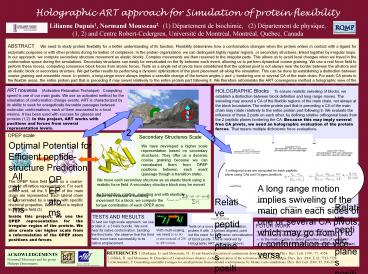
HOLOGRAPHIC Blocks To ensure realistic
swiveling of blocks, we establish a distinction
between block definition and long range moves.
The swiveling may around a CA of the flexible
regions of the main chain, not always at the
block boundaries The entire protein part that is
preceding a CA of the main chain may rotate
relatively to the entire protein part following
it. We evaluate the influence of those 2 parts on
each other, by defining relative orthogonal basis
from the 2 peptidic planes bordering the CA.
Because this may imply several free CA pivots, we
need an holographic evaluation of the protein
forces. That means multiple dichotomic force
evaluations.
1
2
OPEP scale
3
Secondary Structures Scale
Optimal Potential for Efficient peptide-structure
Prediction
We have developed a higher scale representation
based on secondary structures. They offer us a
dynamic coarse graining because we can
reevaluated them from OPEP positions between each
event (passage though a transition state)..
3 orthogonal axes are computed for each peptidic
plane using CAs and Oxygen positions
All atoms
OPEP atoms
We move each secondary structure as an elastic
block using a realistic force field. A secondary
structure block may be moved by translation,
rotation, swiveling and with elasticity
The OPEP force field gives us a coarse-grained
off-lattice representation. For each amino acid,
all the 5 atoms of the main chain are
represented. Each lateral chain is approximated
by a sphere, with specific chemical properties.
Water effect is implicit in the force
field.(3) Inside this project, we use the OPEP
representation for the irregular region of the
protein. We also create our higher scale from a
reformulation of the OPEP atom positions and
forces
A long range motion implies swiveling of the main
chain each sides of one or several CA pivots,
which may go from ? to ? conformation or
vice-versa.
When we evaluate a swiveling movement for a
block, we compute the torque contribution of each
OPEP atom.
Relative peptidic planes position in ?
conformation
Relative peptidic planes position in ?
conformation
TESTS AND RESULTS
To test our high scale approach, we use protein
A, a 3 helix bundle. We work near its native
conformation, bending the third helix. We observe
that the third helix move back successfully to
its native emplacement.
- FUTUR WORK
- We will test the method on protein A, EF-hand
- We will study the loop flexibility of HPPK enzyme
- Is the method able to detect sensitive parts of a
protein? - We will adapt the method for 2 proteins
interaction (or more)
Tests on a more distant conformation, protein A
with 3 helices aligned, point out the need for
a dynamic relocalization of block pivots. This is
resolved by Holographic ART approach (above).
With multi-scaling, we need 10 to 60 events
instead of 250 to 400 events.
REFERENCES 1) Barkema, G. and Mousseau, N.,
Event-based relaxation of continuous disordered
systems, Phys. Rev. Lett. 1996, 77, 4358. 2)
Malek, R. and Mousseau, N. Dynamics of
Lennard-Jones clusters A characterization of the
activation-relaxation technique, Phys. Rev. 2000,
E 62. 7723-7728. 3) Derreumaux, P. Generating
ensemble averages for small proteins from
extended conformations by Monte Carlo
simulations. Phys. Rev.Lett. 2000, 85, 206-209.
ACKOWLEDGEMENTS Normand Mousseau and his
group Philippe Derreumaux
Recommended

