

Networks PowerPoint PPT Presentation
1 / 20
Title: Networks
1
Networks
- Why networks?
- Impractical to connect two stations
- Limitations to number of stations that can be
connected directly - Distance considerations make direct connections
infeasible - Need to access multiple stations/services
- Any one machine may need access to many others
- Access requirements may change/expand periodically
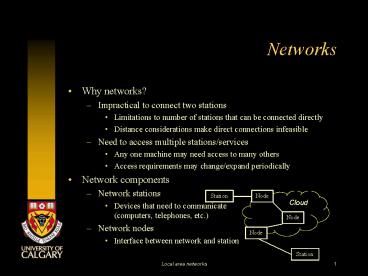
- Network components
- Network stations
- Devices that need to communicate(computers,
telephones, etc.) - Network nodes
- Interface between network and station
Node
Station
Cloud
Node
Node
Station
2
Network classification schemes
- Topology star, bus, ring, mesh, hierarchical,
hybrid - Ownership private, public
- Purpose/transmission type VAN, PDN, ISDN, Telex
- Geography GAN, WAN, MAN, LAN, TAN
- Architecture/transfer technique
- Switched networks circuit-switched,
packet-switched - Broadcast networks packet radio, satellite,
local networks - Dedicated networks
3
Local area networking functionality
- Local and remote communication
- Mail conferencing
- Resource sharing
- Network printers CD-ROMs modems fax
capabilities files and databases applications - Network management
- Backup LAN monitoring problem analysis,
diagnosis administration optimization security - Groupware integrated LAN functionality
- Workflow automation virtual interaction
scheduling communication
4
Local area networking approaches
- Printer-sharing networks
- Used when simple printing resources are the only
ones required - Zero-slot LANs
- Networked via standardized ports (e.g., serial,
parallel ports) - Peer-to-peer LANs
- Offers much of the full-featured functionality of
fully-integrated LANs but server-based
capabilities missing - Fully integrated LANs
- Powerful network operating system server-based
software
5
Local area networking considerations
- Types of local networks
- Circuit-switching (e.g., private branch exchange
(PBX)) - Packet broadcasting (e.g., local area network
(LAN)) - Differences between LANs and WANs
- Geographic scope
- Transmission WANs use switching LANs use
broadcasting - Media WANs use variety of media LANs typically
use one
6
Topologies used in LANs
- Ring topology
- Unidirectional
- Stations attach to medium through repeaters
- Repeaters responsible for reception and
transmission of data - May be in listen, transmit, or bypass state
- Bus/tree topology
- Bidirectional or unidirectional
- Broadband is unidirectional
- Stations attach to medium through taps
- Signal balancing issue because of no repeaters
- Other
- Star, mesh, hierarchy, hybrid
7
LAN topologies basic operations
- Ring
- Repeater handles data insertion, reception,
removal - In listen mode
- Identifies patterns in bit stream for control
info (e.g. address) - Copies bit streams to attached station if
addressed to station - Modifies passing bits to alter control
information - If returning bits, removes them from medium
- In bypass mode, no delay of signal as it passes
- Bus/tree
- Station emits signal, which is propagated along
the medium - Stations copy information if addressed to them
- Terminators absorb signals at ends
8
LAN transmission media
- Twisted-pair
- Could be shielded or unshielded
- Usually digital signaling, could be analog
- Coaxial cable
- Transceiver interface is twisted-pair wire
- Baseband or broadband (digital or analog
signaling) - Optic fiber
- Can implement token ring or ethernet
- Not as expensive now as earlier
- Infrared radiation
9
Relationship between LAN medium and topology
- Certain topologies suit certain media
- Ring uses repeaters, so needs point-to-point
links - Broadband coax requires complex technology to be
feasible in ring - Bus requires convenience of tapping
- Optic fiber unsuitable due to difficulty of
lossless taps - Certain media suit certain topologies
- Twisted pair good for ring, bus, not tree
(bandwidth issue) - Broadband coax good for bus, tree, not ring (too
complex for repeater) - Fiber good for ring, not bus, tree (hard to tap)
10
LAN layout
- Linear layout
- Wiring follows topology, short drop cables to
stations - Minimizes overall wiring
- Flexibility is compromised(especially for
growth) - Servicing and maintenance could be difficult
- Star layout
- Topology used in wiring closet, long drop cables
to stations - Requires considerable wiring
- High flexibility (especially for growth)
- Easier servicing and maintenance
- Permits pre-wiring of building
11
LAN operation baseband and broadband
- Baseband and broadband transmission compared
- Baseband is digital broadband usually analog
- Baseband signal uses full spectrum broadband
uses FDM - Broadband uses modulation for digital data, needs
modems - Broadband is good as a backbone
- Baseband usable for relatively short distances
- Baseband and broadband bus
- Baseband is bidirectional broadband is
unidirectional - Broadband bus uses single (split) or dual cable
- Headend frequency converter on split cable
different send/receive frequencies - Passive headend on dual cable, same frequency for
send/receive
12
LAN operation medium access control (MAC)
- Carrier Sense Multiple Access w/ Collision
Detection - Station senses the medium if medium is busy,
station waits - When medium is idle, station transmits message
- If collision occurs, station transmits jamming
signal, waits - Token bus
- Station on logical ring controls medium when
token received - After specified time token passed to next station
- Station can remove itself by splicing
predecessor, successor - Token ring
- Station takes control of token when transmission
required - Converts token to start-of-packet sequence
- When message comes back, it is purged, new token
generated
13
Network interface unit
- Unit connecting device to network
- Transceiver repeater
- Can be outboard (serial/parallel port) or inboard
- Provides multiple services
- Provides addressing, link control translates bit
rates, makes packets provides regeneration if on
a ring generates required signaling (baseband,
etc.) executes MAC technique buffers data
converts parallel to serial data - Functions could be split between devices
- Division between medium interface and network
services - On a bus, transceiver attaches to medium, LAN
coprocessor on card provides other services - Token ring card and MAU divide services
14
LAN standards
- IEEE 802 standards project (established 1979)
- At time of initiation, 44 LAN implementations
existed - Committee members are vendors, users, academics
- 802 subcommittees
- 802.1 internetworking
- 802.2 logical link control
- 802.3 CSMA/CD
- 802.4 token bus
- 802.5 token ring
- 802.6 MAN-CATV, DQDB
- 802.7 broadband LAN operating specifications
- 802.8 fiber optic LAN standards
- 802.9 integrating voice/data on a LAN
- 802.11 wireless LANs
- 802.12 100BaseVG ethernet
- 802.13 100BaseX CSMA/CD ethernet
15
IEEE 802.3 CSMA/CD
- Based on Xerox Ethernet standard
- Original standard was 10Base5
- 10 Mbps baseband max segment length is 500
meters - Max 100 taps per segment, 2.5 meters between taps
- Multiple segments with repeaters (max five)
- Maximum four repeaters between any two stations
- Repeaters could be full (segment-repeater-segmen
t) or half (segment-repeater-IRL-repeater-segmen
t) - Strictly, two of max five segments must be
inter-repeater links (IRL) without stations - Cable is approximately 10 mm in diameter (aka
frozen yellow garden hose) - Drop cables (attachment interface units) connect
via transceiver to medium
16
IEEE 802.3 CSMA/CD
- 10Base2 (a.k.a. Cheapernet Thinnet)
- Max segment length is 185 meters max 30 taps per
segment - 10BaseT
- Wiring is unshielded twisted pair (UTP)
- Uses 4-pair bundles (RJ-45 connector)
- Bus located in 10BaseT hub
- 10BaseF
- Optical fibre standard
- Max segment length of 2000 meters
- 10Broad36
- Provides broadband version max segment length
3600 meters
17
IEEE 802.4 token bus
- Physical layer specs allow for two transmission
modes - Broadband option supporting channels of 1, 5, and
10 Mbps - Headend frequency converter used on mid-split
cable - Carrierband option supporting a single broadband
channel of 1, 5, or 10 Mbps - Use of broadband makes token bus more flexible,
more resilient than 802.3 baseband - Could use token bus for backbones, 802.3 bus for
subnetworks - Token bus good in factory environment
- Process control LANs utilize this standard
18
IEEE 802.5 token ring
- Standard for shielded twisted pair at 1, 4, 16
Mbps - Some vendors provide UTP alternatives
- Higher data rates expected with fiber use in the
future - Maximum of 260 devices, 300 meters total length
- Uses star layout
- Stations connect through Multistation Access Unit
- Eight devices per MAU MAUs connected to form a
ring - MAU includes bypass capability does repeater
function - Token circulates on ring in free or busy state
- If busy, stations copy frame assess whether to
keep, discard - Transmitter removes frame on return, issues new
token
19
802.5 vs. 802.3 (token ring vs. ethernet)
- 802.5 better than 802.3 when high utilization
- More deterministic MAC
- 802.5 more efficient MAC algorithm than CSMA/CD
- Token passing results in more predictable
communication - 802.5 more reliable than 802.3
- Regeneration of signals
- - 802.5 usually more expensive than 802.3
- 400 vs. 150 for interface card
- - 802.5 less established than 802.3
- Market acceptance of 802.3 is very high
20
ANSI X3T9.5 (Fiber Distributed Data Interface)
- Based on IEEE 802.5 standard data rate of 100
Mbps - Total distance up to 200 km up to 1,000 stations
- Used as LAN backbone as well as LAN
- Uses redundant dual ring for fault tolerance
- Rings transmit in opposite directions
- Dual-attachment (DAS) and single-attachment
stations (SAS) - When breaks occur, DASnearby reroute data
Recommended

