

EHRENFEST DYNAMICS IN THE LASER CONTROL OF MOLECULAR REACTIONS PowerPoint PPT Presentation
1 / 1
Title: EHRENFEST DYNAMICS IN THE LASER CONTROL OF MOLECULAR REACTIONS
1
EHRENFEST DYNAMICS IN THE LASER CONTROL OF
MOLECULAR REACTIONS
Christine M. Isborn, Xiaosong Li Department of
Chemistry, University of Washington Seattle, WA
98195
Understanding the energy transfer from an
intense, ultrafast laser pulse to the dynamics of
molecules is essential for predicting,
controlling and creating new laser induced
chemical reactions. 1-3 To gain insight into
the mechanisms of dissociation and optimal
control, we extend time-dependent density
functional theory (TDDFT) methods to include
dynamics and the real time effects of a pulsed
laser field. The method of solution of the TDDFT
equations allows for strong couplings and does
not assume a small perturbation as some methods
that solve for response to electromagnetic fields.
LASER CONTROL
EHRENFEST DYNAMICS
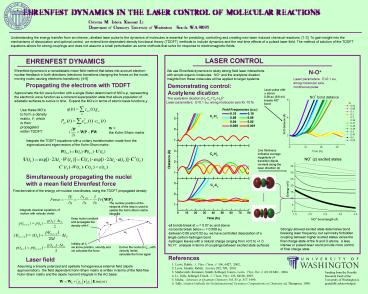
Ehrenfest dynamics is a nonadiabatic mean field
method that takes into account electron-nuclear
feedback in both directions (electronic
transitions changing the forces on the nuclei,
moving nuclei causing electronic transitions).
4-6
N-O
We use Ehrenfest dynamics to study strong field
laser interactions with simple organic molecules
NO and the acetylene dication. Insights from
these molecules will be applied to larger systems.
Laser parameters E0.1 au, along molecular
axis, continuous pulse
Propagating the electrons with TDDFT
Demonstrating control Acetylene dication
Laser pulse with w above 0.36 au (9.8 eV) breaks
NO bond
Approximate the full wave function with a single
Slater determinant of MOs f, representing the
electronic wave function as a coherent
superposition state that allows population of
adiabatic surfaces to evolve in time. Expand the
MOs in terms of atomic basis functions ?
The acetylene dication Ha-CaCb-Hb2 Laser
parameters E0.1 au, along molecular axis for
10 fs
Use these MOs to form a density matrix, P,
which is then propagated within TDDFT
W the Kohn-Sham matrix
Integrate the TDDFT equations with a unitary
transformation made from the eigenvalues and
eigenvectors of the Kohn-Sham matrix
Line thickness indicates average magnitude of
transition dipole moment along the laser
direction (z)
HOMO
Simultaneously propagating the nuclei with a
mean field Ehrenfest force
First derivative of the energy wrt nuclear
coordinates, using the TDDFT propagated density
The nuclear position at the midpoint of the step
is used to update the Kohn-Sham matrix integrals
Integrate classical equations of motion with
velocity Verlet
Keep nuclei constant and propagate the density
with U
- -all bonds break at w 0.07 au and above
- no bonds break below w 0.009 au.
- between 0.06 and 0.02 au, we have controlled
dissociation of a single carbon-hydrogen bond - hydrogen leaves with a natural charge ranging
from 0.5 to 1.0 - NEXT analysis in terms of couplings between
excited state surfaces
Strongly allowed excited state determines bond
breaking laser frequency, but symmetry forbidden
coupling between higher excited states varies the
final charge state of the N and O atoms. A less
intense or pulsed laser could provide more
control of final charge state.
Initially, at tk we know position, velocity and
we calculate the force
Evolve the nuclei to tk1 with velocity Verlet,
calculate the force again
References
Laser field
- Levis, Rabitz. J. Phys. Chem. A 106, 6427,
2002. - 2. Levis, Menkir, Rabitz. Science 292, 709,
2001. - 3. Markevitch, Romanov, Smith, Schlegel, Ivanov,
Levis. Phys. Rev. A 69, 013401, 2004. - 4. Li, Tully, Schlegel, Frisch. J. Chem. Phys.
123, 84106, 2005. - 5. Micha. Advances in Quantum Chemistry Vol. 35,
p. 317. 1999. - 6. Tully. Modern Methods for Multidimensional
Dynamics Computations in Chemistry ed. Thompson.
1998.
Assuming a linearly polarized and spatially
homogeneous external field (dipole
approximation), the field dependent Kohn-Sham
matrix is written in terms of the field-free
Kohn-Sham matrix and the dipole moment integrals
in the AO basis
Funding from the Royalty Research Fund of the
University of Washington is gratefully
acknowledged.
Recommended

