

Instructions PowerPoint PPT Presentation
1 / 21
Title: Instructions
1
Instructions
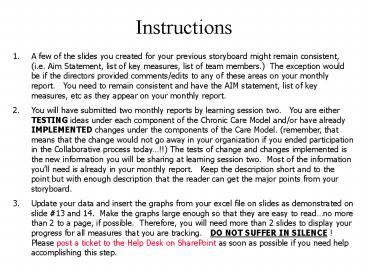
- A few of the slides you created for your previous
storyboard might remain consistent, (i.e. Aim
Statement, list of key measures, list of team
members.) The exception would be if the
directors provided comments/edits to any of these
areas on your monthly report. You need to
remain consistent and have the AIM statement,
list of key measures, etc as they appear on your
monthly report. - You will have submitted two monthly reports by
learning session two. You are either TESTING
ideas under each component of the Chronic Care
Model and/or have already IMPLEMENTED changes
under the components of the Care Model.
(remember, that means that the change would not
go away in your organization if you ended
participation in the Collaborative process
today!!) The tests of change and changes
implemented is the new information you will be
sharing at learning session two. Most of the
information youll need is already in your
monthly report. Keep the description short and
to the point but with enough description that the
reader can get the major points from your
storyboard. - Update your data and insert the graphs from your
excel file on slides as demonstrated on slide 13
and 14. Make the graphs large enough so that
they are easy to readno more than 2 to a page,
if possible. Therefore, you will need more than
2 slides to display your progress for all
measures that you are tracking. DO NOT SUFFER
IN SILENCE ! Please post a ticket to the Help
Desk on SharePoint as soon as possible if you
need help accomplishing this step.
2
Learning Session 2May 12-14, 2005Atlanta,
Georgia
Cluster
SouthEast Lancaster Health Services
3
SouthEast Lancaster Health Serivces
- Lancaster, PA 17602
- 13 Providers
- Population Served 73 of our patients are
Hispanic - Number of patients diagnosed with Diabetes are
623. - Currently 109 are in our patient of focus group.
4
Team Members
- Dr. Efrain Torres Physician Champion
- Dr. Chad Harris Dentist Champion
- Jane Marlin Medical Provider Leader
- Leslie Aikens Team Leader
- Mirna Guzman Clinical Support
- Teresa Durden Data Entry Support
- Jim Kelly Executive Director
Leslie Aikens 717-299-6371, ext.
104 Laikens_at_selhs.org
5
AIM Statement
- The SouthEast Lancaster Health Services wants to
create a system to optimize the medical standard
of care and the dental care. We will accomplish
this by using the Care Model and Model for
improvement for our patients living with
diabetes.
6
Selected Measures
- At least 90 of our patients receiving at least 2
HgbA1cs 3 months apart within one year - An average HgbA1c less than 7.0
- At least 70 of our patients will have documented
self-management goals - At least 70 of our patients will have BPlt130/80
- At least 70 of our patients will have LDLlt100
- At least 70 of our patients will be on statins
age 40 or older - At least 70 of our patients with diabetes will
have a dental exam - At least 70 of our patients will have a dilated
eye exam in the past year - At least 70 of our patients will have a foot
exam at each visit
7
Self-management
- Currently Testing
- Review of patients chart to determine education
focus - An Open House for our Diabetic Patients
- Implemented into our Delivery System
- Created a packet in English and Spanish of
resources and information for the diabetic
patient - Referral to Harrisburg Area Community College
Nursing Care Program
8
Community
- Currently Testing
- We are currently looking for places to have our
patients go for exercise and develop an exercise
sheet with options - Implemented into our Delivery System
- The relationship with Harrisburg Area Community
College
9
Healthcare Organization
- Currently Testing
- We are evaluating the advantage of purchasing
equipment to perform HgbA1c and lipid panels in
the office - Implemented into our Delivery System
- Every Board of Directors meeting an update is
given on the Diabetes Collaborative Care Model
10
Decision Support
- Currently testing
- Diabetes patient appointment times are being
evaluated to determine the length of time needed
for each appointment - Implemented into Delivery System
- Diabetes Goal Sheet for chart documentation
- Standing order form for the diabetic patient
- Dental appointment routing form
11
Clinical Information System
- Currently Testing
- We are testing the information in the PECS system
for accuracy - Implemented into Delivery System
- A system to identify the Diabetic patients in our
computer system ( Centricity) so the scheduler is
alerted to this information when the patient
calls in for an appointment
12
Delivery System Design
- Currently Testing
- We are testing two different time frames for
appointments. - We are testing the review of charts by a Medical
Assistant ahead of time and anticipating what is
needed during the medical visit - Implemented into Delivery System
13
Functional and Clinical Outcomes
- Measures Goal as of 4/05
- 2 HbA1cs in last yr gt90 4.5
- Average HbA1c lt7.0 16.7
- Documented self gt70 0
- management goal setting
- BP lt 130/80 gt70 26.9
- Statins (age gt40) gt75 61.2
- Dental exam in past year gt70 16.4
- REGISTRY SIZE 110 100
14
National Key Measures
15
Additional Center Key Measures
16
Senior LeadershipMaking the Case for Change
- What information did you share with your ED/CEO
and/or Board of Directors to encourage them to
make improvements in the management of
Diabetes/Depression? i.e., graphs, data, patient
stories, articles, etc. - How did you promote the work? i.e., speak at
meetings, talk with particular people, write
articles, produce a video, etc
17
Communication Plan (How are you communicating
your progress at the center level and within your
community)
- At the center level
- On February 16, 2005 we had a staff meeting from
noon - 1pm and described the impact of the Care
Model with a visualization process. Each team
member introduced themselves and describe their
role on the team - Casual conversations with peers
- Teaching in areas on a need to know basis
- At the Community level
- A representative from the Harrisburg Area
Community College joined one of our meetings to
describe their nursing care program approach to
the Diabetic patient - A dietician from the Penn State Extension
Services came to one of our meeting to describe
their program and look for ways to collaborate.
18
Anticipating Barriers and Issues
Those that the team can resolve
Those that leadership needs to address
- Staff responsibilities
- Education for additional staff
- Resources for time and equipment
- The amount of time allocated for scheduled
visits- should it vary on the type of visit.
19
A story to share.the patient
- A 55 year old Hispanic male with a 15 year
history of Diabetes was meeting with me to learn
about self-management goal setting. His HgbA1c
was 9.1. As we reviewed diabetic education, diet
and exercise, his comment to me was I was never
told not to consume regular sugar?! Starchy
hispanic vegetables are a daily food for him as
well. - I have found the one on one relationship with the
patient allows the patient to be more open and
establishes a better working relationship. I gave
him samples of Equal and Splenda and he agreed to
try them. The client expressed enthusiasm and a
readiness to make needed changes in his
lifestyle. - He wants to live a healthier life. His goal is
to gradually decrease the HgbA1c, and have better
control of his diabetes. He will follow-up with
me in three months. - -Submitted by Mirna Guzman, Clinical Support
20
A story to share.our staff
- Our Provider Champion is a very busy internist
who does not feel very supported. So when we
asked him to join us on our journey to create a
new care model and it would involve more
paperwork, lets say he was not excited. As a
team we listened to his concerns, documented them
and decided that if these are the concerns that
one physician has, then these will be the
concerns the others will have as well. - So, instead of looking for a new provider
champion we decided to meet his challenge and try
to create a more supportive system for our
providers so they may better serve our patients.
21
A story to share.the organization
- Employees not involved on the team are asking
questions of team members concerning the Care
Model for Diabetes. They want to know what we
are doing and if we like what we are doing. - Using the Chart Abstraction tool showed us the
importance of documentation. We struggled to
find some information in some of the charts.
This was a good lesson. - The information we evaluate on the Registry is
very useful to planning and measuring
improvement. We were surprised by the number of
uninsured out of the 110 patients. We expected a
higher number. When requesting services for our
uninsured it is so helpful to be working with a
specific number who may need the service.
Recommended

