

Purpose and Importance PowerPoint PPT Presentation
1 / 17
Title: Purpose and Importance
1
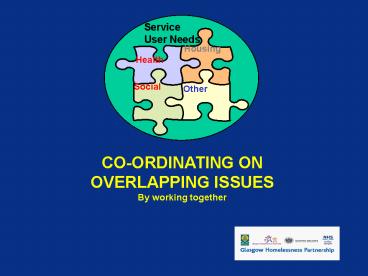
Service User Needs
Housing
Health
Social
Other
CO-ORDINATING ON OVERLAPPING ISSUES By working
together
2
Homelessness in Glasgow
- 10,000 homeless presentations per year in
Glasgow. - 8,000 households - 60 of whom are single
- 4,000 households likely to be homeless at any
time - Family homelessness rising
- Highest drug using population in western Europe
- Presenting with increasingly complex needs
- (
3
Health Homelessness Coordinator
Homelessness Health Services 2005-7
- Homeless Mental Health Team
- Primary Care Mental Health Team
- GP Practice
- Homeless Families Service
- Physiotherapy
- Dieticians/ Podiatry / OTs
- Sexual Health Service
- HART / ADT
- PD and Trauma Service
- Homeless Addiction Team (2007)
- DART Acute and Mental Health
4
Health Services Within the Homelessness
Partnership
- 120 Health Staff across various teams
- Mental Health Teams (primary and secondary)
- GP Practice, Physio / Pod /OTs / Diet, PHT DNs /
RGNs - Homeless Families Service, Sexual Health Service
- PD and Trauma Service
- Homeless Addiction Team (2007) (45 staff Health
SW) - DART Acute and Mental Health
- Integrated Health / Social Work (housing )
- HART / ADT
- Additional Capacity to mainstream
- Locality Development Coordinators
5
Partnership Working in Glasgow
CHCPs Community Health Care
Partnerships
- Consists of all Services Within Defined Area
- Primary Health Care Services
- Social Work Teams
- Mental Health Services
- Addiction Services
- Learning Disability Services
- Working with
- GHA RSLs
- Voluntary Sector Providers
- Community representatives
- Police
Other Partnership Structures Addictions
Partnership Mental Health Partnership
Learning Disability Partnership
Homelessness Partnership
6
The Homelessness Partnership is the mechanism
for the coordination of Glasgows response to
homelessness by agencies working together within
a partnership organisation
7
Overlapping Issues for Homelessness service
providers?
- Levels of accommodation available ?
- Supply and demand for services
- Multiple assessments - multiple conflicting
views - Financial constraints - a reality for services
and service users - Managing a complex client group
- Barriers to joint working - affect on service
delivery - Attitudes to homeless people ? deserving v
undeserving - Sharing / obtaining information
- Overcoming prejudice
- Policy constraints versus practice realities
8
Impact of these Issues on Service Users
- Conflicting views expressed by professionals
- Pass the parcel culture
- Confusion for service user who is right? Who
is responsible? - ? Who to trust
- Inequalities in service provision - luck of
the draw? - Prejudicial treatment / service received
- Lack of coordination of response
- Duplication of effort and or service at times
- Duplication of cost waste of resource
- Lower service users expectations of service
delivery - Poorer outcomes for service user
- Neither policy nor practice meets the needs of
the client
9
How do we overcome these Challenges ?
- Agree principles in partnership working across
agencies - Develop training jointly with partners
- Agree information sharing process (consent, can
be given at various levels and on a need to know
basis) - What are the competing priorities find a way to
balance - Identify blocks, gaps pressure points to be
addressed - Plan in partnership - (use expertise across
agencies) - Measure and share successes across services
develop best practice models - Involve staff and service users at all levels
10
Similarities across homelessness agencies ?
- Direct Access / Needs led services
- Deliver service where people affected by
homelessness present - Services tend to respond quicker than other
mainstream areas - We are all affected by same shortfalls in the
system - Our client group is often difficult to engage
with complex issues - We find it difficult access mainstream services
for this client group - All have meeting the needs of homeless people as
our core objective - Why then are there barriers to joint working?
11
Differences Across Agencies
- Cultural
- Based on organisational norms and history of
service development - Ethos, values and beliefs of the organisation
shape its response - Systems and processes
- Designed to meet organisational needs but can be
self limiting - Often task led not needs led (eg supporting
people financial requirements) - The bigger the org the Slower to respond to
change - Different organisations have different reporting
requirements
12
Differences across agencies (cont.)
- Knowledge and skills
- Knowledge base varies across agencies
- Training opportunities and personal development
support varies across agencies - Linked to terms and conditions and ability to
fund for Vol org. and professional role for
health and social work. - Priorities
- Working towards org. objectives as defined (which
may change) - Competing local and national priorities
- Managing financial constraints
- Target driven
- Political drivers and legislative requirements
13
- What Helps ?
- Integrated Assessment across agencies
- Developing integrated teams
- Sharing care, experience and building trust.
- Planning services together to a joint strategy
- Information sharing
- Improving access back into mainstream services
- Work locally on prevention models
- Joint agreed and signed up protocols
- Joint training initiatives
- Developing effective service user and
stakeholder consultation - RESPECT
14
AN EXAMPLE OF GOOD PRACTICELOCALITY DEVELOPMENT
CO-ORDINATORS ROLE(temporary posts 3 4 years
2004 2008)
- To work with key local managers to implement the
homeless strategy at community level - Embed homelessness in local community and health
planning - Facilitate commissioning locally work with
elected members - Monitor the effectiveness of new services
- Facilitate improved joint working across key
agencies - Support the management of change to achieve best
practice
15
AN EXAMPLE OF GOOD PRACTICELOCALITY DEVELOPMENT
CO-ORDINATORS ROLE
- Actively facilitate Joint training initiatives
and awareness raising - Develop an effective two way communication
structure across agencies within localities and
the partnership - Develop and support effective homeless user
involvement within localities - Identify gaps, blocks and pressure points within
localities and take appropriate action to address
with local managers. - Measure service user outcomes and feedback to
services - Troubleshoot access issues from an objective
stance - Evaluate effectiveness of resettlement through
Continuity of Care Audits
16
IN SUMMARY Shared Care - The Buck Stops Here
- Define basic principles of service and share
- Share care instead of pass care when
appropriate - Recognise the barriers we build and
dismantle them - Take a different perspective
- Recognise where objectives meet
- Put the service user at the centre
- Value the experience of others
The Buck
STOP HERE
17
- Alice Docherty
- Health Homelessness Coordinator
- Glasgow Homelessness Partnership
- Granite House
- 31 Stockwell Street
- Glasgow G1 4RZ
- Alice.docherty_at_GGC.scot.nhs.uk 0141.276.4860
Recommended

