

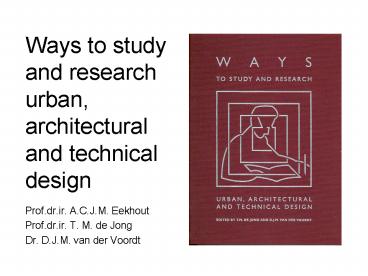
Ways to study and research urban, architectural and technical design PowerPoint PPT Presentation
1 / 33
Title: Ways to study and research urban, architectural and technical design
1
Ways to study and researchurban, architectural
and technical design
- Prof.dr.ir. A.C.J.M. Eekhout
- Prof.dr.ir. T. M. de Jong
- Dr. D.J.M. van der Voordt
2
Ways to Study and Researchurban, architectural
and technical design
- CONTENTS
- Introduction
- Naming and describing
- Design research and typology
- Evaluating
- Modelling
- Programming and optimising
- Technical Study
- Design Study
- Study by design
- Epilogue
Empirical research
Study by design
3
Introduction
CONTENTS Introduction A. Naming and describing B.
Design research and typology C. Evaluating D.
Modelling E. Programming and optimising F.
Technical study G. Design Study H. Study by
design Epilogue
- Preface (Fokkema)
- Introduction (Jong Voordt)
- Languages (Dijkhuis)
- Criteria for scientific research, study and
design (Jong, Voordt)
Science equals any collection of statements that
features a reliable relationship to reality, a
valid mutual relationship and a critical
potential with regard to other statements in the
same domain.
4
Domains according to Van der Voordt
5
Domains according De Jong
6
Imaginable
art
design study
Extending science
empirical research
7
Classical empirical research proposals
- problem statement (problem isolation)
- clear aim
- reference
- starting points
- hypothesis
- variables
- data
- method
- content
- publish
8
Design related study
- can not isolate problems from a coherent field of
problems - brings aims together in a field of aims, a
concept - has many references, not only written text but
especially images forms, types, models,
concepts, programmes - has many starting points
- has designs as hypothesis stating This will
work - has many context variables (parameters)
- while the object still varies in your head
- has many ways to study (in a book with 10 000 key
words) - content grows drawing, calculating and writing
- publishes with the medium as a message
9
Design related study orempirical research
- Research produces probabilities by causes
- Design produces possibilities by conditions
10
Design related Study
Preface by Rector Fokkema Within the range of a
technical university the object of design in
terms of (urban) architecture and technique is
the design subject that is amongst all others
most sensitive to context. The programme of
requirements is not only derived from an
economical and technical context, but also from
contexts hailing from political, cultural,
ecological en spatial considerations on many
levels of scale.
11
The concept ofcontext
12
Problems and aims
13
Subtracting futures
- Field of problems Probable - Desirable
- Field of Aims Desirable - Probable
14
Explicit future context
- protects your study against judgements with other
suppositions about the future context - raises the debate about the robustness of your
study in different future contexts - makes your study comparable to other studies in
comparable contexts - raises a field of problems instead of an
isolated problem statement by subtracting
desirable futures from the probable ones
15
Explicit impacts within that context
- indicate actors and specialists to join the team
or take into account - imply a societal and personal relevance or
fascination - imply a field of aims
- imply actors willing to finance your study
- could produce a programme of requirements
- before you have a precise study proposal !
16
1 OBJECT OF MY STUDY AND ITS CONTEXT
- 1.1. Object of my study
- 1.2. Probable future context field of problems
- 1.3. Desired impacts of my study field of aims
- 1.4. My designerly references field of means
- 1.5. My portfolio and perspective field of
abilities
17
Undesired, improbable possibilities
Are they relevant as long as nobody wants them?
18
Unexpected inventions
Yes
19
Changing desires
20
Changing desires
21
How to limitate, concentrate
- give way to fascinations (motivated
concentrations) - choose a scale (frame and grain) before an object
- publish your portfolio evaluating it as field of
abilities - decide to improve or to extend them in your
proposal - publish images that fascinate you as a field of
means - look at them as a professional which concepts,
types, models programmes could you harvest? - make your assumptions about the future explicit
- imagine the impacts your study could have
- cash your dreams
22
Ways to Study and Researchurban, architectural
and technical design
- CONTENTS
- Introduction
- Naming and describing
- Design research and typology
- Evaluating
- Modelling
- Programming and optimising
- Technical Study
- Design Study
- Study by design
- Epilogue
Empirical research
Study by design
23
A. Naming anddescribing
CONTENTS Introduction A. Naming and describing B.
Design research and typology C. Evaluating D.
Modelling E. Programming and optimising F.
Technical study G. Design Study H. Study by
design Epilogue
- Naming components and concepts (Jong Rosemann)
- Retrieval and reference (Jong Voordt)
- Descriptive research (Lans Voordt)
- Historical research (Macel)
- Map study (Moens)
- Casuistry resulting in laws (Hobma Schutte)
24
B. Design researchand typology
CONTENTS Introduction A. Naming and describing B.
Design research and typology C. Evaluating D.
Modelling E. Programming and optimising F.
Technical study G. Design Study H. Study by
design Epilogue
- Design research (Jong Duin)
- Designerly enquiry (Breen)
- Typological Research (Jong Engel)
- Concept and Type (Leupen)
- Analysis of buildings (Molema)
- Plan analysis (Meyer)
- Design driven research (Breen)
25
C.Evaluating
CONTENTS Introduction A. Naming and describing B.
Design research and typology C. Evaluating D.
Modelling E. Programming and optimising F.
Technical study G. Design Study H. Study by
design Epilogue
- Ex post evaluation of buildings (Voordt Wegen)
- Ex ante research (Hulsbergen Schaaf)
- Ex ante performance evaluation of housing
(Thomsen) - Evaluating prototypes
- Comparing and evaluating drawings (De Jong)
26
D. Modelling
CONTENTS Introduction A. Naming and describing B.
Design research and typology C. Evaluating D.
Modelling E. Programming and optimising F.
Technical study G. Design Study H. Study by
design Epilogue
- Modelling reality (Klaasen)
- Verbal Models (Jong)
- Mathematical Models (Jong Graaf)
- Visualisation and architecture (Koutamanis)
- The empirical cycle (Priemus)
- Forecasting and Problem Spotting (Jong Priemus)
27
Example Mathematical models
- De Jong en De Graaf
- Origins
- The mathematical model is no reality
- Mathematics is a language
- Numbering
- Counting
- Values and variables
- Combinatorics
- Taming the combinatorial explosion
- Program of a site
- The resolution of a medium
- The tolerance of production
- Nominal size systems
- Geometry
- Graphs
- Probability
- Linear Programming (LP)
- Matrix calculation
- The Simplex method
- Functions
- Fractals
- Differentiation
- Integration
- Differential equations
- Systems modelling
28
A mathematical model
29
E. Programming and optimising
CONTENTS Introduction A. Naming and describing B.
Design research and typology C. Evaluating D.
Modelling E. Programming and optimising F.
Technical study G. Design Study H. Study by
design Epilogue
- Urban Programming Research (Guyt Hulsbergen)
- Programming of buildings (Voordt Wegen)
- Programming Building Construction (Eekhout
Cuperus) - Designing a city hall (Weeber Eldijk Kan)
- Design by optimisation (Loon)
- Optimisation of performance requirements (Houben)
- The environmental maximisation method
(Duijvestein)
30
F.Technical study
CONTENTS Introduction A. Naming and describing B.
Design research and typology C. Evaluating D.
Modelling E. Programming and optimising F.
Technical study G. Design Study H. Study by
design Epilogue
- Re-design and renovation (Verhoef)
- Study of Building Services and Installations
(Schalkoort) - Methodical design of load-bearing constructions
(Kamerling) - Classification and combination (Cuperus)
- Methodology and component development (Eekhout)
- Industrial design methods (Jager)
- Future ICT developments (Sariyildiz Stouffs
Ciftcioglu Tuncer)
31
G. Design study
CONTENTS Introduction A. Naming and describing B.
Design research and typology C. Evaluating D.
Modelling E. Programming and optimising F.
Technical study G. Design Study H. Study by
design Epilogue
- Creating space of thought (Hertzberger)
- Perceiving and conceiving (Hertzberger)
- Formation of the image (Jong Rosemann)
- Experience, intuition and conception (Geuze
Eldijk Kan) - Designing an office (Brouwer Eldijk Kan)
- Designing a village (Heeling Eldijk Kan)
- Urban design methods (Westrik)
- Studying Design (Jong)
There are more design methods than designers.
32
H. Study by design
CONTENTS Introduction A. Naming and describing B.
Design research and typology C. Evaluating D.
Modelling E. Programming and optimising F.
Technical study G. Design Study H. Study by
design Epilogue
- Types of study by design (Voordt, Jong)
- Designing Naturalis in a changing context
(Verheijen Eldijk Kan) - Designing a building for art and culture (Röling
Eldijk Kan) - Contemplations for Copenhagen (Bergh)
- Learning from The Bridge project (Breen)
- Creating non-orthogonal architecture (Vollers)
- Design in Strategy (Frieling)
33
Ways to Study and Researchurban, architectural
and technical design
- CONTENTS
- Introduction
- Naming and describing
- Design research and typology
- Evaluating
- Modelling
- Programming and optimising
- Technical Study
- Design Study
- Study by design
- Epilogue
Empirical research
Study by design
Recommended

