

Development of Heterosexuals into Sexual Minority Allies: A Qualitative Exploration PowerPoint PPT Presentation
1 / 1
Title: Development of Heterosexuals into Sexual Minority Allies: A Qualitative Exploration
1
Development of Heterosexuals into Sexual Minority
Allies A Qualitative Exploration
Julie M. Duhigg, Ed.S, Sharon Scales Rostosky,
Ph.D., Barry E. Gray, M.A., and Mary K. Wimsatt,
B.A.
UNIVERSITY OF KENTUCKY Department of Educational
Counseling Psychology
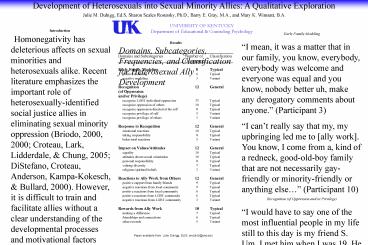
Introduction Homonegativity has deleterious
affects on sexual minorities and heterosexuals
alike. Recent literature emphasizes the important
role of heterosexually-identified social justice
allies in eliminating sexual minority oppression
(Briodo, 2000, 2000 Croteau, Lark, Lidderdale,
Chung, 2005 DiStefano, Croteau, Anderson,
Kampa-Kokesch, Bullard, 2000). However, it is
difficult to train and facilitate allies without
a clear understanding of the developmental
processes and motivational factors that lead
heterosexuals to social justice action on behalf
of sexual minorities. As educators, trainers,
clinicians, and researchers, we have far too
little empirical evidence on which to base
psychoeducation and training that will encourage
heterosexual allies to promote social justice for
sexual minorities. Given the lack of previous
research, we designed an in-depth qualitative
interview study to explore the experiences of a
purposive sample of 12 heterosexually-identified
individuals who actively volunteer to work in
their communities for sexual minority social
justice. Methods Procedures Individuals were
chosen through a nomination process, which
solicited recommendations from lesbian and gay
leaders in local organizations addressing
lesbian, gay, bisexual, and transgender (LGBT)
rights in Lexington Kentucky. Participants
completed a short survey of demographic items
and, during 1-2 hour interviews, were asked to
describe the range of influences that motivated
them to become involved in LGBT ally volunteer
work. In addition, they were asked to reflect
upon how their ally-work has impacted
them. Description of Participants 12
self-identified heterosexual participants Age
range 28-74 years (Mean age 53.5) Gender 7
females and 5 males Race/Ethnicity of
participants 9 Caucasian or White 1
Caucasian/Irish/Cherokee 1
Mixed/White 1 South East Asian. Data
analyses The Consensual Qualitative Research
(CQR Hill, Thompson, Williams, 1997) method was
used to analyze the data by a primary research
team of three coders and one external
auditor. The research team members involved
graduate students and one faculty member,
supervised by the first author. This research
study was funded in part by the American
Psychological Associations Division 44 Maylon
Smith Scholarship Award (2005) additional
funding provided by University of Kentuckys
Arvle and Ellen Turner Thacker Endowment Fund
(2005).
- Early Family Modeling
- I mean, it was a matter that in our family, you
know, everybody, everybody was welcome and
everyone was equal and you know, nobody better
uh, make any derogatory comments about anyone.
(Participant 3) - I cant really say that my, my upbringing led me
to ally work. You know, I come from a, kind of
a redneck, good-old-boy family that are not
necessarily gay-friendly or minority-friendly or
anything else (Participant 10) - Recognition (of Oppression and/or Privilege)
- I would have to say one of the most influential
people in my life still to this day is my friend
S. Um, I met him when I was 19. He was very out
except to his family... Hes brilliant. He has
one of the most incredible minds. And his family
cannot see that. All they really sort of, you
know, focus on is the fact that hes gay.
(Participant 7) - Response to Recognition
- I got dealt a hand where Ive got some
opportunities to make a difference that perhaps I
wouldnt have, sadly, if I were not
heterosexual. Um, and so I feel like OK you
know, you get privileges and responsibilities.
Ive got unearned privilege and along with that
goes this responsibility. You have to do
something with that. (Participant 8) - Impact on Values/Attitudes
- its healthy for the straight people to see,
this is what gay people are about. I mean, and
ultimately its more a process of unlearning than
it is of learning, because people have got their
preconceptions and I know as many variety of gay
people that there are straight people.
(Participant 12) - Reactions to Ally Work from Others
- I get a chance to earn peoples trust. And that,
once again, I think comes from actions and not
words I keep coming back and Im committed
thats what I think a straight ally should be
doing... Ive been able to probably gain more
trust with the LGBT community by being around.
(Participant 5) - Anti-gay activists have said youre going to
go to hell, and youre taking people to hell with
you, and you know, youre doubly going to hell
because youre choosing to support them.
(Participant 8) - Rewards
- I feel blessed by having gay and lesbian
friends thats been a very good thing in terms
of.. theyre great friends I had never
considered anything I did with the GLBT community
work although I guess it has been because, you
know, if you volunteer time, thats considered
work. (Participant 1) - Implications for Training
- Increase awareness of homophobia and sexual
minority oppression. - Provide experiences with and exposure to sexual
minorities as a population. - Facilitate exploration of how values, attitudes,
and actions can either contribute to or help end
sexual minority oppression.
Results Domains, Subcategories, Frequencies, and
Classification for Heterosexual Ally Development
Paper available from Julie Duhigg, Ed.S.
jmduhi2_at_uky.edu
Recommended

