

Astrophysics in the Early Universe Ingredients of the Primordial Soup PowerPoint PPT Presentation
1 / 24
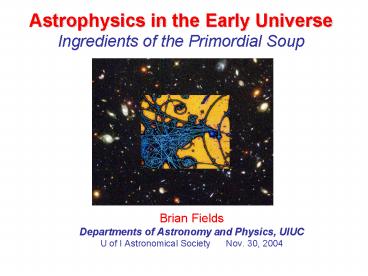
Title: Astrophysics in the Early Universe Ingredients of the Primordial Soup
1
Astrophysics in the Early UniverseIngredients of
the Primordial Soup
- Brian Fields
- Departments of Astronomy and Physics, UIUC
- U of I Astronomical Society Nov. 30, 2004
2
From the Home Office in Shampoo-Banana...
Top Three Pillars of the Big Bang Cosmology
- Expansion of Universe
- t 13 x 109 yr 13 billion yr
3
Cosmology
- Structure, Origin, Evolution of the Universe
- stars organized into galaxies
- ex Solar Sytem is part of Milky Way
- Typical galaxy 100 billion stars
Andromeda galaxy
Sombrero galaxy
Think big! galaxies are building
blocks smoothly fill universe (like dust)
4
Edwin P. Hubble
- The great observer of galaxies
- Measured galaxy
- Distance
- Speed
Hubble, the man
5
Its 1928.Hubble is measuring galaxy
velocities, distances.What will Edwin find?
- More galaxies approaching than receding
- More galaxies receding than approaching
- About equal numbers of each
6
Hubbles Law and Its Meaning
- Edwin Hubble (1929)
- galaxies moving away from us
- farther faster
- that is, v D
- v HD
- Interpretation What does it mean?
- Egoist
- view
- We are at
- center of Universe
- Einstein
- view
- Universe is
- expanding!
- No center!
7
AGE OF UNIVERSE
Expansion implies finite age
If constant speed, distance speed x time D vt
- Hubble v HD
- D distance between 2 particles (galaxies)
All together v HD H(vt) Htv so Ht
1 expansion age of universe
t1/H
best estimate age t 13 billion years
8
A Telescope is a Time Machine
9
A Telescope is a Time MachineThe Hubble Deep
Field
- Farther away means
- Takes light longer to get to us
- Light seen now started long ago
- Most distant Universe 10 present age!
10
(No Transcript)
11
Questions so far?
12
Words of the great Cosmologist Woody Allen
13
From the Home Office in Shampoo-Banana...
Top Three Pillars of the Big Bang Cosmology
- Expansion of Universe
- t 13 x 109 yr 13 billion yr
- Cosmic Fireball Released
- t 100, 000 yr
14
EXPANDING UNIVERSE THE PAST
- U. expanding today
- galaxies closer in past
- more dense
- long ago, very dense
- matter in contact energy, heat flow
- Universe has temperature
- dense compressed heat up
- Expand cool
- Early Universe very dense and very hot
BIG BANG
15
INTERLUDE I LIGHT HEAT
- hot objects glow
- light, heat connected
- thermal radiation
Spread out into colors spectrum
- color wavelengths where brightest
- depends on temperature
- color-temperature connection (think flame!)
16
TAKING THE TEMPERATURE OF THE UNIVERSE
- Penzias Wilson (1964)
- entire sky bright with microwaves
- spectrum is thermal, with
- the temperature of space"
- ...extremely cold today
Nobel Prize!
the Universe filled with thermal radiation
Cosmic Microwave Background Radiation
17
FROM ATOMS TO THE COSMOS
- Microwave background radiation observed
- what does it tell us?
- when was it created?
- To answer follow microscopic behavior
- atoms in expanding Universe
18
INTERLUDE II ATOMS IN A NUTSHELL
- Atoms made of
- electrons - charge
- nucleus protons charge, neutrons 0 charge
- neutral equal p and e
- bind" together, stable
- ionized some or all e gone
- not bound, less stable
- To ionize need energy to un-bind
- tear away electron
- Cold gas gentle collisions neutral
- Hot gas violent collisions ionized
19
THE COSMIC FLAME
- At present Universe extremely cold neutral
atoms - In past Universe hotter
- when T _at_ 3300 K 5500F
- whole universe ionized
- in primeval fireball
20
THE COSMIC FOG CLEARS
- When universe ionized opaque
- But universe cooled
- until t _at_ 300, 000 yrs
- collisions gentle neutral
- universe transparent
- atoms formed pe hydrogen
- microwave background is
- faded snapshot of cosmic fireball
- when ionized neutral
- Big bang model works well
- back to t 300 000 yrs !
21
From the Home Office in Shampoo-Banana...
Top Three Pillars of the Big Bang Cosmology
- Expansion of Universe
- t 13 x 109 yr 13 billion yr
- Cosmic Fireball Released
- t 100, 000 yr
- Light Elements Born
- t 1 sec
22
THE NUCLEAR AGE
- In Atoms
- electrons bound to nuclei
- need energy (high T) to remove
- In Nuclei protons, neutrons bound together
- by nulcear forces strong
- to break apart need very high energy
- very high T
- At t lt 1 sec
- T gt 1010 K 10 billion degrees
- nuclei totally ionized
- only p and n exist
23
BIRTH OF THE LIGHT ELEMENTS
- At T 1 billion degrees
- nuclear ionization stops
- nuclear reactions proceed rapidly
- Big Bang Prediction
- Fill Universe w/ lightest elements
- Hydrogen, Helium, Lithium
- Example 24 He
- Astronomical Observations
- Measure light elements in near and distant sites
CONCORDANCE!
- Theory can explain all observations
- Theory Vindicated!
- Big Bang working well back to t 1s!
- earliest probe of Universe!
- take my word
- lite elements cosmic n and p content
24
THE FUTURE
25
EXPANDING UNIVERSE FINAL FATE
- Competition gravity vs inertia
- Compare pop fly!
- quantitative question
- launch speed vs speed to escape Earth
- For Universe
- gravity galaxy mass density
- inertia expansion
- Both are observable!
- Fate quantitative question
- if expand forever
- if expansion halts, collapse
or
26
BBN AND DARK MATTER
- Big bang nuke measures density of
- anything made of protons neutrons
- all ordinary matter
- Light element observations
- Consequences
- if normal is all, expand forever
- Can measure luminous matter (stars, gas)
- most normal matter dark baryonic dark matter
- Can estimate total matter content
- most matter not normal! non-baryonic dark matter
- exotic particles?
27
ORIGIN OF DARK MATTERTHE VERY EARLY UNIVERSE?
- Maybe Dark Matter particles created at times ltlt
1 sec !? - T, energies ultrahigh
- Q how probe such high energies?
- Hint its in the Great State of Illinois
- Fermilab
28
INNER SPACE / OUTER SPACE
- Fermilab is a telescope!
- Probes conditions in
- Universe at 10-12 s
- but also
- The Universe is the poor mans accelerator
- Probes conditions inaccesible at laboratories
Russian cosmologist Yakov Zeldovich
29
OUTLOOK
- PRESENT
- Big bang theory in great shape
- tested from t 13 billion years 4 x 10¹⁷ sec
- down to t 1 sec
- NEAR FUTURE
- New era dawning for Cosmology
- flood of high precision data
- right now Golden Age!
- old questions answered
- new questions emerge
- new tools available
- Exciting, expansive future!
- Room for you to join the fun!
30
How can I join the fun?Two Words Astronomy
Major!
- From the Home Office in Urbana, IL...
- Top Ten Reasons to Major in Astro
- 10. integrates all areas of physics (many double
majors Phys/Astro!) - 9. also geology, chemistry, biology
- 8. flat central Illinois more sky to look at!
- 7. develop critical thinking, problem solving
- 6. get all of Douglas Adams' inside jokes
- 5. two words Hubble telescope
- 4. better at parties than Accounting
- 3. pretty pictures are homework
- 2. be part of golden age
- cosmology, black holes, extrasolar planets
- 1. it's fun!
Recommended

