

Development process models PowerPoint PPT Presentation
1 / 15
Title: Development process models
1
Development process models
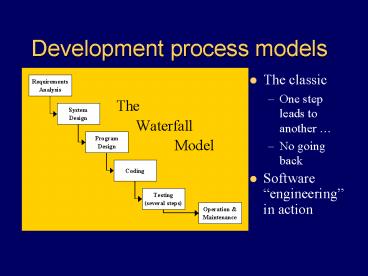
- The classic
- One step leads to another
- No going back
- Software engineering in action
2
Software development activities
- Note activities not steps
- Often happening simultaneously
- Not necessarily discrete
- Planning mostly study the requirements
- Domain analysis study the problem area
- System design devise the computer solution
- Implementation the easy step?
- Testing, documentation, maintenance,
3
Alternatives to waterfall model
- Okay, we all agree this extreme doesnt work
either - Is there a middle ground?
4
Risk another reality
- Considered wise to tackle risky issues early
5
Engineering the risk factor
- Spiral Model
- Includes frequent risk analyses
- Frequent reevaluation during an extended planning
stage
6
Testing and iterating
- Because we make mistakes
- Requirements change too
- Clients dont always know what they want until
they see it - Key idea plan to iterate
7
Incremental and iterative development process
- Hmmm. A hybrid that seems to work.
8
Iterating reduces risk overall
- Especially if thorny issues are tackled early
9
Agile Software Development
- Agility common feature of successful processes
- Different projects need different processes
- Generally better to focus on skills,
communication, and community instead of processes - Fruitful to consider it a cooperative game of
invention and communication (Cockburn, 2002) - Extreme Programming (www.extremeprogramming.org)
- Basically client on-site pair programming
constant testing short iterations frequent,
incremental builds - Unified Process more elaborate (see text), but
same basic ideas iterative and incremental
10
About OOA and OOD
- Means analyzing and designing a system from an
object perspective - System composed of objects or concepts
- What things or ideas are involved?
- How do objects/concepts interact?
- Means not function-oriented
- System composed of processes, functions
- What to do, and how to do it?
- Mostly worry about flow of control
Catalog Library Book Librarian
- Record loans
- Add resources
- Report fines
11
Doing OOA and OOD
- Not easy to do it well
- But worth it for big systems, big teams,
long-term productivity (software reuse, etc.) - Takes skill experience, practice, learning
- OOA investigation of the problem
- What must the system do?
- Focus on learning the problem domain.
- OOD find solution to the problem
- How will system fulfill requirements?
- Define logical software objects and associations
to solve the problem.
12
Tools for doing OOA and OOD
- UML Unified Modeling Language
- Standardized notation now well accepted
- Subset required in CS 50 see the text
- CASE tools computer-aided software engineering
tools (like Rational Rose) - Getting highly sophisticated now
- Can generate code from modeling diagrams
- Can do reverse engineering,
- Not necessary for CS 50 (but could help with
diagrams, and other requirements) may cost
13
Start by not even thinking about programming
- Try to focus on domain concepts at first
- Not software constructs (wait until design stage)
- Avoids complexity overload
- Design and eventual system will be better too!
- Create and maintain a steady stream of artifacts
- Mostly pre-programming
- Diagrams
- Class specifications
- Glossary,
- Guides initial implementation, and aids
subsequent modification, maintenance, and
software reuse
14
CS 50 development process
- Overview a planning phase, followed by at least
2 complete development iterations each
iteration produces a working system - Planning phase first 2 assignments
- First be the client describe the project
- Then analyze the requirements
- Itemize system functions and characteristics
- Write use cases, and assign use cases to
development iterations
15
CS 50 process (cont.)
- First iteration assignments 3 and 4
- Analyze the domain pertinent to the iteration
- Identify classes, class attributes, and
associations - Identify system behavior (as a black box)
- Design the current system
- Specify the way objects will behave and interact
- Tie to other systems/tools as necessary
- Implement and test
- Complete at least 1 more iteration assignment 6
- Analyze/design/implement/test and update
documents - Also present intermediate project to class
(assignment 5)
Recommended

