

Ch 14: From Randomness to Probability Dealing with Random Phenomena PowerPoint PPT Presentation
1 / 21
Title: Ch 14: From Randomness to Probability Dealing with Random Phenomena
1
Ch 14 From Randomness to Probability Dealing
with Random Phenomena
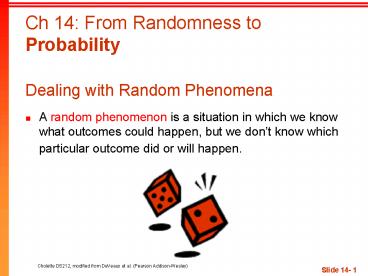
- A random phenomenon is a situation in which we
know what outcomes could happen, but we dont
know which particular outcome did or will happen.
2
Probability
- The probability of an event is its long-run
relative frequency. - While we may not be able to predict a particular
individual outcome, we can talk about what will
happen in the long run. - For any random phenomenon, each attempt, or
trial, generates an outcome. - These outcomes are individual possibilities, like
the number we see on top when we roll a die. - Sometimes we are interested in a combination of
outcomes, called an event - A die is rolled and comes up even or odd. These
are both events! - When thinking about combinations of outcomes,
things are easiest if the individual trials are
independent. - The outcome of one trial doesnt influence or
change the outcome of another. (e.g. coin tosses,
die rolls)
3
The Law of Large Numbers
- The Law of Large Numbers (LLN) says that the
long-run relative frequency of repeated
independent events gets closer and closer to the
true relative frequency as the number of trials
increases. - Consider flipping a fair coin many, many times.
The overall percentage of heads should settle
towards about 50. - A common misunderstanding of the LLN is that
random phenomena are supposed to compensate for
whatever happened in the past. This is not true. - When flipping a fair coin, if heads comes up on
each of the first 10 flips, what is the chance it
will land tails next ?
4
Probability
- Thanks to the LLN, we know that relative
frequencies settle down in the long run, so we
can officially give the name probability to that
value. - Probabilities must be between 0 and 1, inclusive.
- A probability of 0 indicates impossibility.
- A probability of 1 indicates certainty.
5
Equally Likely Outcomes
- When probability was first studied, a group of
French mathematicians looked at games of chance
in which all the possible outcomes were equally
likely. - Its equally likely to get any one of six
outcomes from the roll of a fair die. - Its equally likely to get heads or tails from
the toss of a fair coin. - However, keep in mind that events are not always
equally likely. - A skilled basketball player has a better than
50-50 chance of making a free throw. - your stats professor has much less than a 50-50
chance!
6
Personal Probability
- In everyday speech, when we express a degree of
uncertainty without basing it on long-run
relative frequencies, we are stating subjective
or personal probabilities. - Personal probabilities lack the consistency that
we need probabilities to have, so well stick
with formally defined probabilities in this class.
7
Formal Probability
- Two requirements for a probability
- A probability is a number between 0 and 1.
- For any event A, 0 P(A) 1.
8
Formal Probability (cont.)
- Something has to happen rule
- The probability of the set of all possible
outcomes of a trial must be 1. - P(S) 1 (S represents the set of all possible
outcomes.)
9
Formal Probability (cont.)
- Complement Rule
- The set of outcomes that are not in the event A
is called the complement of A, denoted AC. - The probability of an event occurring is 1 minus
the probability that it doesnt occur P(A) 1
P(AC)
This is a Venn Diagram, which is discussed more
in Chapter 15
10
Formal Probability (cont.)
- Addition Rule
- Events that have no outcomes in common (and,
thus, cannot occur together) are called disjoint
(or mutually exclusive).
11
Formal Probability (cont.)
- Addition Rule
- For two disjoint events A and B, the probability
that one or the other occurs is the sum of the
probabilities of the two events. - P(A or B) P(A) P(B), provided that A and B
are disjoint.
12
Formal Probability (cont.)
- Multiplication Rule
- For two independent events A and B, the
probability that both A and B occur is the
product of the probabilities of the two events. - P(A and B) P(A) x P(B), provided that A and B
are independent.
- Two independent events A and B are not
disjoint, provided that each of these events has
a probability greater than zero
13
Formal Probability (cont.)
- Multiplication Rule- Independence
- Many Statistics methods require an Independence
Assumption, but assuming independence doesnt
make it true. - Always Think about whether that assumption is
reasonable before using the Multiplication Rule.
14
Formal Probability - Notation
- Notation alert
- In this text we use the notation P(A or B) and
P(A and B). - In other situations, you might see the following
- P(A ? B) instead of P(A or B)
- P(A ? B) instead of P(A and B)
15
Putting the Rules to Work
- In most situations where we want to find a
probability, well use the rules in combination. - A point to remember is that it can be easier to
work with the complement of the event were
really interested in.
16
What Can Go Wrong?
- Beware of probabilities that dont add up to 1.
- To be a legitimate probability distribution, the
sum of the probabilities for all possible
outcomes must total 1. - Dont add probabilities of events if theyre not
disjoint. - Events must be disjoint to use the Addition Rule.
- Dont multiply probabilities of events if theyre
not independent. - The multiplication of probabilities of events
that are not independent is one of the most
common errors people make in dealing with
probabilities. - Dont confuse disjoint and independentdisjoint
events cant be independent.
17
What have we learned?
- Probability is based on long-run relative
frequencies. - The Law of Large Numbers speaks only of long-run
behavior. - Watch out for misinterpreting the LLN.
- There are some basic rules for combining
probabilities of outcomes to find probabilities
of more complex events. We have the - First check if probabilities for individual
outcomes make sense - Then..
- Something Has to Happen Rule
- Complement Rule
- Addition Rule for disjoint events
- Multiplication Rule for independent events
- Also always do a Sanity Check on your results.
If your calculations give you a probability
greater than 1 or less than 0, you know youve
made a mistake!
18
Example
- 11 A consumer organization estimates that over
a 1 year period, 17 of cars will need to be
repaired once, 7 will need to be repaired twice
and 4 will require 3 or more repairs (regardless
of car make or year, apparently). According to
this study, what is the probability that a random
car will need - No repairs
- No more than 1 repair
- Some repairs
19
Example
- 13 15 Now assume you have 2 cars. Using the
info from the prior study, what is the
probability that - Neither car needs repairs?
- Both will need repairs?
- At least 1 car will need to be repaired?
- What needs to be true about the cars to make this
approach valid? Is it a reasonable assumption?
20
More Examples
- 24 The American Red Cross says 45 of the US
population has Type O blood, 40 Type A , 11
Type B and the rest Type AB (although in reality
there are other rarer types, we will assume they
do not exist now). - If someone has volunteered to give blood, what is
the probability this donor is - Type AB
- Has either Type A or Type B
- Is not Type O
- For the next 4 donors that walk in, what is the
probability that - They are all Type O
- No one is Type A
- They are all not Type A (note this is different
than 2b!) - At least 1 person is Type B?
- What has to be true for us to do this? Is this
assumption justified?
21
Yet More Examples
- 36 You are drawing cards out of a standard deck
(52 cards, no jokers) that youve just shuffled.
The first 10 cards you have drawn are all red.
You start thinking The next one has got to be
black - Are you absolutely correct in your reasoning?
- Is it more likely that you might draw a black
than red card? - Compute the probability of drawing
- a red card next.
- a black card next.
- Is this an example of the Law of Large numbers?
Recommended

