

Classification of Cost Behavior PowerPoint PPT Presentation
1 / 9
Title: Classification of Cost Behavior
1
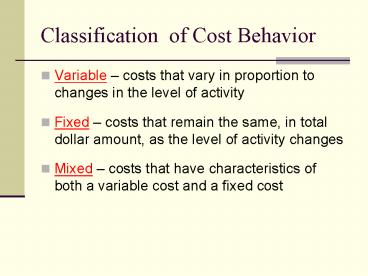
Classification of Cost Behavior
- Variable costs that vary in proportion to
changes in the level of activity - Fixed costs that remain the same, in total
dollar amount, as the level of activity changes - Mixed costs that have characteristics of both a
variable cost and a fixed cost
2
High-Low Method
- Estimation method used to split Mixed Costs
- into fixed and variable components
- Uses highest and lowest activity levels, and
- related costs, to estimate variable cost per unit
- and fixed cost component of mixed costs
- TC (VC x units of production) FC
3
Cost-Volume-Profit Analysis
- Systematic examination of the relationships
- among selling prices, sales and production
- volume, costs, expenses, and profits
- Provides management with useful information
- for decision making
4
Contribution Margin Concept (1)
- Contribution Margin - excess of sales revenues
over - variable costs
Useful in business planning because it gives
insight into the profit potential of a firm
5
Contribution Margin Concept (2)
- Contribution Margin Ratio (Profit-Volume Ratio)
- indicates the of each sales dollar available to
cover - Fixed Costs and to provide income from operations
Sales Variable costs Contribution margin ratio
--------------------------------
Sales 1,000,000 - 600,000 CMR
----------------------------------- 40
1,000,000
Measures the effect of an increase or decrease in
sales volume on income from operations most
useful when increase/decrease in sales volume is
measured in sales dollars
6
Contribution Margin Concept (3)
- Unit Contribution Margin sales price variable
cost - per unit of product
UCM unit selling price unit variable cost
8 20 -
12 Increase sales by 15,000 units 8 x 15,000
120,000 increase in income
Most useful when increase/decrease in sales
volume is measured in sales units
7
Mathematical Approach to Cost-Volume-Profit
Analysis (1)
- Uses equations to
- Determine the units of sales necessary to achieve
the break-even point in operations - Determine the units of sales necessary to achieve
a target or desired profit
8
Break-Even Point (2)
- Level of operations where revenues and
- expenses are exactly equal (no income or loss)
Fixed costs Break-even sales (units)
-------------------------------
Unit contribution
margin 90,000 Break-even
sales (units) --------------------------------
9,000 units
10
Useful in business planning, especially when
expanding or decreasing operations
9
Target Profit (3)
- Profit desired by management can be
- estimated by modifying the Break-Even
- equation
Fixed costs Target
profit Sales (units) --------------------------
----------- Unit
contribution margin 200,000
100,000 Sales (units) -------------------------
------- 10,000 units
30
Useful in business planning since the goal of
most managers is to maximize profits
Recommended

