

Recent political relations between Japan and the two Koreas PowerPoint PPT Presentation
1 / 14
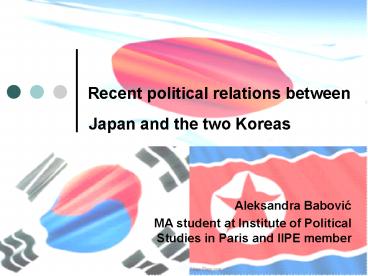
Title: Recent political relations between Japan and the two Koreas
1
Recent political relations between
Japan and the two Koreas
- Aleksandra Babovic
- MA student at Institute of Political Studies in
Paris and IIPE member
2
Introduction
- Normalization
- Japan South Korea (ROK) - Treaty on
Basic Relations in 1965 motivated by economic aid
(500) - Japan North Korea (DPRK) trade
relations initiated in 1961 while unofficial
political relations established in 70s - Nixon-Sato Communiqué in 1969 - Korean clause
the security of the Republic of Korea is
essential to Japans own security - 80s favorable to the normalization talks
between Japan DPRK, but from 90s till today
they never resumed. - Common point unsolved historical issues from
Japanese occupation of Korean Peninsula
(1910-1945) mutual resentment
3
Thesis
- The current state of Japan and two Koreas recent
political relations (from the end of the Cold
war) dualistic with ROK and worsening with
DPRK. - The near future no likely to ameliorate -
peoples mentalities and lack of pragmatic
diplomacy - Prospective Japans normalization process with
DPRK and deepening of political ties with ROK
still remain a long run goas for its diplomacy.
4
Japan DPRK relations Sad State of Play and Sad
Prospects
- Normalization process unreachable goal of two
diplomacies - September 1990 - Three-Party Declaration
encouraged apology and compensation from Japan - Shift in Japanese policy toward DPRK (ROK and US
pressure) inspection of nuclear facilities by
IAEA as pre-condition normalization talks
postponed until the new Millennium - 1994 North Korean nuclear crisis and launching of
a Taepodong missile in 1998 friction between
US-ROK-Japan - September 2001 Pyongyang Declaration violation
- Adoption of a hard-line policy toward DPRK -
abduction issue as a top priority on governments
agenda
5
B. Resolving the thorny abduction issue
- Abductees 13 Japanese nationals, mostly young
people, who were abducted to North Korea (1977 to
1982) in order to participate in training of
espionage agents - Kim Jong Ils 2002 confirmation
- Diplomatic efforts 5 abductees returned in
Japan BUT unconfident information on others
pressure groups reason why Japan did not
redraw from this question
6
C. Japans role in DPRK denuclearization
within the Six-Party Talks
- Six-Party Talks- the international forum aiming
at denuclearization of DPRK initiated in 2003 - The "stop and go negotiations - erratic posture
of DPRK and divergent approaches of parties
involved - Six-Party Talks - a second place for Japan for
making potential breakthroughs on the sensitive
abduction issue by pairing it up with
denuclearization process
7
D. North Korea as a security threat to Japan
- Nuclear tests from 1998 - a wake-up call for
Japan - The US- Japan regional missile defense system
- Frequent smuggling of North Korean spy ships
introduction of unilateral sanction in 2006 by
Japan against DPRK (ships, goods, persons, and
surveillance of money transactions) - Explanation of the hard-line approach
8
D. North Korea as a security threat to Japan
- Nuclear tests from 1998 - a wake-up call for
Japan - The US- Japan regional missile defense system
- Frequent smuggling of North Korean spy ships
introduction of unilateral sanction in 2006 by
Japan against DPRK (ships, goods, persons, and
surveillance of money transactions) - Explanation of the hard-line approach
9
E. April 2009 ballistic launch new
developments and their impact on the future
- 2009 Ballistic Launch or communication satellite
launch, DPRK expelled IAEA inspectors, threats
to resume its nuclear program - September 2009 announcement we entered the
final phase of weaponizing plutonium and we are
prepared for both, dialogue and sanctions - A real military threat or a tactical move?
- Possible shift on the agenda abduction issue is
to be topped by denuclearization issue - Newly elected Yukio Hatoyama continuation of a
hard-line policy
10
2. Japan- South Korea relations
- A. The future-oriented and pragmatic political
relations between Japan and ROK remain a goal
difficult to achieve in the near future - Future oriented statements strained by periodical
flare-up of historical issues - 1998 Joint Statement of a New ROK-Japan
Partnership toward the Twenty-First Century and
Roh Moo Hyun Premier Koizumi meeting - The historical international politics or
historical disputes involve the battle for the
power or to be more precise, it becomes an arena
when power dominates. - Different perception of political and strategic
environment of three key regional players
impediment for building more strategic
alliance between Japan and ROK
11
B. Periodical flare-ups of historical and
territorial issues as a major impediment for full
reconciliation of Japan-ROK ties
- The comfort women 1992 official documents
revealed the involvement of Japanese Imperial
Army - 1993 Kono Statement (Government admitted its
moral responsibility for comfort women,
apologized for their mental and physical
sufferings, promised it would never repeat the
same mistake and teach about it to future
generations ) BUT never admitted legal
responsibility - Abe Shinzos 2007 denial of comfort women,
controversy with textbooks negative impact on
Korean public opinion - The problem of Asian/Womens Fund created in 1995
- The international dimension Canada, GB, the US,
the UN and the EU Parliament passed resolutions
making pressure over Japan
12
B. Periodical flare-ups of historical and
territorial issues as a major impediment for full
reconciliation of Japan-ROK ties
- The issue of Takeshima or Dokdo in 1905 put
under Japanese authority - 1952 Singhman Ree Line and two years later,
Korean military presence on the islands - The territorial dispute is also result of the US
cold war policy - 1954 and 1962 attempt of Japan for peaceful
resolving of issue via ICJ (International Court
of Justice) - Dokdo is like a volcano, ready to erupt every
time a minor incident happens
13
C. Could Japan and ROK be a good neighbors
despite of their history burden?
- Fertile ground for establishing a good political
neighbor policy - Significant level of cultural and economic
exchanges between ROK and Japan (J-Wave and
K-Wave) - Japan is Roks second largest trade partner,
while the latter is the third one to Japan (2007) - Frequent diplomatic visits on both sides
- BUT the demons of history continue and will
continue to haunt Japan-Korea relations
14
- Thank you for your attention!
- ?????????????
Recommended

