

EXTENSION OF 1D MODEL TO INCLUDE BANK EROSION AND FLOODPLAIN DEPOSITION PowerPoint PPT Presentation
1 / 13
Title: EXTENSION OF 1D MODEL TO INCLUDE BANK EROSION AND FLOODPLAIN DEPOSITION
1
CHAPTER 15 EXTENSION OF 1D MODEL TO INCLUDE BANK
EROSION AND FLOODPLAIN DEPOSITION
It was noted in the last chapter that rivers are
different in many ways from laboratory flumes.
One important way in which they are different is
that they do not have infinitely high, vertical,
non-erodible sidewalls. The example of the
straightened East Prairie River, Canada given in
Chapter 2 serves to illustrate this.
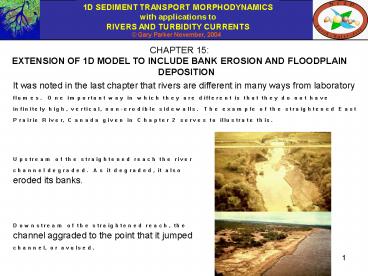
Upstream of the straightened reach the river
channel degraded. As it degraded, it also eroded
its banks. Downstream of the straightened
reach, the channel aggraded to the point that it
jumped channel, or avulsed.
2
DEGRADATION AND BANK EROSION
The Little Wekiva River drains a now
heavily-urbanized area in the northern suburbs of
Orlando, Florida, USA. The stream was
straightened, and the floodplain filled in in the
period 1940 1970.
Urbanization of the basin a) reduced
infiltration, increasing the severity of floods,
and b) cut off most of the supply of sediment to
the stream. As a result, the stream degraded
severely and produced substantial bank (sidewall)
erosion.
3
COUNTERMEASURES FOR THE LITTLE WEKIVA RIVER NORTH
OF ORLANDO, FLORIDA
Countermeasures for the problem included both
bank protection and grade control (drop)
structures.
A morphodynamic model of the river considering
both bed and bank erosion helped in the design of
these countermeasures.
4
1D EXNER EQUATION OF SEDIMENT CONTINUITY
INCLUDING SIDEWALL EROSION
If channel degradation is sufficiently severe,
the former floodplain surface eventually becomes
a terrace, rarely or never flooded by the river.
As the river cuts down, it takes out sidewall
material on both sides. In a simple 1D model,
this rate is equal on both sides. Some
parameters are defined below.
- Bb channel bottom width,
- here assumed constant
- bed elevation
- ?t elevation of top of bank
- (former floodplain)
- Qt volume bed material transport rate
- Ss sidewall slope ( constant)
- ?p porosity of the bed and bank deposits
- Bs width of sidewall zone on one side
- Is volume rate of input per unit length
- of sediment from sidewalls
5
1D EXNER EQUATION OF SEDIMENT CONTINUITY
INCLUDING SIDEWALL EROSION contd.
The width Bs of the sidewall zone on one side is
given geometrically from the relation As the
bed degrades a distance ??, the volume of bed
sediment removed per unit stream length is
(1-?p)Bb ?? and the amount of sidewall sediment
removed from one side is (1-?p)Bs ??
(1-?p)(?t-?)??/Ss
The volume rate of supply of material from both
sidewalls per unit stream length is thus given
as (e.g. Cui et al., in press). Note that Is
gt 0 for ??/?t lt 0 (degradation)
6
1D EXNER EQUATION OF SEDIMENT CONTINUITY
INCLUDING SIDEWALL EROSION contd.
The bank material may contain sediment that moves
as bed material load and wash load. Let fbb
denote the volume fraction of bank material that
is coarse enough to move as bed material load.
Sediment balance for the control volume takes the
form
?/?t(mass of bed sediment) input rate from
upstream output rate to downstream input rate
from sidewalls
This term is positive for a degrading channel
or reducing,
7
1D EXNER EQUATION OF SEDIMENT CONTINUITY
INCLUDING SIDEWALL EROSION contd.
The Exner equation for sediment conservation for
a degrading channel with sidewall erosion thus
reduces to the form or recalling that Qt
Bbqt and Bb is assumed to be constant,
extra term
Thus sidewall erosion suppresses but does not
stop channel degradation.
8
AGGRADATION AND CHANNEL SHIFT
The Kosi River flows southward from the Himalaya
Mountains to the Ganges River, visible at the
bottom of the image. As the Kosi River comes out
of the Himalayas, bed slope is greatly reduced,
causing sediment to deposit. The channel
aggrades, then shifts repeatedly to build up the
entire surface of the fan. In the long term,
then, the depositional width is the width of the
fan, not the width of the river bed. Gradual
channel shift is referred to as migration sudden
shift is referred to as avulsion.
Kosi River and Fan, India. Satellite image from
the web.
9
CHANNEL SHIFTING ON THE KOSI FAN
The map shows channels of the Kosi River from
1731 to 1963. The channel shifts are associated
with floods. The fan is densely inhabited, so
that migration and avulsion create considerable
human hardship. At present the river has been
jacketed in place with dikes on the western
edge of the fan. This is unlikely to be a
permanent solution the river will eventually
overwhelm its dikes and begin avulsing again.
Channel shift on the Kosi Fan. Adapted from Gole
and Chitale (1966).
10
CAN AVULSION OF A CHANNEL SUBJECTED TO LONG-TERM
AGGRADATION BE PREVENTED?
The Kusatsu River flows from a mountainous region
onto the densely populated plains surrounding
Lake Biwa, Japan. The river has not been allowed
to avulse for hundreds of years. As a result,
the river bed is so high that a tunnel has been
excavated underneath it to allow traffic to pass
under the river.
View from levee looking toward river.
View looking behind from same point on levee.
11
AGGRADATION WITH CHANNEL SHIFT WITHIN A
WELL-DEFINED FLOODPLAIN
Scroll bars denote channel migration
Abandoned channel denotes avulsion
The Missouri River has a well-defined floodplain
within high valley walls. Since the construction
of Garrison Dam in 1956 and the subsequent
formation of Lake Sakakawea behind it, base level
has been raised on the river. The river bed must
aggrade as the delta progrades into Lake
Sakakawea. Aggradation gradually fills the
entire width of the floodplain through gradual
channel migration and sudden channel avulsion.
Floodplain width
Missouri River at the upstream end of Lake
Sakakawea, North Dakota, USA. Image from
NASA https//zulu.ssc.nasa.gov/mrsid/mrsid.pl
12
EXNER EQUATION FOR AGGRADATION WITH CHANNEL SHIFT
Assume that bed material load is transported
within a channel of constant width B, but is
deposited across the width of the floodplain Bf.
The channel sinuosity ? is defined to be the
ratio between average down-channel distance x and
average down-valley distance xv between the same
points for meandering rivers ? is often between
1.5 and 3.
In the average over many bends,
Thus the reach-averaged, long-term form of the
Exner equation becomes
(e.g. Parker et al., 1998 Cui et al. 1998). The
relation applies for ??/?t gt 0. Floodplain
deposition suppresses but does not stop channel
aggradation.
13
REFERENCES FOR CHAPTER 15
Cui, Y. and Parker, G, 1998, The arrested gravel
front stable gravel-sand transitions in rivers.
Part 2 General numerical solution, Journal of
Hydraulic Research, 36(2), 159-182. Cui, Y.,
Parker, G., Braudrick, C., Dietrich, W. E., and
Cluer, B, in press, Dam Removal Express
Assessment Models (DREAM). Part 1 Model
development and validation, Journal of Hydraulic
Research. Gole, C. V. and Chitale, S. V., 1966,
Inland delta building activity of the Kosi River,
Journal of Hydraulic Engineering, ASCE, 92(2),
111-126. Parker, G. and Cui, Y., 1998, The
arrested gravel front stable gravel-sand
transitions in rivers. Part 1 Simplified
analytical solution, Journal of Hydraulic
Research, 36(1), 75-100.
Recommended

