

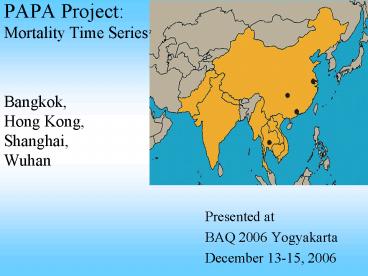
PAPA Project: Mortality Time Series Bangkok, Hong Kong, Shanghai, Wuhan PowerPoint PPT Presentation
1 / 29
Title: PAPA Project: Mortality Time Series Bangkok, Hong Kong, Shanghai, Wuhan
1
PAPA ProjectMortality Time Series Bangkok,
Hong Kong, Shanghai, Wuhan
- Presented at
- BAQ 2006 Yogyakarta
- December 13-15, 2006
2
PAPA group First Wave
Bangkok N Vichit-Vadakan, N Vajanapoom, B
Ostro Hong Kong CM Wong, JSM Peiris, TQ Thach,
PYK Chau, KP Chan, RY Chung, GN Thomas, TH Lam,
TW Wong, and AJ Hedley Shanghai HD Kan, BH
Chen, NQ Zhao, GX Song, GH Chen, LL Jiang, and YH
Zhang Wuhan Z Qian, Q He, HM Lin, L Kong, D
Zhou, D Liao, W Liu, CM Bentley, J Dan, B Wang,
N Yang, S Xu, J Gong, H Wei, H Sun, and Q Zudian
3
PAPA First Wave
WHY ?
Shanghai
Wuhan
Hong Kong
Bangkok
4
Selection Criteria
- Data Availability and Accessibility
- Research capacity and experience
- Investigators interest
5
PAPA ProjectMulti-City Study
- One major goal
- Compare results across the cities
- Factors similarities or differences
- Air pollution
- Climate
- Population characteristics
- Economic structure
- Health status and health care system
- Etc
6
PAPA Project Multi-City StudyApproach
- Similar Research Methodology
- Common research protocol
- Existing literature
- Inputs from experts
- Participatory process
- Data Collection
- Mortality Data
- Air pollution Data
- Data Analysis
7
Common Protocol for Mortality Data
8
Common Protocol for Pollutant Measurement
- General monitoring stations
- Days with data gt75 of hourly measurements
- Daily mean 24 hours for NO2, SO2 and PM10
- 8 hours for O3
- Stations with data gt 75 daily data for study
period - The same stations for the whole period
- Simple average without filling in missing data
was used to compute the daily mean
9
Commonality Vs. Specifics
- Specifics
- Bangkok
- Effects of economic recession in 1997
- Hong Kong
- Effects of influenza
- Wuhan
- Effects of temperature
- Commonality
- Risk estimates of air pollution on mortality
- Combined
- City specific
10
Methods and Recent Results
11
Mortality data
12
Plots of daily death counts for all natural
causes
Clearer seasonal cycle when we go further north.
13
PM10
NO2
?g/m3
?g/m3
O3
SO2
?g/m3
?g/m3
14
Establishment of core model
- Poisson regression in a Generalized Additive
Model (GAM) - where
- E(y)Expected daily mortality counts
- X air pollutant concentration
- Z dummy variables
- ? covariates
- ?i regression coefficients
- df 3 df for temperature and humidity
- 4-6 df per year for time
subject to city conditions - s smoothers based on natural spline method
15
Criteria/methods for adequte model
- When PACF lt 0.1 for the lag 1-2 days, the core
model is regarded as adequate. - The following 3 methods were established to meet
these criteria - Localized smoothing (WH)
- Inclusion of epidemic variables (defined by
weekly respiratory mortality gt90th percentile)
(HK) - Introduction of auto-regression terms (HK, SH)
16
- Cross validation of results
- To ensure the results free from technical errors
- Pair up cities (HK-WH, BK-SH)
- Provide data in a standardized format with core
models - Replicate estimates of PM10 and NO2 on
- all causes
- cardiovascular mortality
- Preliminary results showed no differences
- between original and replicated estimates
17
Comparison of results across cities
All natural causes all ages
PM10
Excess risk per10?g/m3 ()
BK had the biggest but less precise ER than the
others
18
NO2
Excess risk per 10?g/m3 ()
All cities had similar ER and lag structure
19
SO2
Excess risk per 10?g/m3 ()
Similar ERs across cities, but less precise in BK
and non-significant in WH.
20
O3
Excess risk per 10?g/m3 ()
Similar ERs and 95 CIs among all cities, though
not significant for HK and WH.
21
Co-pollutant model
PM10
S single effect C1 adjust NO2 C2 adjust
SO2 C3 adjust O3
Excess risk per 10?g/m3 ()
After adjusting for NO2, ER for PM10 attenuated
and became non-significant in all the Chinese
cities
22
Meta analysis
The p-value for test of homogeneity lt0.001
23
Meta analysis
- The p-value for test of homogeneity lt0.05
- The p-value for test of homogeneity lt0.001.
24
Sensitivity analysis
All natural causes, Lag day 0
ER changed gt20 in blue colour.
25
- In general the estimates were robust to the
sensitivity analysis - However, some estimates were sensitive to
exclusion of higher PM10 concentrations and the
traffic related stations - The estimates were different during warm season,
but were quite robust using different methods in
dealing with missing data and in data analysis
(data not shown)
26
Effects for NO2 higher but PM10 slightly lower
than European estimates while SO2 and O3 were
similar.
Comparison with other coordinated study
All natural causes ER per 10mg/m3 with random
effect
27
Discussion
- There are similarities as well as discrepancies
in effect estimates within PAPA cities with
varying air pollution levels, and socio-economic
and environmental conditions - The combined estimates from the 4 PAPA cities are
largely consistent with those from other
multi-city studies, except from NO2 which is
three times as high as that from the European
studies - Further sensitivity analysis may help to validate
the results and throw light on the sources of
variations - Larger number of cities is need to consolidate
the results
28
Way forward
- Joining with the second wave India cities
To form Bigger PAPA.
29
Acknowledgment HEI for funding
Recommended

