

Session 1: Skills ? Memory ? 1 - Essentials PowerPoint PPT Presentation
1 / 1
Title: Session 1: Skills ? Memory ? 1 - Essentials
1
Session 1 Skills ? Memory ? 1 - Essentials
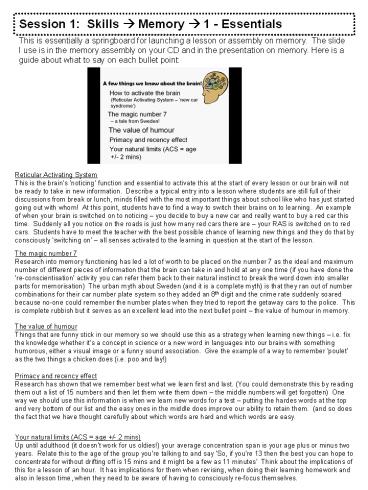
This is essentially a springboard for launching a
lesson or assembly on memory. The slide I use is
in the memory assembly on your CD and in the
presentation on memory. Here is a guide about
what to say on each bullet point
Reticular Activating SystemThis is the brains
noticing function and essential to activate
this at the start of every lesson or our brain
will not be ready to take in new information.
Describe a typical entry into a lesson where
students are still full of their discussions from
break or lunch, minds filled with the most
important things about school like who has just
started going out with whom! At this point,
students have to find a way to switch their
brains on to learning. An example of when your
brain is switched on to noticing you decide to
buy a new car and really want to buy a red car
this time. Suddenly all you notice on the roads
is just how many red cars there are your RAS is
switched on to red cars. Students have to meet
the teacher with the best possible chance of
learning new things and they do that by
consciously switching on all senses activated
to the learning in question at the start of the
lesson.
The magic number 7Research into memory
functioning has led a lot of worth to be placed
on the number 7 as the ideal and maximum number
of different pieces of information that the brain
can take in and hold at any one time (if you have
done the re-conscientisation activity you can
refer them back to their natural instinct to
break the word down into smaller parts for
memorisation) The urban myth about Sweden (and
it is a complete myth) is that they ran out of
number combinations for their car number plate
system so they added an 8th digit and the crime
rate suddenly soared because no-one could
remember the number plates when they tried to
report the getaway cars to the police. This is
complete rubbish but it serves as an excellent
lead into the next bullet point the value of
humour in memory.
The value of humourThings that are funny stick
in our memory so we should use this as a strategy
when learning new things i.e. fix the knowledge
whether its a concept in science or a new word
in languages into our brains with something
humorous, either a visual image or a funny sound
association. Give the example of a way to
remember poulet as the two things a chicken
does (i.e. poo and lay!)
Primacy and recency effectResearch has shown
that we remember best what we learn first and
last. (You could demonstrate this by reading them
out a list of 15 numbers and then let them write
them down the middle numbers will get
forgotten) One way we should use this
information is when we learn new words for a test
putting the hardes words at the top and very
bottom of our list and the easy ones in the
middle does improve our ability to retain them.
(and so does the fact that we have thought
carefully about which words are hard and which
words are easy.
Your natural limits (ACS age /- 2 mins)Up
until adulthood (it doesnt work for us oldies!)
your average concentration span is your age plus
or minus two years. Relate this to the age of
the group youre talking to and say So, if
youre 13 then the best you can hope to
concentrate for without drifting off is 15 mins
and it might be a few as 11 minutes Think about
the implications of this for a lesson of an hour.
It has implications for them when revising, when
doing their learning homework and also in lesson
time, when they need to be aware of having to
consciously re-focus themselves.
Recommended

