

Quality of Service in Data Networks: Trends, Solutions, and Issues PowerPoint PPT Presentation
1 / 40
Title: Quality of Service in Data Networks: Trends, Solutions, and Issues
1
Quality of Service in Data Networks Trends,
Solutions, and Issues
- Raj JainThe Ohio State University
2
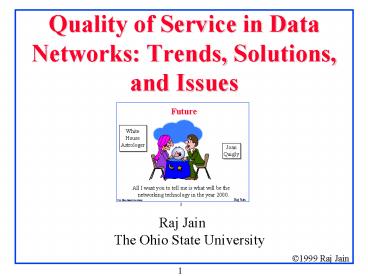
Future
White House Astrologer
Joan Quigly
- All I want you to tell me is what will be the
networking technology in the year 2000.
3
Overview
- 10 Trends in Networking
- QoS Approaches
- ATM
- IEEE 802.1D
- Integrated Services
- Differentiated Services
- MPLS
- Design Philosophies of each and problems
- These slides are available athttp//www.cse.ohio-
state.edu/jain/talks/icon99.htm
4
Ten Networking Trends
- 1. Faster Media
- 2. More Traffic
- 3. Traffic gt Capacity
- 4. Data gt Voice
- 5. ATM in Backbone
- 6. Everything over IP
- 7. Differentiation Not Integration
- 8. Back to Routing From Switching
- 9. Traffic Engineering
- 10. Other Trends
5
Dime Sale
- One Megabit memory, One Megabyte disk, One Mbps
link, One MIP processor, 10 cents each.....
6
Trend 1 Faster Media
- One Gbps over 4-pair UTP-5 up to 100 m10G being
discussed.Was 1 Mbps (1Base-5) in 1984. - Dense Wavelength Division Multiplexing (DWDM)
64OC-192 0.6 TbpsOC-768 40 Gpbs over a 1l
to 65 km Alcatel98400 Gbps using 80l
products.Was 100 Mbps (FDDI) in 1993. - 11 Mbps in-building wireless networksWas 1 Mbps
(IEEE 802.11) in 1998.2.5 Gbps to 5km using
light in open air
7
Trend 2 More Traffic
- Number of Internet hosts is growing
super-exponentially. - Traffic per host is increasing
- Cable modems allow 1 to 10 Mbps access from home
- 6-27 Mbps over phone lines using ADSL/VDSL
- Bandwidth requirements are doubling every 4 months
8
Trend 3 Traffic gt Capacity
- Expensive Bandwidth
- Sharing
- Multicast
- Virtual Private Networks
- Need QoS
- Likely in WANs
- Cheap Bandwidth
- No sharing
- Unicast
- Private Networks
- QoS less of an issue
- Possible in LANs
9
Trend 4 Data gt Voice
- Voice traffic is growing linearlyData traffic is
growing exponentially - In 1998-99, data traffic on carrier networks
exceeded the voice traffic. - Everyone is trying to get into the data business
- Phone Networks Þ High-speed frame relay
- Video Networks Þ Cable Modems
10
Data gt Voice (Cont)
- Past Data over Voice
- Future Voice over Data
- Convergence DataVoiceVideoATT TCI,
LucentAscend, NortelBaynetworks - Voice over DSL 16 lines Data over 1 UTP by
CLECs
11
Trend 5 ATM in Backbone
- Most carriers including ATT, MCI, Sprint, UUNET,
have ATM backbone - Over 80 of the internet traffic goes over ATM
- ATM provides
- Traffic management
- Voice Data Integration CBR, VBR, ABR, UBR
- Signaling
- Quality of service routing PNNI
- ATM cant reach desktop Designed by carriers.
Complexity in the end systems. Design favors
voice.
12
ATM QoS
Today
ATM
- Too much too soon
13
IEEE 802.1D Model
- Massive bandwidth. Simple priorities will do.
- Up to eight priorities Strict.
- 1 Background
- 2 Spare
- 0 Best Effort
- 3 Excellent Effort
- 4 Control load
- 5 Video (Less than 100 ms latency and jitter)
- 6 Voice (Less than 10 ms latency and jitter)
- 7 Network Control
14
IP vs ATM
1995-98
ATM
IP
15
Old House vs New House
- New needsSolution 1 Fix the old house (cheaper
initially)Solution 2 Buy a new house (pays off
over a long run)
16
Trend 6 Everything over IP
- Data over IP Þ IP needs Traffic engineering
- Voice over IP Þ Quality of Service and Signaling
- Internet Engineering Task Force (IETF) is the
center of action. Attendance at ATM Forum and
ITU is down.
17
Integrated Services
- 1. Best Effort Service Like UBR.
- 2. Controlled-Load Service Performance as good
as in an unloaded datagram network. No
quantitative assurances. Like nrt-VBR or UBR w
MCR - 3. Guaranteed Service rt-VBR
- Firm bound on data throughput and delay.
- Like CBR or rt-VBR
- Need a signaling protocol RSVP
- Design philosophy similar to ATM
- Per-flow
- End-to-end
- Signaling
18
Before Marriage
19
After Marriage
20
Problems with IntServRSVP
- Complexity in routers classification, scheduling
- Not scalable with of flowsÞ Not suitable for
backbone. - Need a concept of Virtual Paths or aggregated
flow groups for the backbone. - Need policy controls Who can make reservations?
Þ RSVP admission policy (rap) working group. - Receiver Based Need sender control/notifications
in some cases. - Soft State Need route/path pinning (stability).
- No negotiation and backtracking
- Note RSVP is being revived for MPLS and DiffServ
21
Trend 7 Differentiation Not Integration
d/dx
Þ
- DiffServ to standardize IPv4 ToS bytes first six
bits - Packets gets marked at network ingressMarking Þ
treatment (behavior) in rest of the netSix bits
Þ 64 different per-hop behaviors (PHB)
22
DiffServ (Cont)
- Per-hop behavior of link bandwidth, Priority
- Services End-to-end. Voice, Video, ...
- Transport Delivery, Express Delivery,...Best
effort, controlled load, guaranteed service - DS group will not develop servicesThey will
standardize Per-Hop Behaviors - Marking based on static Service Level
Agreements (SLAs). Avoid signaling.
23
Problems with DiffServ
- End-to-end ? S per-HopDesigning end-to-end
services with weighted guarantees at individual
hops is difficult.Only Expedited Forwarding will
work. - Designed for static Service Level Agreements
(SLAs)Both the network topology and traffic are
highly dynamic. - How to ensure resource availability inside the
network? - DiffServ is unidirectional Þ No receiver control
24
DiffServ Problems (Cont)
- QoS is for the aggregate not micro-flows.Not
intended/useful for end users. Only ISPs. - Large number of short flows are better handled by
aggregates. - Long flows (voice and video sessions) need
per-flow guarantees. - High-bandwidth flows (1 Mbps video) need per-flow
guarantees. - Þ DiffServ alone is not sufficient for
backbone.Signaling via RSVP will be required.
25
Trend 8 Back to Routing From Switching
- Routing Based on address lookup. Max prefix
match. Þ Search OperationÞ Complexity ?
O(log2n) - Switching Based on circuit numbers Þ Indexing
operation Þ Complexity O(1) Þ Fast and Scalable
for large networks and large address spaces - 128 Gbps IP forwarding Neo Networks 99
26
Multiprotocol Label Switching
- Label Circuit number VC Id
- Ingress router/host puts a label. Exit router
strips it off. - Switches switch packets based on labels.Do not
need to look inside ? Fast. - OC-192 (10 Gbps) routers from Nexabit. Þ
Switching for traffic engineering, not for speed.
27
Trend 9 Traffic Engineering
- Users Performance OptimizationÞ Maximum
throughput, Min delay, min loss, min delay
variation - Efficient resource allocation for the providerÞ
Efficient Utilization of all links Þ Load
Balancing on parallel pathsÞ Minimize buffer
utilization - Current routing protocols (e.g., RIP and OSPF)
find the shortest path (may be over-utilized). - QoS Guarantee Selecting paths that can meet QoS
- Enforce Service Level agreements
- Enforce policies Constraint based routing ? QoSR
28
Traffic Engineering Components
Signaling and Admission control
1
Policing
3
Shaping
2
Scheduling
5
Routing
4
Buffer Mgmt
6
7
Traffic Monitoring and feedback
29
MPLS Mechanisms for TE
- Signaling, Admission Control, Routing
- Explicit routing of Label Switched Paths (LSPs)
- Constrained based routing of LSPsAllows both
Traffic constraints and Resource Constraints
(Resource Attributes) - Hierarchical division of the problem (Label
Stacks) - Danger Too much too soonagain
30
QoS Design Approaches
- Massive Bandwidth vs Managed Bandwidth
- Per-Flow vs Aggregate
- Source-Controlled vs Receiver Controlled
- Soft State vs Hard State
- Path based vs Access based
- Quantitative vs Qualitative
- Absolute vs Relative
- End-to-end vs Per-hop
- Static vs Feedback-based
- Homogeneous multicast vs heterogeneous multicast
- 1-to-n multicast vs n-to-1 multicast
31
Comparison of QoS Approaches
Issue
ATM
IntServ
DiffServ
MPLS
IEEE
802.3D
Massive Bandwidth
Managed
Managed
Massive
Managed
Massive
vs Managed
Bandwidth
Per-Flow vs
Both
Per-flow
Aggregate
Both
Aggregate
Aggregate
Source-Controlled
Unicast
Receiver
Ingress
Both
Source
vs Receiver
Source,
Controlled
Multicast
both
Soft State vs Hard
Hard
Soft
None
Hard
Hard
State
Path based vs
Path
Path
Access
Path
Access
Access based
Quantitative vs
Quantitative
Mostly
Both
Qualitative
Quantitative
Qualitative
Qualitative
qualitative
Absolute vs Relative
Absolute
Absolute
Mostly
Absolute
Relative
Relative
relative
32
Comparison (Cont)
Issue
ATM
IntServ
DiffServ
MPLS
IEEE
802.3D
End-to-end vs Per-
end-end
end-end
Per-hop
end-end
Per-hop
hop
Static vs Feedback-
Both
Static
Static
Static
Static
based
Homogeneous
Homo-geneous
Hetero-geneous
N/A
N/A
multicast vs
Homo-geneous
heterogeneous
multicast
1-to-n vs n-to-1
1-to-n
1-to-n
N/A
Both
Both
multicast
33
10. Other Trends
- LANMAN convergence EtherLoop
- Packet over ATM vs SONET vs DWDM
- Network Economy In 1999, revenues by
Internet-based Corporations exceed that of
Internet equipment vendors - Networking is the key to a Corporations
(countrys/individuals) success - Information Glut Þ Intelligent agents for
searching, digesting, summarizing information - Mobility, Security
34
Summary
- Super-exponential increase in data traffic and
voice over IP Þ Traffic Engineering and QoS over
IP - ATM and Integrated Services are based on per-flow
end-to-end guarantees using signaling. - DiffServ provide aggregate per-hop treatment.
Meaningful services yet to be designed. - MPLS combines the best of ATM and IP.Must avoid
becoming too complex too soon.
35
References
- References on MPOA, MPLS, and IP Switching,
http//www.cse.ohio-state.edu/jain/refs/ipsw_ref.
htm - Quality of Service using Traffic Engineering over
MPLS An Analysis, http//www.cse.ohio-state.edu/
jain/papers/mpls-te-anal.htm - IP Switching, http//www.cse.ohio-state.edu/jain/
cis788-97/ip_switching/index.htm - References on QoS over IP, http//www.cse.ohio-sta
te.edu/jain/refs/ipqs_ref.htm - IP Switching Issues and Alternatives,
http//www.cse.ohio-state.edu/jain/talks/ipsw.htm
36
References (Cont)
- Quality of Service in IP Networks,
http//www.cse.ohio-state.edu/jain/talks/ipqos.ht
m - Requirements for Traffic Engineering over MPLS,
draft-ietf-mpls-traffic-eng-01.txt - Constraint-based LSP Setup using LDP,
draft-ietf-mpls-cr-ldp-01.txt
37
Acronyms
- ATM Asynchronous Transfer Mode
- CBR Constant Bit Rate
- CDV Cell Delay Variation
- DS Differentiated Services
- DVD Digital Video Disks
- DWDM Dense Wavelength Division Multiplexing
- FDDI Fiber Distributed Data Interface
- IEEE Inst. of Elect. and Electronic Engineers
- IETF Internet Engineering Task Force
- IP Internet Protocol
- ISP Internet Service Provider
38
Acronyms (Cont)
- LAN Local Area Network
- LSP Label Switched Path
- MCR Minimum Cell Rate
- MIPS Millions of Instructions Per Second
- MPLS Multiprotocol Label Switching
- MPOA Multiprotocol over ATM
- OC Optical Carrier
- PHB Per-hop Behavior
- PNNI Private Network-Node Interface
- QoS Quality of Service
- QoSR Quality of Service Routing
39
Acronyms (Cont)
- RIP Routing Information Protocol
- RSVP Resource Reservation Protocol
- SLA Service Level Agreement
- ToS Type of Service
- UBR Unspecified Bit Rate
- UTP Unshielded Twisted Pair
- VBR Variable Bit Rate
- VC Virtual Circuit
- VP Virtual Path
40
Thank You!
41
ATM QoS Issues
- Cant easily aggregate QoS VP S VCs
- Cant easily specify QoS What is the CDV
required for a movie? - Signaling too complex Þ Need Lightweight
Signaling - Need Heterogeneous Point-to-Multipoint
Variegated VCs - Need QoS Renegotiation
- Need Group Address
- Need priority or weight among VCs to map DiffServ
and 802.1D
42
Expedited Forwarding
- Also known as Premium Service
- Virtual leased line
- Similar to CBR
- Guaranteed minimum service rate
- Policed Arrival rate lt Minimum Service Rate
- Not affected by other data PHBs Þ Highest data
priority (if priority queueing) - Code point 101 110
43
Assured Forwarding PHB Group
- Four Classes No particular ordering
- Three drop precedences
- Code Points
44
Near Future
- DiffServ past the marriage phase
- MPLS provides QoS and traffic engineering or
dies of complexity - Bandwidth is still expensiveÞ Entertainment
Video on networks not soon - Local video is coming via DVDs
- Voice and Data over video networks (Cable)
Almost free voice. - Frame-based ATM
- Terabit Ethernet
Recommended

