

Elasticity of Substitution PowerPoint PPT Presentation
1 / 19
Title: Elasticity of Substitution
1
Elasticity of Substitution
- How easy is it to substitute one input for
another??? - Production functions may also be classified in
terms of elasticity of substitution - Shape of a single isoquant
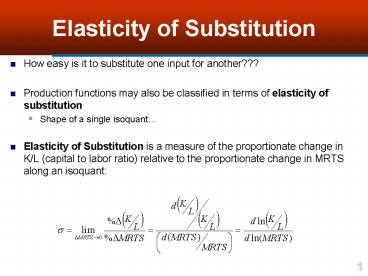
- Elasticity of Substitution is a measure of the
proportionate change in K/L (capital to labor
ratio) relative to the proportionate change in
MRTS along an isoquant
2
Note Throughout
- Book uses ? for substitution elasticity
- I use s
- They are the same ? s
- It just seems to me that s is used more often in
the literature.
3
Elasticity of Substitution
- Movement from A to B results in
- L becomes bigger, K becomes smaller
- capital/labor ratio (K/L) decreasing
- MRTS -dK/dL MPL/MPK
- gt MRTSKL decreases
- Along a strictly convex isoquant, K/L and MRTS
move in same direction - Elasticity of substitution is positive
- Relative magnitude of this change is measured by
elasticity of substitution - If it is high, MRTS will not change much relative
to K/L and the isoquant will be less curved (less
strictly convex) - A low elasticity of substitution gives rather
sharply curved isoquants
MRTSA
MRTSB
4
Elasticity of Substitution Perfect-Substitute
- ? ?, a perfect-substitute technology
- Analogous to perfect substitutes in consumer
theory - A production function representing this
technology exhibits constant returns to scale - (?K, ?L) a?K b?L ?(aK bL) ?(K, L)
- All isoquants for this production function are
parallel straight lines with slopes -b/a
5
Elasticity of substitution for perfect-substitute
technologies
s 8
6
Elasticity of Substitution Leontief
- ? 0, a fixed-proportions (or Leontief )
technology - Analogous to perfect complements in consumer
theory - Characterized by zero substitution
- A production technology that exhibits fixed
proportions is
- This production function also exhibits constant
returns to scale
7
Elasticity of substitution for fixed-proportions
technologies
- Capital and labor must always be used in a fixed
ratio - Marginal products are constant and zero
- Violates Monotonicity Axiom and Law of
Diminishing Marginal Returns - Isoquants for this technology are right angles gt
Kinked - At kink, MRTS is not uniquecan take on an
infinite number of positive values - K/L is a constant, d(K/L) 0, which results in ?
0
s 0
8
Elasticity of Substitution Cobb-Douglas
- ? 1, Cobb-Douglas technology
- Isoquants are strictly convex
- Assumes diminishing MRTS
- An example of a Cobb-Douglas production function
is - q (K, L) aKbLd
- a, b, and d are all positive constants
- Useful in many applications because it is linear
in logs
9
Isoquants for a Cobb-Douglas production function
s 1
10
Constant Elasticity of Substitution (CES)
- ? some positive constant
- Constant elasticity of substitution (CES)
production function can be specified - q ??K-? (1 - ?)L- ?-1/?
- ? gt 0, 0 ? 1, ? -1
- ? is efficiency parameter
- ? is a distribution parameter
- ? is substitution parameter
- Elasticity of substitution is
- ? 1/(1 ?)
- Useful in empirical studies
11
Investigating Production
- Spreadsheets available to assess Cobb-Douglas and
Constant Elasticity of Substitution Production
Functions. - On Website
- I suggest reviewing them.
12
Technical Progress/Technological Change
K
Technical Progress shifts the isoquant
inward The same output can be produced with
less/fewer inputs
K0
K1
q0
q1
L1
L0
L
13
How to Measure Technical Progress?
- If q A(t)fK(t), L(t),
- The term A(t) represents factors that influence
output given levels of capital and labor. - Proxy for technical progress
14
Technical Progress Continued
Divide result on previous page by q and adjust
Some identities
output elasticity wrt labor eL
output elasticity wrt capital eK
15
Technical Progress Continued
Rate of Growth of Output is
- Rate of Growth of Output is equal to
- Rate of growth of autonomous technological change
- Plus rate of growth of capital times eK (output
elasticity of capital) - Plus rate of growth of labor times eL (output
elasticity of labor)
16
Historically
Data from Robert Solows study of technological
progress in the US, 1909 - 1949
17
Annual Productivity Growth in Agriculture (1965
1994) (Nin et al., 2003)
18
How much can the world produce?
- DICE Model (W. Nordhaus see Nordhaus and Boyer,
2000). - Dynamic Integrated Model of Climate and the
Economy. - Production
- Q(t) A(t)(K(t)0.30L(t)0.70)
- A(0) 0.018
- K(t) 73.6 trillion
- L(t) 6,484 million (world population)
- Q(t) denominated in trillion/year
19
Additional Assumptions
- A(t) increases at 0.37 per year.
- Global average increase in productivity.
- Compare to alternative 0.19 per year.
Recommended

