

Is your dialysis unit safe Are there opportunities to improve safety PowerPoint PPT Presentation
1 / 36
Title: Is your dialysis unit safe Are there opportunities to improve safety
1
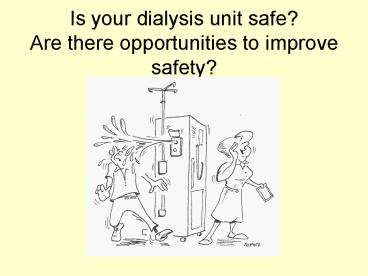
Is your dialysis unit safe?Are there
opportunities to improve safety?
2
We are all humanWe make mistakes
- Mistakes are common.
- They occur daily.
- Mistakes are part of our every day lives.
- When you are admitted to a hospital (or dialysis
unit) you expect - NO MISTAKES
3
(No Transcript)
4
(No Transcript)
5
Institute of Medicine Report (1999)
- 44,000 98,000 people die each year from medical
errors that occur in hospitals. That's more than
die from motor vehicle accidents, breast cancer
and AIDS--combined--making medical errors the
fifth leading cause of death in this country.
6
February 18, 2003
- DURHAM, North Carolina (AP) -- A teenager from
Mexico who mistakenly received organs from a
donor with a different blood type was not
expected to live more than a few days, a family
friend said Tuesday.
7
- This was actually the second girl in several
months to die after receiving a transplant with
the wrong blood type - Dallas, 2002 A patient received a partial liver
transplant from her father (type A) - but it was
her mother who had compatible (type O) blood. - Laboratory mix-up was not detected until 19 days
post-op
8
- Theres more double-checking and systematic
avoidance of mistakes at Starbucks than at most
health-care institutions. - - Carolyn M. Clancy, Director AHRQ
9
It is fundamental that the hospital shall do
nothing to harm the patient my view you know is
that the ultimate destination of all nursing is
the nursing of the sick in their own homes I
look to the abolition of all hospitals and
workhouse infirmaries. But it is no use to talk
about the year 2002.
Florence Nightingale
Letter to Henry Bonham
Carter circa 1867
10
U.S. Has Most Medical Errors
Schoen et. al., Health Affairs Nov 3, 2005
- 34 of US patients said they were given a wrong
medication or dose, experienced a medical mistake
in treatment, received incorrect test results, or
had a delay in being notified of abnormal test
results in the past 2 years. - 1/3 US patients had a physician visit in which
their test results or medical records were
unavailable, or a physician ordered a test that
had already been done.
11
Safety Conundrum
- Medical workers are expected to function without
error. - Errors are made by highly competent, careful and
conscientious people for the simple reason that
everyone makes mistakes every day.
Lucian Leape, 1997
12
The Blame Trap
- Blame is universal, natural, emotionally
satisfying, and legally convenient, it does
nothing to make healthcare safer. - -- Reason, 1994
13
Systems can be designed...
- To help prevent errors
- To make them detectable so that they can be
intercepted - To mitigate them if they are not intercepted
14
Dialysis Chains Top Patient
Safety Issues
- Patient Falls
- Medication Errors
- Access-Related Events
- Dialyzer Errors
- Excess blood loss and prolonged bleeding
15
Risk of Hip Fracture Among Dialysis and Renal
Transplant Patients
December 18, 2002
- Incidence of hip fracture in dialysis patients
2.9/1,000 patients/year - Extrapolation to national incidence 800 hip
fractures each year in dialysis patients.
16
Medication Errors Major Safety Issue in Hospitals
- Pharmacists on Rounding Teams Reduce Preventable
Adverse Drug Events in Hospital General Medicine
Units - Kucukarslan SN, Peters M, Mlynarek M, Nafziger DA
- Arch Intern Med. 2003 (Sept) 1632014-2018
17
(No Transcript)
18
(No Transcript)
19
Health Safety Survey Project Patients
Professionals
Sponsors
Partners
Funding by Abbott Laboratories CMS Special
Project
20
Patient Survey
- Invitations to participate in an anonymous survey
sent to 3,587 patients drawn from a
representative national patient sample - Network 1 implemented the patient selection and
coordinated survey mailing and responses - Surveys completed by 1,762 patients
21
Patient Survey
- Sample Characteristics
- Mean Age 64 yrs.
- Gender 54 males
- Race 67 Caucasian, 28 African Amer.
- Dialysis Type all in-center hemodialysis
- Vascular access 21 catheter
22
Professional Survey
- Invitations to participate in an anonymous
web-based survey widely distributed by RPA,
Networks, Professional Meetings - Web-based Surveys completed by 649 professionals
23
Percent ESRD Patients Survey Respondents by
Network
24
Patient Falls Patients View
- Patient Survey last 3 months
- 95 patients had never fallen at the dialysis
unit - 5 fell extrapolated nationwide 15,240 falls
- 55 patients (3.1) reported falls in the unit
- Some had several falls mean falls 1.3
- Reason for falls
- Feeling dizzy or weak 60
25
Patient Falls Staff View
- Professional Survey Past 3 months
- Mean falls 0.65
- If presume 100 pts/nurse/yr,
falls rate 26/1,000 pts/yr - 2002 Hip fractures 2.9/1,000 pts/yr
- Reasons for falls
- Feeling dizzy or weak 40
26
Needle Insertion
- Patient Survey Past 3 months
- 46 patients report staff sometimes, usually or
always has problems inserting needles - 6 say the last time there were problems, staff
tried to insert the needle more than 3 times
before getting help - Additional 24 say staff tried 3 times before
getting help
27
Medication Safety Patients View
- Patient Survey Past 3 months
- Physician review of medications with patients
- 40 patients report that they discuss their meds
with their doctor only sometimes.
28
Medication Safety Staff View
- Professional Survey Past 3 months
- 43 professionals report 1 or more instances of
patient given the wrong medicine or medicine at
wrong time - 63 report patients fail to receive 1 of their
meds at times - 37 report that a patient is given wrong dose of
a medication at least once - Overall 77 staff indicate a patient had a
medication omission or error in past 3 months
29
Handwashing Patients View
- Patient Survey Past 3 months
- 11 of patients report seeing nurses or
technicians who do not washing their hands or
change gloves before touching their access site
30
Handwashing Staff View
- Professional Survey Past 3 months
- 27 professionals reported observing staff fail
to wash hands or change gloves before touching a
patients access
31
Set-up Predialysis Patients View
- Wrong Dialyzer Set-ups
- 17 patients reported problems with settings on
their dialysis machine - 3 wrong dialyzer set up for treatment
- 2 wrong dialyzing solution set up
- 3 patients report a treatment when weight not
recorded - 6 patients report a treatment when BP not
obtained prior to treatment - 86 Staff report a patient blood sample was not
taken when ordered in past 3 months
32
Overall Assessment of Safety
- Patients
- 27 patients have seen at least 1 medical mistake
in past 3 months - 16 patients say they sometimes feel unsafe at
the dialysis center - 49 patients sometimes, usually or always worry
that someone will make a mistake
33
Overall Assessment of Safety
- Professionals
- 30 professionals said mistakes occur more than
rarely - 30 professionals said the last observed mistake
was not trivial - Medical mistakes are connected to failure to
adhere to procedures (59 of staff reporting
medical mistakes) - Most believe their dialysis facility has a
positive patient safety environment
34
(No Transcript)
35
Conclusions
- Patients worry about medical mistakes more than
they experience them (49) - Most staff (87) are aware that medical mistakes
have occurred in past 3 months
36
Conclusions
- Medication errors recognized frequently by
patients and staff - Patient Falls remain frequent source of adverse
events - Handwashing is recognized as patient safety issue
in dialysis units - Correct dialysis set-up and predialysis
procedures are safety issues - Adherence to procedures is a major source of
medical mistakes
37
What Can You Do?
- Wash your hands
- Review medications with your patients frequently
- Assess patients for risk factors for falls
- CMS new Conditions of Coverage require a Quality
Assessment Performance Improvement Program
participate - Help design a culture of safety in your unit
Recommended

