

Objective of the lab: to identify two unknown plasmids by PowerPoint PPT Presentation
1 / 9
Title: Objective of the lab: to identify two unknown plasmids by
1
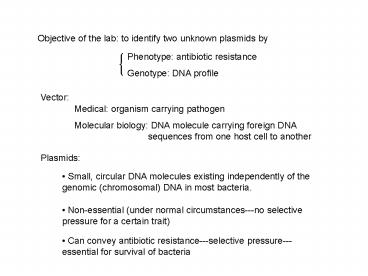
Objective of the lab to identify two unknown
plasmids by
Phenotype antibiotic resistance Genotype DNA
profile
Vector
Medical organism carrying pathogen Molecular
biology DNA molecule carrying foreign DNA
sequences from one host cell to another
Plasmids
- Small, circular DNA molecules existing
independently of the genomic (chromosomal) DNA in
most bacteria.
- Non-essential (under normal circumstances---no
selective pressure for a certain trait)
- Can convey antibiotic resistance---selective
pressure---essential for survival of bacteria
2
Plasmids
- Propagation DNA replication---have its own
ORI---use host replication machinary
- Copy number control
Relaxed control plasmid 10200 copies
----preferred in recombinant DNA
technology Stringent control plasmid a few copies
- Physical states
Supercoiled----DNA gyrase Relaxed circular
(nicked---single strand break)--- topoisomerase
, test tube Linear (---double strand
break)---restriction endonuclease
3
Restriction endonuclease
Enzyme isolated from different organisms
Cut both strands of DNA molecules to create
double strand breaks
Each has its own unique cleavage sequence, which
can appear several times in a DNA molecule
Generate a profile for DNA molecules
Different DNA molecules have different sequence
Restriction endonucleases cleave DNA to generate
different fragments
Run fragments through agarose gel, stain with
EtBr, view under UV
4
Agarose gel electrophoresis
DNA---negatively charged--- move to anode in an
electric field
Matrix agarose gel
Pore size is determined by the percentage of
agrose in the gel
Higher percentage small pore size, good for
separating small fragments Lower percentage big
pore size, good for separating large fragments
Distance traveled is determined by size and
physical state of the DNA molecule
Linear DNA size is inversely related to distance
traveled
Same size of DNA supercoiled travels faster than
linear then relaxed circular
5
Agarose gel electrophoresis
Staining EtBr intercalates between stacked base
pairs
EtBr absorbs 300 nm light (UV), reemits 590 nm
light (visible).
Loading wells
600
500
A band contains hundreds of thousands of DNA
molecules (population), not just one molecule
400
300
DNA standard
200
100
6
Show plasmid map------how to read how to
calculate how to make prediction
Show Lambda
7
Genetic information exchange between bacteria
Conjugation Transduction transformation
Find out for yourself page 147
Competent cells plasmid DNA
Transformation procedure
Preincubation making competent cells---cations
Incubation of mixed plasmid and competent cells,
on ice, 30 min---cations neutralize negative
charge of DNA and cell membrane
Heat shock 42oC, 45 sec----then on ice 2 min
rapid T change creates draft carrying plasmid
into cells
Recovery 37oC, 60 min
8
How to select the right plasmid and right host
bacteria?
The criteria page 147
9
Todays lab transformation
- E.coli can grow on rich non-selective media,
such as LB - sensitive to antibiotics, such as ampicillin,
kanamycin
- How ampicillin and kanamycin kills
bacteria?----page 148
- pAMP plasmid carries Amp resistance gene
encoding protein disables ampicillin
- pKAN plasmid carries Kan resistance gene
encoding protein disables kanamycin
- E.Coli carry pAMP can grow on LBAmp
- E.Coli carry pKAN can grow on LBKan
Selective media
Recommended

