

Small Scale Magnetic Fields and their Role in Magnetic Flux Transport PowerPoint PPT Presentation
1 / 2
Title: Small Scale Magnetic Fields and their Role in Magnetic Flux Transport
1
Small Scale Magnetic Fields and their Role in
Magnetic Flux Transport
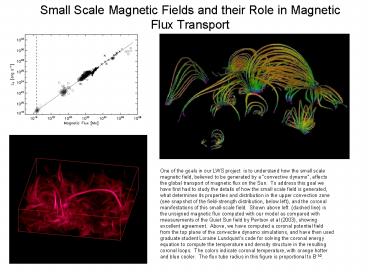
One of the goals in our LWS project is to
understand how the small scale magnetic field,
believed to be generated by a convective
dynamo, affects the global transport of magnetic
flux on the Sun. To address this goal we have
first had to study the details of how the small
scale field is generated, what determines its
properties and distribution in the upper
convection zone (see snapshot of the
field-strength distribution, below left), and the
coronal manifestations of this small-scale field.
Shown above left (dashed line) is the unsigned
magnetic flux computed with our model as compared
with measurements of the Quiet Sun field by
Pevtsov et al (2003), showing excellent
agreement. Above, we have computed a coronal
potential field from the top plane of the
convective dynamo simulations, and have then used
graduate student Loraine Lundquists code for
solving the coronal energy equation to compute
the temperature and density structure in the
resulting coronal loops. The colors indicate
coronal temperature, with orange hotter and blue
cooler. The flux tube radius in this figure is
proportional to B-1/2.
2
The Magnetic Connection Between the Solar
Interior Corona
- Another of the goals of this project is a
physically self-consistent coupling between the
solar corona and the solar interior. A new
approach we have recently employed is to develop
a single MHD code which can accommodate the very
different conditions in the convection zone,
photosphere, and corona, rather than coupling 2
different codes together. The new code, AMPS
(the adaptive MHD parallel solver) solves the 3D
MHD equations with a sophisticated treatment of
the energy equation, and can be run in a fully
implicit mode. AMPS is currently being used to - Study Quiet Sun magnetic fields from the
convection zone to the corona (e.g., images to
the right) - The emergence and decay of active region
magnetic structures. - Global MHD simulations of the solar interior
- are a vital part of understanding active region
emergence and evolution, but there are few codes
in existence that can easily model this part of
the Sun. We have thus recently written the code
SANMHD to study the generation and evolution of
magnetic fields in the solar interior. SANMHD is
currently being debugged and tested.
Complementing its local, Cartesian predecessor
ANMHD, SANMHD is a 3D global anelastic MHD code
that includes an overshoot layer. The code
approach - Spherical harmonic decomposition in the polar
and azimuthal directions for - maximum resolution on a spherical shell
- non-uniform finite difference grid in the radial
direction to allow greater flexibility in
complicated boundary layers, and to ease in code
parallelization - Tunable diffusion parameters that are functions
of depth
Log density in a vertical slice from below the
Quiet Sun photosphere into the corona.
Same as left panel, but different slice
Flow field along a horizontal slice in the
portion of the domain representing the convection
zone. MPI block boundaries are shown.
Top Vertical flows along a horizontal slice
Bottom B along a horizontal slice below the
photosphere in the convection zone.
Recommended

