

Polycystic Kidney Disease CFTR Inhibitors Provide a Novel Therapeutic Approach PowerPoint PPT Presentation
1 / 1
Title: Polycystic Kidney Disease CFTR Inhibitors Provide a Novel Therapeutic Approach
1
Polycystic Kidney Disease CFTR Inhibitors
Provide a Novel Therapeutic Approach Drs. David
N. Sheppard, Zhiwei Cai and Hongyu Li (University
of Bristol) Presenter Dr Sandra Cree, Technology
Transfer Manager, s.j.cree_at_bristol.ac.uk
Inhibitory Effects of Fluorescein Derivatives on
CFTR Cl- Channel and Renal Cyst Growth
A New Therapeutic Approach Compounds which
inhibit the CFTR chloride channel have been
demonstrated to inhibit the growth of renal cysts
in vitro and present a potential therapy for
Polycystic Kidney Disease
CFTR Inhibitors Retard Renal Cyst Growth
1. Structure-Activity Relationships of
Fluorescein Derivatives
- Polycystic Kidney Disease (PKD) the therapeutic
need - PKD is the most common single gene disorder to
affect the kidney. - PKD is characterised by multiple fluid-filled
epithelial cysts that progressively grow and
destroy kidney function. - PKD affects 600,000 people in the U.S. alone, and
12.5 million world-wide and it is the fourth
leading cause of kidney failure, accounting for
8 of patients requiring kidney transplantation. - No current therapies for ADPKD inhibit cyst
growth. This is a massive financial and medical
burden and a significant un-met medical need.
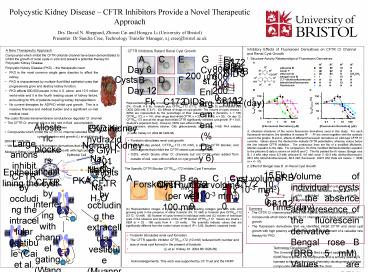
Representative images of renal cysts grown over a
6 day period in the presence of forskolin (Fk, 10
mM, A B), forskolin plus CFTRinh-172 (C172, 10
mM, C D) and forskolin plus DIDS (200 mM, E
F). (G) Effects of drugs on cyst growth. The
volume of cysts (means SEM) are represented by
the percentage of their values on day 6
(forskolin, n 186 CFTRinh-172, n 141, other
drugs that inhibit CFTR, n 22 - 36 DIDS, n
32). On day 12, CFTRinh-172 and all the drugs
that inhibit CFTR significantly inhibited cyst
growth (P lt 0.01, Students unpaired t-test).
However, DIDS was without effect. Gen genistein,
allosteric blocker Glib glibenclamide, large
anion H-89 PKA inhibitor NPPB (Li et al.
Kidney Int. 2004 661926-38)
The cystic fibrosis transmembrane conductance
regulator Cl- channel
- The CFTR Cl- channel plays a key role in fluid
accumulation within the cyst lumen. - Compounds which inhibit the CFTR Cl- channel
retarded renal cysts formation and growth (Li et
al. Kidney Int. 2004 661926-38) - We identified a group of fluorescein derivatives
that inhibit CFTR and renal cysts growth with
high potency.
A, chemical structures of the seven fluorescein
derivatives used in this study. For each
fluorescein derivative, the identities of residue
R1 ? R4 are shown together with the symbols used
in the graphs. B and C, effects of different
fluorescein derivatives on wild-type CFTR Cl-
currents. Values above the dashed line indicate
CFTR potentiation, whereas values below the line
indicate CFTR inhibition. The continuous lines
are fits of a modified Michaelis-Menten equation
to the data. For comparison, fit of the modified
Michaelis-Menten equation to the phloxine B data
is shown on both B and C. The fits yielded the
Ki values Bengal rose B, 1.4 mM ethyl eosin 6.3
mM phloxine B, 4.6 mM eosin Y, 40.3 mM
dichlorofluorescein, 66.3 mM tetrachlorofluoresce
in, 68.3 mM fluorescein, 229.5 mM Data are
means SEM (n 4 - 10).
Model of Renal Cyst and Epithelial Cell
2. Effect of Bengal rose B on Renal Cyst Growth
The Specific CFTR Blocker CFTRINH-172 Inhibits
Cyst Formation
Volume of individual cysts in the absence and
presence of the fluorescein derivative Bengal
rose B (BRB, 5 mM). Values are means SEM
(forskolin (10 mM), n 96 BRB, n 36).
Mechanism of Action of CFTR Inhibitors
Glycine hydrazide GlyH-101 inhibits CFTR by
occluding the extracellular vestibule (Muanprasat
et al. 2004)
Large anions inhibit CFTR by occluding the
intracellular vestibule (Cai et al. 2002)
(A) Representative images of cysts on day 6 after
seeding collagen gels with cells and growing
cysts in the presence of either forskolin (Fk, 10
mM) or forskolin plus CFTRinh-172 (C172, 10 mM).
(B) Number of cysts formed in individual wells
and (C) volume of individual cysts in the absence
and presence of the CFTR blocker CFTRinh-172.
Values are means SEM (n 23 - 186 cysts from 4
- 23 wells). The asterisks indicate values that
are significantly different from the control
values at day 6 (P lt 0.05 Students unpaired
t-test).
Allosteric blockers inhibit CFTR by interfering
with channel gating (Wang et al. 1998 Cai et al.
2002)
Technology Development The University of Bristol
has filed a patent application (WO 02/05794) to
protect the compounds and is actively seeking a
licensee to lead the medicinal chemistry
development of these compounds and move them into
the clinic
Acknowledgements This work was supported by CF
Trust and the NKRF
Recommended

