

Groups and Change PowerPoint PPT Presentation
1 / 12
Title: Groups and Change
1
Groups and Change
Lewins law of change It is usually easier to
change individuals formed into a group than to
change any of them separately.
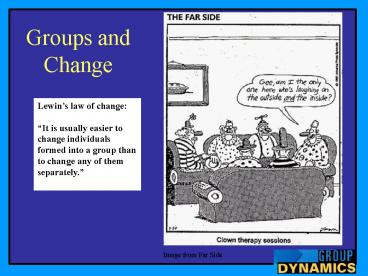
Image from Far Side
2
Issues
How can professional helpers use groups to
achieve therapeutic goals? How could a group of
similarly suffering people help each other? How
do groups work, therapeutically From what do
they derive their therapeutic powers?
3
What are Some of the Ways That Groups are Used to
Help Members Change?
- Individuals rely on groups to achieve personal
and therapeutic change. - Lewins law of change It is usually easier to
change individuals formed into a group than to
change any of them separately. - Types of groups
- psychotherapy groups
- interpersonal learning groups
- self-help groups (mutual support groups)
4
What are Some of the Ways That Groups are Used to
Help Members Change?
- Group therapy
- Group psychoanalysis Freuds book Group
Psychology and the Analysis of Ego - gaining insight into problems
- interpretations and working through sibling and
parental transference - Gestalt group therapy
- emotional growth using experiments and
role-playing methods - psychodrama was developed by Moreno
5
What are Some of the Ways That Groups are Used to
Help Members Change?
- Group therapy (cont.)
- Interpersonal group psychotherapy
- Yaloms interactive group psychotherapy
- here-and-now focused
- Cognitive-behavioral therapy groups
- Learning theory principles
- Behavioral contracts, modeling, behavior
rehearsal, feedback
6
What are Some of the Ways That Groups are Used to
Help Members Change?
- Interpersonal learning groups self-understanding
and relationship enhancement - Training groups, or T-groups
- Growth groups (sensitivity-training groups or
encounter groups) - Structured learning groups (workshops)
7
What are Some of the Ways That Groups are Used to
Help Members Change?
- Self-help groups
- Characteristics
- focus on a specific problem, such as alcohol,
physical illness - formed by nonprofessionals, self-governing
- egalitarian, supportive
- Example Alcoholics Anonymous (AA)
- Online support groups
8
How Do Groups Promote Change?
- Curative factors (therapeutic factors) in groups
- Universality We all have problems
- Hope If others can change, so can I
- Upward social comparison
- Hope sense of efficacy and multiple pathways
- Vicarious learning I learn by watching others.
- Social learning theory
9
How Do Groups Promote Change?
- Curative factors (therapeutic factors) in groups
(cont.) - Interpersonal learning Im learning to get along
better with people. - Guidance Members give me good suggestions.
- Leadership and co-leadership
- Cohesion and support The group takes me in and
sustains me. - Group development and therapeutic interventions
10
How Do Groups Promote Change?
- Curative factors (therapeutic factors) in groups
(cont.) - Self-disclosure It feels better to share these
secrets. - Catharsis Ive gotten some anger off my chest.
- Altruism Helping others makes me feel more
confident in myself. - Insight Ive learned a lot about myself.
11
How Do Groups Promote Change?
- Members most value universality, interpersonal
learning, cohesion/support, and insight - Application to traumatic events
- Victims of negative events, such as floods,
terrorism - Interventions involve the curative factors,
particularly hope, guidance, cohesion,
opportunities for self-disclosure, and altruism.
12
How Effective are Groups in Bringing About
Change?
- Group approaches are as effective as individual
methods - Limitations
- Changes are often more perceptual than behavioral
- Premature termination
- Psychological casualty
- Group methods, despite their diversity, tend to
be equally effective.
Recommended

