

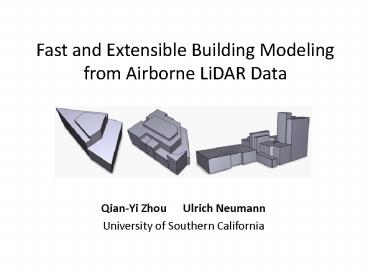
Fast and Extensible Building Modeling from Airborne LiDAR Data PowerPoint PPT Presentation
1 / 28
Title: Fast and Extensible Building Modeling from Airborne LiDAR Data
1
Fast and Extensible Building Modeling from
Airborne LiDAR Data
- Qian-Yi Zhou Ulrich Neumann
- University of Southern California
2
Introduction
- Toward automatic 3D building model reconstruction
- 3D models are useful in several applications
- Manual creation is slow and expensive
- New instruments provides more and more data
- Problem
How to fulfill the gap between data and 3D
building models?
3
Introduction
- Approach overview
- Data source airborne LiDAR data
- Without other data sources
- Working directly on point cloud, without
rasterization - Experiments
- On 3 different data sets
- Automatic vs. interaction
- Fully automatic for flat roofs
- Use interaction to acquire the extensibility for
non-flat roof patterns
4
Pipeline
5
Pipeline
6
Classification
- Algorithm
- Use a SVM (Support Vector Machine) algorithm
- Machine learning method
- All the weight parameters could be trained from
a small area of labeled data - Take several differential geometry properties as
features - Features are defined locally
- Same solution works for different data sets, even
their global variants (e.g. absolute height)
varies
7
Classification
- Features Building (ground) vs. vegetation
- Distribution of neighbor points
- Regular vs. Irregular
- Normal direction
- Vertical vs. Unordered
- Flatness
- Flat vs. Non-flat
- Normal distribution
- Regular vs. Irregular
8
Classification
0.0
1.0
0.5
Input LiDAR data
F1 (regularity of distribution)
F2 (normal direction)
F3 (flatness)
F4 (regularity of normal dist.)
F5 (regularity of normal dist.)
9
Classification
- Experiments for classification
- Weights for features learned from data
- W15 (2.5, 0.1, 1.7, 5.2, 20.4)
- Regularities of normal distribution are important
- We get around 95 accuracy rate on 3 different
data sets - Sample rate of different data sets varies from 6
points per sq.m. to 17 points per sq.m. - Global variants (e.g. average height, average
intensity) varies between different data sets
10
Classification
- Post-processing
- Refinement
- Use the intuition that points of same category
usually occur together in space - Let points in a local neighborhood vote for the
final classification result - Segmentation
- Apply region growing algorithm to find roof
patches - Largest patch is assigned as ground
11
Classification
12
Pipeline
13
Plane extraction
- Algorithm
- For each roof patch, apply a region growing
algorithm but based on normal similarity - Iteratively find all plane patterns in one roof
patch
14
Pipeline
15
Boundary detection
- Algorithm
- Apply a uniform grid onto the point cloud P
- Correspondence
- Boundary line in grid ? Boundary point of P
- Boundary corner in grid ? Boundary edge of P
- Run two passes, to construct a watertight
manifold polygonal boundary from boundary points
and edges
16
Boundary detection
- Algorithm (continue)
Boundary corners
Boundary lines
First pass
Second pass
17
Boundary detection
- Advantages
- Topology guarantee watertight manifold boundary
- Easy to implement
- Efficient and robust
- Can be used withmorphological operations
- Limitation
- Cannot guarantee geometry completeness
18
Pipeline
19
Building modeling
- Principal directions
- Intuition most boundary line segments in a local
area fall into a couple of directions, known as
principal directions
6
7
2
3
1
4
5
20
Building modeling
- Snapping
- Snap to principal directions
- Find as much as possible boundary segments along
principal directions - Snap between neighbor segments
- Patches may share same boundary segments
- Patches may be connected via a vertical wall
21
Building modeling
22
Pipeline
User interaction
23
Non-flat objects extension
- Algorithm
- Define a few pattern types, e.g. cone, sphere,
cylinder - Let user specify pattern type of certain roof
patch - Apply RANSAC algorithm to get the parameters for
this shape pattern
24
Experiments
- Oakland (17 samples/sq.m. 600m x 600m)
25
Experiments
- Denver (6 samples/sq.m. 1km x 1km)
26
Experiments
- Industrial site (14 samples/sq.m.)
27
Conclusion
- We provide an automatic building modeling
pipeline with novel classification, boundary
extraction and modeling algorithms in addition,
we show the extensibility to non-flat roofs with
the help of a few user interactions. - Future works
- How to quantitatively analysis errors?
- How to handle data sets with billions of points?
- An out-of-core implementation is possible!
28
The end
- Q A
- Acknowledgement
- Data
- Airborne 1 Corp., Sanborn Corp., Chevron Corp.,
Sentinel AVE LLC - Discussion and comments
- Suya You, Yuan Li, and anonymous reviewers
- Support
- Provosts Fellowship from USC
Recommended

