

Establishing stateoftheart coding, documentation, configuration management standards for the AWG' PowerPoint PPT Presentation
1 / 1
Title: Establishing stateoftheart coding, documentation, configuration management standards for the AWG'
1
Quality Assurance of the GOES-R AWG Product
Processing System L. Zhou2, Walter Wolf1, S.
Qiu2, P. Keehn2, Q. Guo3, S. Sampson3, and M.
Goldberg1 1NOAA/NESDIS/STAR, Camp Springs, MD
20746 USA 2PSGS, Alexandria , VA 22311, USA
3IMSG, Kensington, MD 20895, USA
4. Verification/Validation
1. INTRODUCTION
3. Monitoring/Visualization
2. Quality Standards
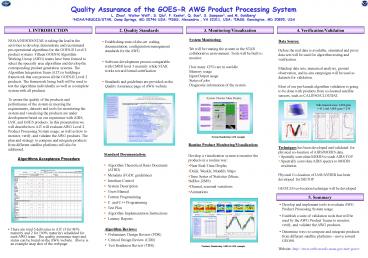
System MonitoringWe will be running the system
in the STAR collaborative environment. Tools will
be built to monitorHow many CPUs are in
use/idleMemory usageInput/Output usageStatus
of jobsDiagnostic information of the system
NOAA/NESDIS/STAR is taking the lead in the
activities to develop, demonstrate and recommend
pre-operational algorithms for the GOES-R Level 2
product systems. Fifteen GOES-R Algorithm Working
Group (AWG) teams have been formed to select the
specialty area algorithms and develop the
corresponding product generation systems. The
Algorithm Integration Team (AIT) is building a
framework that can process all the GOES-R Level 2
products. The framework being built will be used
to test the algorithms individually as well as a
complete system with all products. To assure
the quality of the products and performance of
the system in meeting the requirements, datasets
and tools for monitoring the system and
visualizing the products are under development
based on our experience with AIRS, IASI, and GOES
products. In this presentation we will describe
how AIT will evaluate AWG Level 2 Product
Processing System usage, as well as how to
monitor, verify, and validate the AWG products.
The plan and strategy to compare and integrate
products from different satellite platforms will
also be addressed.
Data Source Before the real data is available,
simulated and proxy data sets will be used for
algorithm testing and verification. Matchup data
sets, numerical analysis, ground observation, and
in-situ campaigns will be used as datasets for
validation. Most of our pre-launch algorithm
validation is going to be done with products from
co-located satellite sensors, such as
CALIPSO/CLOUDAT.
- Establishing state-of-the-art coding,
documentation, configuration management standards
for the AWG. - Software development process comparable with CMMI
level 3 maturity while STAR works toward formal
certification - Standards and guidelines are provided on the
Quality Assurance page of AWG website
Sub-tropical case IASI gran 411 and AIRS gran
234
System Monitoring IASI example
- Routine Product Monitoring/Visualization
- Develop a visualization system to monitor the
products in a routine way - Near Real-Time Display
- Daily, Weekly, Monthly Maps
- Time Series of Statistics (Mean, StdDev.,RMS)
- Diurnal, seasonal variations
- Animations
- Techniques has been developed and validated for
physical co-location of AIRS/MODIS data. - Spatially convolute MODIS to each AIRS FOV
- Spectrally convolute AIRS spectra to MODIS
- resolution.
- Physical Co-location of IASI/AVHRR has been
developed for METOP - GEO/LEO co-location technique will be developed
- Standard Documentation
- Algorithm Theoretical Basis Document (ATBD)
- Metadata (FGDC guidelines)
- Interface Control
- System Description
- Users Manual
- Fortran Programming
- C and C Programming
- Test Plan
- Algorithm Implementation Instructions
- Latency Reports
Algorithms Acceptance Procedure
5. Summary
- Develop and implement tools to evaluate AWG
Product Processing System usage. - Establish a suite of validation tools that will
be used by the AWG Product Teams to monitor,
verify, and validate the AWG products. - Determine ways to compare and integrate products
from different satellite platforms move toward
GEOSS.
- Algorithm Reviews
- Preliminary Design Review (PDR)
- Critical Design Review (CDR)
- Test Readiness Review (TRR)
- There are total 5 deliveries to AIT (3 for 80
maturity and 2 for 100 maturity) scheduled for
each AWG team. The quality assurance steps and
status can be found on the AWG website. Above is
an example snap shot of the webpage
Products Monitoring AIRS IASI example
Website http//www.orbit.nesdis.noaa.gov/star/goe
sr
Recommended

