

openSolarCA09_Bishkek, Kyrgyzstan, August 2009_Architect DI Heimo Staller IFZ InterUniversity Resear PowerPoint PPT Presentation
1 / 24
Title: openSolarCA09_Bishkek, Kyrgyzstan, August 2009_Architect DI Heimo Staller IFZ InterUniversity Resear
1
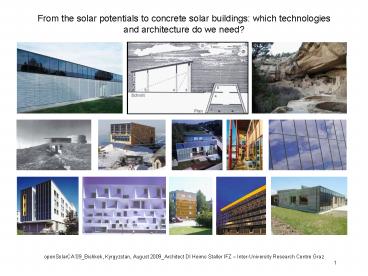
From the solar potentials to concrete solar
buildings which technologies and architecture do
we need?
2
Introduction
- IFZ Inter-University Research Centre
- for Technology, Work and Culture, Graz
- Interdisciplinary research, consulting and
training focusing on the complex relationship
between technology and society - IFZ
- works on an interdisciplinary basis
- initiates social and institutional learning
processes - involves all stakeholders in the research process
- Clients national and international public
institutions, companies
- Architect Heimo Staller
- Study of architecture at the Technical University
of Graz - CEO of A ZT GmbH, Weiz, A, architecture office
specialised in planning low-energy-and passive
house buildings - Scientific employee in the field of energy and
climate at the IFZ, main working areas Green
buildings, sustainable environments - Lecturer at FH JOANNEUM - University of Applied
Sciences
3
Solar architecture - Historical background
- Vernacular architecture
- Buildings are perfectly adapted to their local
context - Knowledge of geographical and climatic conditions
- Use of physical principles (Solar radiation,
wind, thermal mass, ) for conditioning of houses - Low tec In general no building services for
heating and cooling - Form follows energy
- Use of sustainable building materials
- Zero-energy and passive houses
Wind catchers, Haiderabad, Pakistan
4
Solar architecture - Historical background
- Adaption to the local context
Cold wind from north
Sun in summer
agriculture
Ventilation
Cooling by rock
Heating by rock
Sun in winter
River
Winter
Summer
Cliff Palace, Mesa Verde, Colorado, Anasazi
people 12th century A. D.
5
Solar architecture - Historical background
- Similar geographical and climatic conditions gt
similar architectural solutions
Cooling principle Warm air rises in the
courtyard and sucks cold air through the entrance
tunnel
6
Solar architecture - Historical background
- Solar architecture in the ancient world
Concept for a solar house by Socrates, 469 - 399
B.C.
Solar town planning, Priene, 300 B.C.
7
Solar architecture - Historical background
- International Style, 1920s
- Decoupling of building design from energy related
design aspects - International design independent from local
geographical and climatic conditions - Emergence of glass architecture
- Increase of energy consumption
- New building services for heating and cooling,
mainly based on crude oil
Lever Building, New York, 1952, SOM
8
Solar architecture - Historical background
- Solar architecture F.L. Wright
- Solar gap - South orientation of the building
- Large glazing areas in the south, small windows
in the north - Thermal mass in the north (stone bricks, earth)
- Windbreak by integration of the building into the
landscape - Building perfectly fits to local conditions
Solar Hemicycle, Wisconsin, 1944, F.L. Wright
9
Solar architecture - Historical background
- Solar master plan and architecture Louis I.
Kahn - Institute of Management, Ahmedabad, India
- Adaption of the buildings to local climate (sun,
wind, thermal mass) - Use of local building materials material
10
.and today?
- Insufficient building design is compensated by
building service measures
Building services (HVACR)
South Cooling demand
North Heating demand
Refinery
Crude oil
Energy
Building services (HVACR)
11
Energy and buildings what are the main aspects?
Energy during operation stage
Solar strategies
Energy for construction and disposal
External aspects
12
General strategies for energy efficient buildings
Energy demand of buildings - future
- Energy demand of buildings - today
Energy, qualitative
Energy, qualitative
Passive within the comfort zone
Passive within the comfort zone
Average ambient temperature in C
Average ambient temperature in C
Energy demand independent from climate (hot
water, ventilation,)
13
General strategies for energy efficient building
design
Climate shell - atrium
14
Solar architecture Strategies
- Step 1 Minimising the energy demand for heating,
cooling, humidification and electricity - Step 2 Covering residual energy with active
solar energy systems (thermal, electrical) - Integration of solar energy aspects in town
planning - Solar design - Integration of solar aspects in
the early design phase - Integration of solar collectors in the buildings
shell (skin and roof) provides synergy effects
(energy production architectural functions in
one element) - Cost assessment From construction costs to Life
Cycle Costs (LCC)
15
Solar architecture Strategies
- Hierarchy of measures
16
Solar architecture Passive strategies
- Heating
- Compactness
- Orientation
- Size of windows
- Thermal mass
- U-values
- Cooling
- Orientation
- Size of windows
- Thermal mass
- Shading devices
- Illumination
- Natural daylight systems
17
Solar architecture Passive strategies
- Heat trap principle
- Short-wave sunlight is transferred into long
wave radiation - Winter gardens enable to heat neighbouring rooms
- Restricted use of Winter gardens during cold
periods - No heated winter gardens! Waste of energy!
- Winter gardens are thermal instable (Warm Cold)
gt - Thermal mass is very important
- Measures against summery overheating gt Shadow
devices, effective ventilation and exhaust - High construction costs low benefits
- gt Passive house?
Winter gardens
Functional principle
Cooling
Heating
18
Solar architecture Passive strategies
- Winter
- Solar radiation enters carton combs
- Heating of the gap up to 80C (depending on
orientation) - Energy losses in night are low, as element has
good insulating properties - U-values under 0,1 W/m2K are possible
- Average temperature in the panel around 18 C gt
minimal transmission losses for rooms behind - Summer
- Shading of the panel because of high solar
altitude - No shading devices required
Intelligent façade panels
Glass panel
Carton combs
Gap solar panel
19
Solar architecture Active strategies
Heating
Electricity
Cooling
20
Solar architecture Active strategies
- Depending on the solar fraction requested, active
solar elements have large impacts on town
planning and building design gt - Integration in preliminary design phase is
extremely important - Solar panels are cost-intensive elements gt best
coefficient should be aspired (orientation,
inclination are very important) - Multifunctional elements (building shell energy
production)
Facade
PV-sunblind
PV- art
Roof elements
21
Solar architecture Active strategies
- Multifunctional elements
Scheme multifunctional façade element for
renovation (AEE INTEC)
One façade element multiple functions gt Schüco
E2
Energy - PV
Ventilation
Sunblind
HVACR
22
Solar architecture Passive active strategies
From Energy waste house to passive house
- EI 90 kWh / m2a
EI 60 kWh / m2a
EI 40 kWh / m2a
EI 35 kWh / m2a
EI 15 kWh / m2a
gt Passive house Mechanical ventilation system
with heat recovery, reduction of ventilation
losses
EI (Energy Index) Net energy consumption for
heating per m2 heated net area and year
23
Solar architecture Passive active strategies
- Passive house
24
Solar architecture Passive active strategies
- Passive house Building standard of the future?
Passive house 2154 m above sea level
Alpine refuge Schiestlhaus, Hochschwab, A
Architects GP-ARGE pos
architekten and Treberspurg Partner Architekten
ZT GmbH, Vienna
25
Solar architecture Passive active strategies
- Definition by Passive House Institute Darmstadt
- Heating energy consumption max.15 kWh/m2a
- Combined Primary energy consumption (heating, hot
water, electricity-household)
max. 120 kWh/m2a - Requirements on the thermal building shell
- Air leakage n50 less than 0,6 h-1
- U-values of opaque thermal components less than
0,15 W / m2K - U-values of windows and translucent thermal
components less than 0,8 W / m2K - No cold bridges
- www.passiv.de/
Passive house
26
Solar architecture Passive active strategies
Passive house
- Requirements on translucent areas (according to
Passive House Institute Darmstadt) - Translucent areas west or east orientated
deviation from south max. 50 - Translucent areas with inclination under 75 to
the horizontal should not exceed 15 of the floor
space behind - Or temporary sunscreens with reduction factor
of min. 75 - Area of south orientated windows should not
exceed 25 of the floor space behind
Passive house Haas, Gleisdorf, A
Architects A ZT
GmbH, Weiz, A
27
Solar architecture Passive active strategies
Passive house Haas in Gleisdorf, A ZT GmbH, A
Inlet of supply air
Supply air
Exhaust air
Exhaust air
Supply air
Supply air
28
Solar architecture Passive active strategies
Passive house Haas in Gleisdorf, A ZT GmbH, A
Supply air
Exhaust air to WC, bathroom
Supply air
Supply air
29
Solar architecture Passive active strategies
Passive house Haas in Gleisdorf, A ZT GmbH, A
30
Examples Dieselweg, Graz, A
- Passive house renovation with gap solar panels
- Heat storage tank 1200m3 (1.2 Mio litres of
water) - Rental and operation costs for a 60m2 flat after
renovation - 60 Euro less than before
31
Examples Dieselweg, Graz, A
Renovation process, source gapsolution
32
Examples ENERGY Base, Vienna, A
Office building Passive house, Pos
architecture, Vienna, A
- Climate design
- Multifunctional façade
- Bent skin for active solar elements and sunblind
- 280 m2 thermal panels
- 400 m2 PV panels
33
Examples PlusEnergieWohnen, Weiz, A
- 22 residential row houses in passive house
standard - 2000 m2 of useful area
- Construction Prefabricated wood elements
- Passive house standard (PHPP 14,6 Kwh/m2a
- Plus energy housing estate
- Output PV 110 kWp
- Overrun of energy per house ca. 1200 kWh/a
- Architect Erwin Kaltenegger, Passail, A
34
Examples Solar-Active-House, A
- Prototype for a pre fabricated single family
house - 3 types, best type Zero-energy house
- Thermal solar panels
- PV panels
- Ventilation system with heat recovery
- Architect Georg W. Reinberg, Vienna
Thermal solar panels
PV panels
35
Examples Research Centre Ökopark Hartberg, A
- Solar cooling
- First solar desiccant air-conditioning system in
Austria - Output 30 kWc
- Thermal solar panels
- Conception JOANNEUM RESEARCH
36
Examples Alpine refuge Schiestlhaus,
Hochschwab, A
- First passive house refuge in the world
- Hochschwab, 2154 m above sea level
- Thermal solar panels for hot water
- PV panels, 8 kWp
- Ventilation system with heat recovery
- CHP with plant oil
- Ecological sewage system, utilisation of
rainwater - Architects GP-ARGE pos architekten and
Treberspurg Partner Architekten ZT GmbH, Vienna
37
Examples Solar City Linz, A
- Master plan for a settlement of ca. 6.000 people,
following solar principles - Energy related measures following the European
Charter for Solar Energy in Architecture and
Urban Planning of 1996 - Low energy and passive houses, average energy
demand throughout the urban district 36 kWh/m²a - Solar energy systems cover about 50 of hot
water needs - Utilisation of rainwater
- Architects Foster, Herzog, Piano, Treberspurg,
Kaufmann, Laudon.
38
Thank you for your attention!
Recommended

