

On%20the%20Distribution%20of%20Dark%20Matter%20in%20Clusters%20of%20Galaxies PowerPoint PPT Presentation
Title: On%20the%20Distribution%20of%20Dark%20Matter%20in%20Clusters%20of%20Galaxies
1
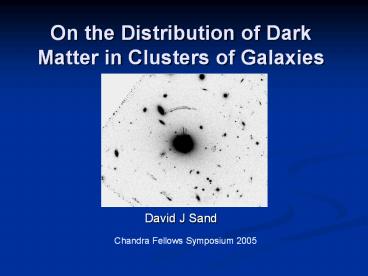
On the Distribution of Dark Matter in Clusters of
Galaxies
- David J Sand
Chandra Fellows Symposium 2005
2
Cold Dark Matter Simulations
log (?)
log (radius)
Moore simulation
Inner profile ??r -? NFW ??1.0 Moore ??1.5
CDM is non-relativistic (cold) collisionless
well motivated theoretically and observationally
3
Galaxy cluster scale
- Strong and Weak Gravitational Lensing
Strength Total mass constraints without
assumptions about dynamical state of
cluster. Weakness Need more info to separate
dark and luminous components.
Smith et al. (2001) ?tot 1.3
Kneib et al. 2003 found outer slope ?out gt 2.4
4
Galaxy cluster dynamics
Strength Can probe to high cluster
radii. Weakness Must assume orbital properties
of stars/galaxies.
- Extended velocity dispersion profile of the
brightest cluster galaxy (e.g. Kelson et al.
2002) - Velocity Dispersion profile of the galaxies in
the cluster (e.g. Carlberg et al. 1997 Katgert
et al. 2003)
NFW profiles require unrealistic stellar M/L
(Kelson et al. 2002)
5
X-ray Observations of the ICM
Strength Can probe to high cluster
radii Weakness Must assume the cluster is in
hydrostatic equilibrium difficult to account for
central BCG!
From Lewis et al. 2002 note the BCG component
can dominate on 10kpc scales
- Wide range of inner slope values have been found
? 0.6 (Ettori et al. 2002) to 1.2 (Lewis et al.
2003 Buote Lewis 2003) to 1.9 (Arabadjis et
al. 2002).
6
Lensing BCG Dynamics
GOAL Combine constraints from dynamics of BCG/cD
galaxies with lensing to measure the mass density
profile of the inner regions of clusters.
7
MS2137-23
zclus0.313 zarc1.50
ESI spectrum
Two component, spherically symmetric mass model
representing BCG and cluster DM halo. We utilize
3 free parameters M/L, ?, ?c. . Scale radius
fixed at 400 kpc.
8
MS2137-23 Results
Best-fitting density profile ?? r -? with ?
0.57 ? 0.11
9
Issues to Explore
- One object cannot be used to understand the DM
density profile of clusters! - What effects could ellipticity and substructure
have on our results (see e.g. Dalal Keeton
2003 Meneghetti et al. 2005)? - Should scale radius be a free parameter?
10
More radial arc systems
lt??gt 0.52 ?? 0.3
11
Tangential Arc Systems
Upper limit ? lt 0.57 (99 CL)
CONCLUSION Radial arc systems are not biased
toward shallower profiles.
12
Full 2D modeling of MS2137
- We have upgraded J.P. Kneibs LENSTOOL software
to include generalized NFW mass profiles. - LENSTOOL accounts for ellipticity (both in
luminous and dark matter components) and
substructure (e.g. associated with visible
galaxies). - Can take into account the full multiple imaging
constraints
- Two background sources associated with the
tangential and radial arcs - Multiple images determined from spectroscopy,
surface brightness conservation and iterative
lens modeling. - Two features on the tangential arc and one on the
radial arc are identified.
13
Constraints on inner slope with CDM motivated
prior on rsc
The inner slope is ?0.250.35-0.12 - in
agreement with work of Sand et al. 2004
(?0.570.11-0.08) . However, the best-fitting
rsc is poorly constrained.
14
Summary Conclusions
What constraints do we get on the inner slope?
Ellipticity of MS2137
Our inner slope constraints are robust if the DM
halos are nearly round, as in MS2137. At least
some cluster DM halos appear to have shallow
inner slopes.
?obs/?sim
Meneghetti et al. 2005
Other issues remain How do we constrain the
scale radius? What effect does triaxiality have
on our results? Would dark matter models that
have undergone adiabatic contraction better fit
the data?
15
Combine Compare Lensing, X-ray and Dynamics
Will partially remove inherent degeneracies and
account for all major cluster mass components
Kelson et al. 2002
X-ray surface brightness and temperature
K-band data and/or galaxy velocity dispersion
profile
Weak Strong lensing data
16
Multiple Image Interpretation
17
Best-fitting Density Profile in Axially symmetric
case
18
Lensing critical lines
- Critical lines are those places in the image
plane where the magnification formally diverges.
- Radial arcs are presumably often obscured by
bright, central galaxies in clusters.
Critical curves occur at the roots of the
eigenvalues of the Jacobian that describes the
lensing transformation.
Narayan Bartelmann 1997
19
Measuring and Modeling Velocity dispersion
profiles
Modeling
Measuring
- Ellipticals are pressure supported (no/slow
rotation). - Expect ?2 ? ?r2 from integrating spherical Jeans
eqn.
- Stellar spectra are used as templates. They are
smoothed and redshifted to match the BCG. - The Gauss-Hermite pixel-fitting software (van
der Marel 1994) was used. In practice, it
convolves a template with a line-of-sight
velocity profile and compares it with the BCG
spectrum.
Kelson et al. 2002
20
Constraints on the inner slope with rsc400 kpc
fixed Direct Comparison with Sand et al. 2004
Lensing Only
Lensing Dynamics
Lower values of ? cannot fit the angular
structure of the lens model.
Same M/L range as Sand et al.
21
More complex Modelling?Dalal Keeton (2003)
Bartelmann Meneghetti (2004) Meneghetti et al.
2005
Dalal Keeton 2003
- Despite systematic check with LENSTOOL concern
remains about 1D modeling performed in Sand et
al. (20042002) - Suggest that by including ellipticity NFW
profiles are not ruled out! - Fixed scale radius of 400 kpc may also bias
results.
Estimated range of systematic ?lt?gt from Sand et
al. 2003
22
Multiple Image Interpretation
- Two background sources associated with the
tangential and radial arcs - Multiple images determined from spectroscopy,
surface brightness conservation and iterative
lens modeling. - Two features on the tangential arc and one on the
radial arc are identified.
Perturber
23
Comparison with 2D results
Using LENSTOOL allows the effects of substructure
and ellipticity to be taken into account.
CONCLUSION Neglect of substructure and
ellipticity leads to at most a ?? 0.2
systematic.
24
Histogram of ellipticity in the potential
Best-fitting density profile
The best mass models are centered around ?0.1
which translates to an ellipticity in the surface
density of 0.2
?0.20 ?221.2 for 16 degrees of freedom
Recommended

