

Jupiter and Saturn: Lords of the Planets PowerPoint PPT Presentation
1 / 30
Title: Jupiter and Saturn: Lords of the Planets
1
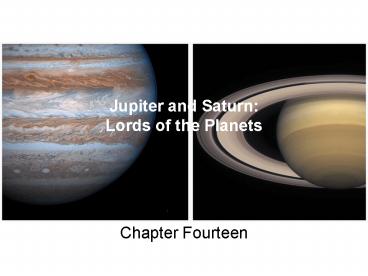
Jupiter and SaturnLords of the Planets
- Chapter Fourteen
2
(No Transcript)
3
(No Transcript)
4
Guiding Questions
- Why is the best month to see Jupiter different
from one year to the next? - Why are there important differences between the
atmospheres of Jupiter and Saturn? - What is going on in Jupiters Great Red Spot?
- What is the nature of the multicolored clouds of
Jupiter and Saturn? - What does the chemical composition of Jupiters
atmosphere imply about the planets origin? - How do astronomers know about the deep interiors
of Jupiter and Saturn? - How do Jupiter and Saturn generate their intense
magnetic fields? - Why would it be dangerous for humans to visit
certain parts of the space around Jupiter? - How was it discovered that Saturn has rings?
- Are Saturns rings actually solid bands that
encircle the planet? - How uniform and smooth are Saturns rings?
- How do Saturns satellites affect the character
of its rings?
5
Jupiter and Saturn are the most massive
planetsin the solar system
- Jupiter and Saturn are both much larger than
Earth - Each is composed of 71 hydrogen, 24 helium, and
5 all other elements by mass - Both planets have a higher percentage of heavy
elements than does the Sun - Jupiter and Saturn both rotate so rapidly that
the planets are noticeably flattened
6
Long orbital periods of Jupiter and Saturn cause
favorable viewing times to shift
7
Unlike the terrestrial planets, Jupiter and
Saturnexhibit differential rotation
8
Atmospheres
- The visible surfaces of Jupiter and Saturn are
actually the tops of their clouds - The rapid rotation of the planets twists the
clouds into dark belts and light zones that run
parallel to the equator - The outer layers of both planets atmospheres
show differential rotation - The equatorial regions rotate slightly faster
than the polar regions - For both Jupiter and Saturn, the polar rotation
rate is nearly the same as the internal rotation
rate
9
Spacecraft images show remarkable activityin the
clouds of Jupiter and Saturn
10
Storms
- Both Jupiter and Saturn emit more energy than
they receive from the Sun - Presumably both planets are still cooling
- The colored ovals visible in the Jovian
atmosphere represent gigantic storms - Some, such as the Great Red Spot, are quite
stable and persist for many years
11
Looking straight down into Jupiters north and
south poles. Composites from the Voyager images.
Various cloud features are evenly spaced in
longitude.
12
Saturns atmosphere also has storms, but they
seem to be shorter-lived than do Jupiters storms
13
The internal heat of Jupiter and Saturn has a
major effect on the planets atmospheres
14
A space probe has explored Jupiters
deepatmosphere
- There are presumed to be three cloud layers in
the atmospheres of Jupiter and Saturn - The reasons for the distinctive colors of these
different layers are not yet known - The cloud layers in Saturns atmosphere are
spread out over a greater range of altitude than
those of Jupiter, giving Saturn a more washed-out
appearance - Saturns atmosphere contains less helium than
Jupiters atmosphere - This lower abundance may be the result of helium
raining downward into the planet - Helium rainfall may also account for Saturns
surprisingly strong heat output
15
(No Transcript)
16
The oblateness of Jupiter and Saturn reveals
their rocky cores
- Jupiter probably has a rocky core several times
more massive than the Earth - The core is surrounded by a layer of liquid
ices (water, ammonia, methane, and associated
compounds) - On top of this is a layer of helium and liquid
metallic hydrogen and an outermost layer composed
primarily of ordinary hydrogen and helium - Saturns internal structure is similar to that of
Jupiter, but its core makes up a larger fraction
of its volume and its liquid metallic hydrogen
mantle is shallower than that of Jupiter
17
Metallic hydrogen inside Jupiter and Saturn
endows the planets with strong magnetic fields
- Jupiter and Saturn have strong magnetic fields
created by currents in the metallic hydrogen
layer - Jupiters huge magnetosphere contains a vast
current sheet of electrically charged particles - Saturns magnetic field and magnetosphere are
much less extensive than Jupiters
18
Synchrotron Radiation
- Charged particles in the densest portions of
Jupiters magnetosphere emit synchrotron
radiation at radio wavelengths
19
Jupiter and Saturn have extensive magnetospheres
- The Jovian magnetosphere encloses a low-density
plasma of charged particles - The magnetosphere exists in a delicate balance
between pressures from the plasma and from the
solar wind - When this balance is disturbed, the size of the
magnetosphere fluctuates drastically
20
Earth-based observations reveal three broad
ringsencircling Saturn
21
- Saturn is circled by a system of thin, broad
rings lying in the plane of the planets equator - This system is tilted away from the plane of
Saturns orbit, which causes the rings to be seen
at various angles by an Earth-based observer over
the course of a Saturnian year
22
Saturns rings are composed of numerous
icyfragments, while Jupiters rings are made of
smallrocky particles
- The principal rings of Saturn are composed of
numerous particles of ice and ice-coated rock
ranging in size from a few micrometers to about
10 m - Jupiters faint rings are composed of a
relatively small amount of small, dark, rocky
particles that reflect very little light
23
(No Transcript)
24
- Most of its rings exist inside the Roche limit of
Saturn, where disruptive tidal forces are
stronger than the gravitational forces attracting
the ring particles to each other - Each of Saturns major rings is composed of a
great many narrow ringlets
25
- The faint F ring, which is just outside the A
ring, is kept narrow by the gravitational pull of
shepherd satellites
26
Saturns rings consist of thousands of
narrow,closely spaced ringlets
27
View from far side of rings shows that the
Cassini division is not empty, but must contain a
number of relatively small particles.
28
Saturns inner satellites affect the
appearanceand structure of its rings
29
(No Transcript)
30
Moon, Pan is only 20 km in diameter gap in rings
is 270 km
31
Key Words
- A ring
- B ring
- belts
- brown oval
- C ring
- Cassini division
- current sheet
- D ring
- decametric radiation
- decimetric radiation
- differential rotation
- E ring
- Encke gap
- F ring
- G ring
- Great Red Spot
- hot spot
- internal rotation period
- light scattering
- liquid metallic hydrogen
- noble gases
- nonthermal radiation,
- oblate, oblateness
- plasma
- ring particles
- ringlets
- Roche limit
- shepherd satellite
- synchrotron radiation
- thermal radiation
- tidal force
- white oval
- zonal winds
- zones
Recommended

